
Summary
Editor's rating
Is the Ninja Foodi OP100UK worth the money?
Chunky but compact enough – with one annoying lid situation
Build quality and non-stick: solid, but you still have to treat it right
Early signs on durability and everyday wear
Speed, capacity and real-world usage
What this Ninja Foodi actually offers in real life
Does it actually cook well? Yes – with a couple of quirks
Pros
- Very versatile: pressure cook, air fry, slow cook and sauté in one compact unit
- Cooks faster than the oven and gives good browning with TenderCrisp
- Non-stick pot and accessories are easy to clean and mostly dishwasher safe
Cons
- Separate pressure lid is bulky and awkward to store
- 4.7L capacity can feel small for more than 2–3 people
- Silicone seal and lid areas can hold smells and are a bit fiddly to clean

Specifications
View full product page →| Brand | Ninja |
A small Ninja that ended up replacing half my pots
I’ve been using the Ninja Foodi OP100UK (the 4.7L mini) for a few weeks now, and honestly, I bought it mostly out of curiosity and lack of oven space. I already had a basic slow cooker and a cheap air fryer, so I wasn’t expecting this to change my habits that much. In practice, I’ve ended up using it almost every day, mainly because it heats fast and because I can throw one-pot meals in without thinking too much.
The first thing I did was pressure cook potatoes and then crisp them, just to see if all the TenderCrisp talk was real or just marketing. The potatoes came out soft inside and properly browned on the outside without being soaked in oil. It wasn’t some life-changing moment, but it was clearly better than my old air fryer and way faster than using my oven. That’s when I started to take the machine seriously.
After a few days, I was trying everything in it: whole chicken, frozen chips, stews, reheating leftovers, even a tray-bake style pasta dish. I messed up a couple of times (especially with timings and remembering to switch the pressure valve), but overall it’s been pretty straightforward. Once you get the hang of the modes, it’s basically: throw stuff in, close lid, press a couple of buttons, done.
So far, my feeling is this: it’s not perfect, it takes up a chunk of space, and it’s not exactly cheap. But for one or two people or a small household, it really does cover a lot of cooking situations. If you expect a miracle box that does everything by itself, you’ll be disappointed. If you just want something that cooks quick, browns properly and is easy to clean, it’s pretty solid.
Is the Ninja Foodi OP100UK worth the money?
Price-wise, the Ninja Foodi is not the cheapest option out there. You can find basic air fryers and slow cookers for a lot less. But here, you’re paying for a combo that actually replaces several devices. In my case, I’ve basically retired my old slow cooker and cheap air fryer, and I use my main oven less. If you were going to buy a decent air fryer plus a decent pressure cooker separately, the price starts to make more sense.
For 1–2 people, the value is pretty solid. You save on energy compared to heating a big oven for small meals, and you save time. I’ve noticed I’m more likely to cook “proper” food after work because I know I can have a stew or chicken and potatoes done in under an hour without much effort. That’s not something you can easily put a price on, but in daily life, it matters. If you’re just going to reheat frozen chips once a week, then no, it’s probably overkill.
Compared to cheaper brands, you’re paying for better build quality, more consistent results and a brand that at least seems to care about support and spare parts. The 2-year guarantee (if you register in the UK/ROI) is also reassuring. On the other hand, if you rarely cook or if you already own a good pressure cooker and a good air fryer, this might feel redundant and not the best use of your money.
So in simple terms: if you cook several times a week and like the idea of one machine that can pressure cook, crisp, and slow cook without fuss, the price feels justified. If you’re on a tight budget and mostly just want basic air frying for chips and nuggets, you can get something cheaper and live with a few compromises.
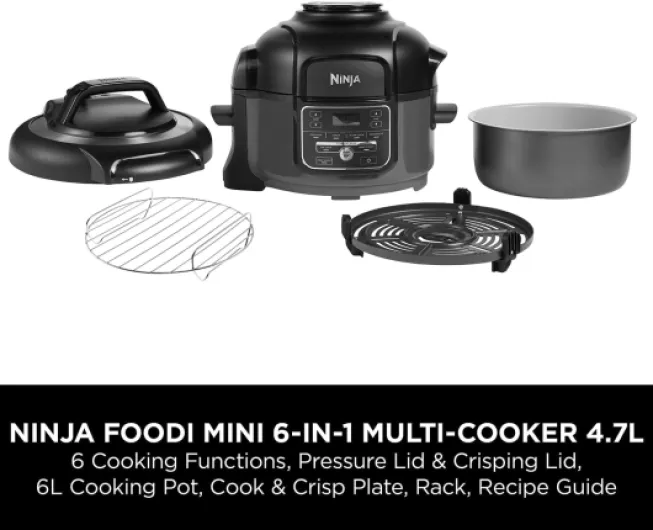
Chunky but compact enough – with one annoying lid situation
Design-wise, the Ninja Foodi OP100UK is a bit of a brick: around 31 cm high, 39.5 cm wide and 32 cm deep, and just over 9kg. It’s not tiny, but for a multi-cooker + air fryer combo, it’s fairly compact. On my counter it takes about the space of a medium-sized stand mixer. If you live in a small flat or have limited workspace, you’ll feel it, but it’s still easier to fit than having a separate air fryer and a separate slow cooker.
The colour is a basic grey/black with some chrome touches. Nothing fancy, but at least it doesn’t look cheap or plasticky. The build feels solid: the body is sturdy, the handles on the pot are decent, and the crisping lid is attached with a hinge that feels robust. You do need to keep some space above and behind it because the unit vents hot air and steam, especially when you pressure cook and release the steam.
The one design thing that really bugged me at the beginning is the pressure lid storage. The crisping lid is attached, but the pressure lid is separate and has to live somewhere. It doesn’t clip onto the side or anything, so it ends up on a shelf or in a cupboard. It’s not a deal-breaker, but it’s one more bulky thing to find space for. Also, you need to be careful not to mix up the valve position; first time I forgot to close it and ended up steaming loudly instead of pressure cooking, with steam blasting out in a slightly alarming way.
The control panel is clear and the buttons are responsive. No rotary knob, just touch buttons. The screen is bright enough and shows time and temperature clearly. One small annoyance: sometimes the heat sensor doesn’t immediately “see” that the pot is in place, so you have to give the pot a firm push or rotate it slightly until the unit recognises it. It doesn’t happen all the time, but when you’re in a hurry, it’s a bit irritating.
Build quality and non-stick: solid, but you still have to treat it right
The main body is a mix of stainless steel and hard plastic. The outer shell feels strong and doesn’t flex, and the handles on the pot are integrated well. It doesn’t feel like a flimsy gadget that will fall apart in six months. At the same time, it’s still an appliance with electronics and a hinge, so I wouldn’t slam the lid or drag it around the counter by the lid handle. Treat it like a small oven, not like a saucepan.
The inner pot is non-stick and dishwasher safe. After several weeks of use, no peeling or scratching so far, but I’ve been careful: only silicone or wooden utensils, no metal tongs scraping the bottom. Food doesn’t stick much, even when I brown meat on Sear/Sauté. For stews and sauces, a quick soak in hot water and a soft sponge is enough. Compared to my old cheap air fryer basket, this is a lot easier to clean and doesn’t feel like it’s going to lose its coating after a month.
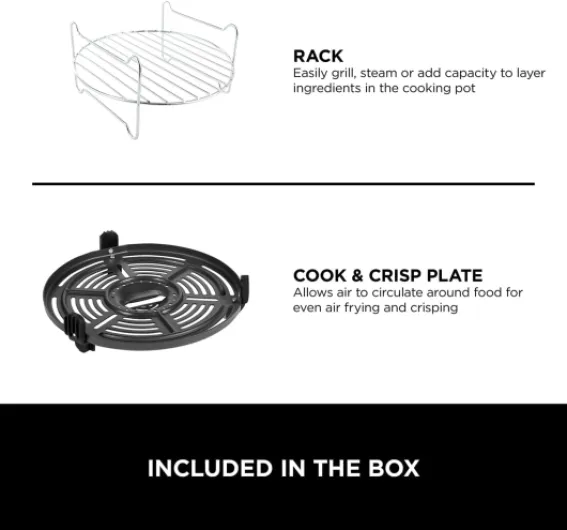
The Cook & Crisp plate is metal with a coating as well. That one needs a bit more effort to clean if you let fat and burnt bits dry on it, but a 10-minute soak solves it. I’ve thrown it in the dishwasher too and it came out fine. The stainless steel rack is basic but useful when you want to stack food or cook something above water (for example, steaming veg while something else is below, or doing a whole chicken above some stock).
The silicone sealing ring in the pressure lid is decent, but like all pressure cooker seals, it tends to hold onto smells a bit. After cooking strong curries or anything very garlicky, you can still smell it. A quick wash helps, but sometimes you need a deeper clean or to leave it to air out. It’s not unique to Ninja; it’s just how these rings are. Overall, the materials feel like they’ll last if you don’t abuse them, but this is not indestructible cookware either.
Early signs on durability and everyday wear
I obviously haven’t had this for years, so I can’t pretend I know exactly how it will age, but after several weeks of pretty heavy use (almost daily), there are some signs. The exterior still looks clean, no peeling paint or weird marks. The hinge on the crisping lid feels just as tight as day one, and the buttons haven’t faded or lost sensitivity. I’ve moved it around the counter a few times and nothing rattles or feels loose.
The inner pot’s non-stick coating still looks good. No scratches, no bubbling. But I’ve been careful with it: no metal utensils, no harsh scrubbing pads. Based on experience with non-stick in general, if you throw it in the dishwasher every single day and use metal tools, you’ll probably shorten its life. The manual even hints at that. Used reasonably, I can see it lasting a decent amount of time. The crisp plate has some slight discolouration from high heat and oils, which is normal; it doesn’t affect performance.
The silicone ring in the pressure lid is the part I’m watching. Like most pressure cookers, that ring is both essential and the first thing that wears or holds smells. So far, it’s fine: still seals properly, no cracks. But if you cook a lot of strong-smelling dishes, you’ll probably want a spare ring at some point or to rotate them. It’s not a Ninja-specific issue; it’s just how these seals work.
Overall, the unit gives the impression of being built to handle regular use, not just occasional Sunday stews. The weight (around 9kg) actually reassures me a bit: it doesn’t slide around when you open the lid or stir. I wouldn’t call it indestructible, but if you’re sensible with cleaning and don’t knock it around, it feels like it should easily last the length of the warranty and beyond.
Speed, capacity and real-world usage
Performance-wise, the 1460W power is enough for the size. The unit heats up quickly in air fry and bake/roast modes. I rarely bother with preheating for everyday stuff, except when I want things extra crisp (like frozen chips or breaded chicken), where a 3–5 minute preheat does help. Compared to using my full-size oven, this is clearly quicker to reach temperature and doesn’t heat up the whole kitchen.
Pressure cooking speed is good, but remember the quoted “up to 70% faster” doesn’t include the time to build pressure and release it. For example, a beef stew that would take 2 hours on the hob might take around 10–15 minutes to reach pressure, 25 minutes cooking, then 10 minutes natural release. Still way faster overall, but don’t expect 10-minute miracles from raw to plate. Once you adjust your expectations, it’s very practical, especially on weeknights.
The 4.7L capacity is honest. For rice, stews, curries and pasta dishes, I’ve comfortably cooked for 2 people with leftovers for lunch the next day. For 3 adults with big appetites, you might hit the limit if you’re doing bulky stuff like roast potatoes or large chunks of meat. For a 1.5kg chicken, it fits, but you’re not adding many extras in the pot at the same time. If you cook for more than 3 people regularly, I’d look at a bigger model.
Noise level is acceptable. Air fry mode sounds like a strong fan – noticeable, but not crazy. Pressure release is the loud part: when you do a quick release, there’s a big burst of steam and noise for a minute or two. The first time, it’s slightly stressful, then you get used to it. Heat output is also something to consider: it does pump out hot air when venting, so don’t stick it right under a low cupboard without some clearance.
What this Ninja Foodi actually offers in real life
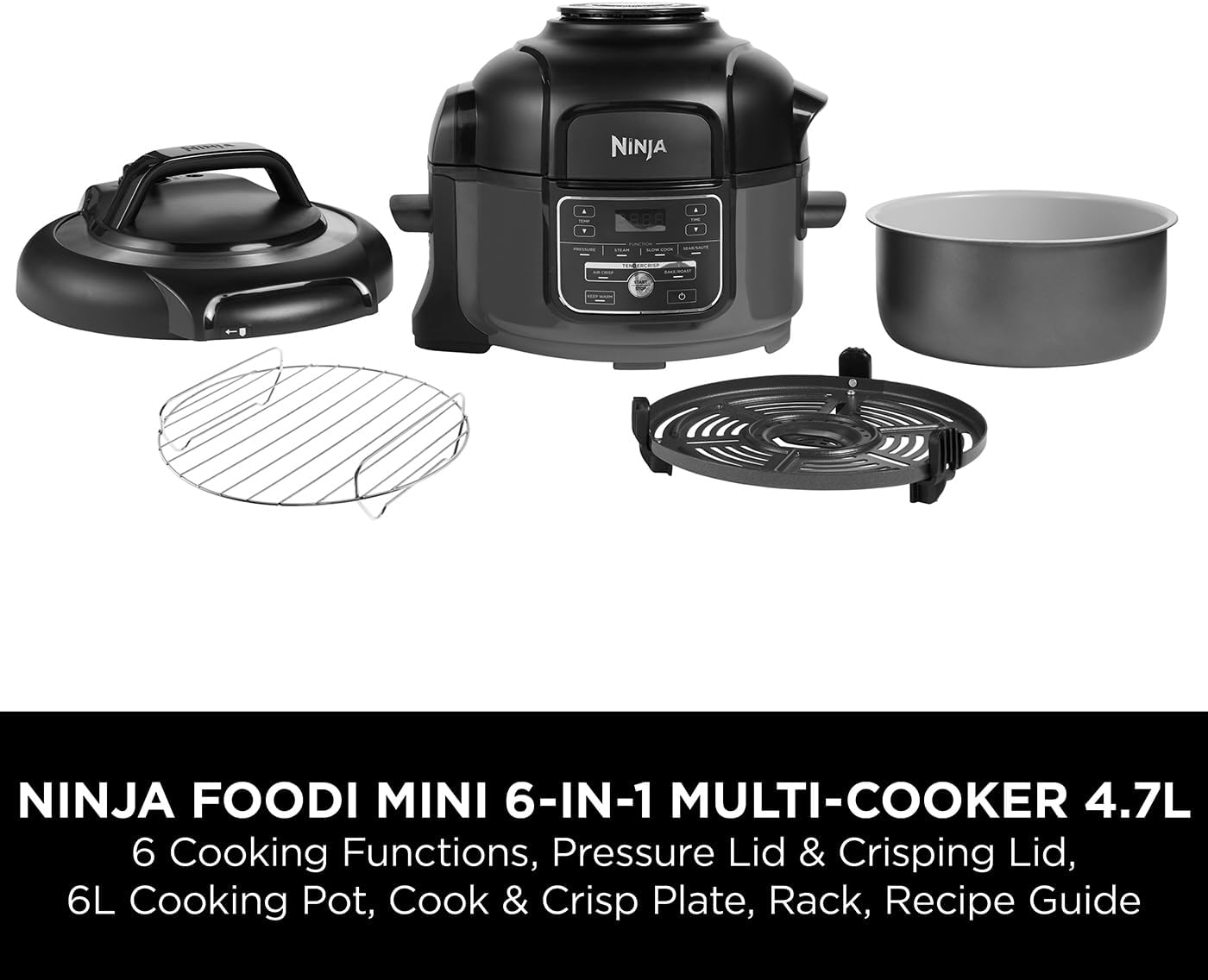
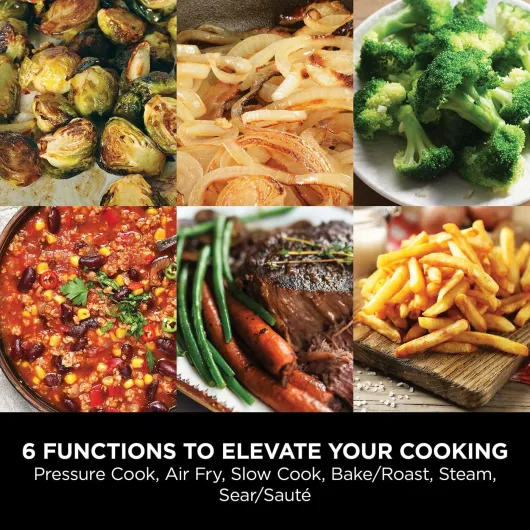
The OP100UK is the “mini” Ninja Foodi: 4.7L capacity, 1460W, and 6 functions: Pressure Cook, Air Fry, Slow Cook, Steam, Bake/Roast, Sear/Sauté. On paper, that sounds like a lot, but in real life I mainly rotate between three: pressure cook, air fry and sauté. The others are more occasional for me, but it’s still handy to have them on the same device instead of cluttering the kitchen with extra gadgets.
Size-wise, Ninja says it fits a 1.5kg chicken. I tested a chicken just under that and it fit, but it’s snug. You’re not cooking for a big family with this model, but for 1–2 people it’s honestly a good size. For 3 people, it works as long as you don’t expect huge quantities of chips or massive batches of stew in one go. If you’re used to cooking in big roasting trays, this will feel smaller at first.
In the box you get the main unit with two lids (one fixed crisping lid, one separate pressure lid), a 4.7L non-stick pot, a Cook & Crisp plate (sort of like an air fryer basket) and a stainless steel rack. The pot and crisp plate are dishwasher safe, which is a big plus. I’ve mostly just been rinsing and washing by hand because the coating actually cleans easily, but I did run them through the dishwasher a couple of times and they came out fine.
The control panel is simple: a few buttons for the modes, temp and time, and a start/stop button. No smart features, no app, nothing fancy. Personally, I’m fine with that. Once you know your usual timings (for example, chips ~18–20 min, chicken wings ~15 min after pressure cooking), you barely look at the book. It’s a practical machine: not flashy, but it covers a lot of cooking jobs for a small household.
Does it actually cook well? Yes – with a couple of quirks
In daily use, the Ninja Foodi OP100UK does the core job: it cooks food fast and properly. Pressure cooking is where it shines for me. Things that used to take 1–2 hours on the hob now take 20–30 minutes including heat-up. Stews, pulled pork, brisket, lentils, chickpeas – they all come out tender without you standing over the stove. The keep-warm function after pressure cooking is handy; if you get distracted, your food doesn’t go cold straight away.
The air fry / TenderCrisp combo is also genuinely useful. For chicken wings, I pressure cook them first for about 5 minutes, then air fry for 10–15 minutes. The meat is soft and the skin browns nicely without drowning in oil. Same for roast potatoes: parboil or pressure cook for a few minutes, shake them in a bit of oil, then air fry. The result is better than my old air fryer, with fewer patchy, half-cooked bits. Chips are pretty good too, though they take a bit longer than the marketing suggests – more like 18–20 minutes for a proper golden finish.
Slow cook and steam modes work as you’d expect. Slow cook is basically set-and-forget; I’ve used it for soups and basic stews when I’m working from home. Nothing special, but it gets the job done. Steam is powerful but noisy when you mess up the valve position like I did the first time. Once you understand the difference between pressure release and steam escaping, it’s fine, but there’s a learning phase where you’re slightly worried you’re about to launch the lid across the kitchen.
It’s not perfect. As an “oven replacement”, it has limits. You’re cooking in a pot, not on a flat tray, so some ready meals or things that rely on spreading out (like pizza) are not ideal. Also, if you’re doing chips and something else, it often turns into a two-pot situation: you cook the main, take it out, then cook the chips, and by the time the chips are done, the main has cooled a bit. Still, for one-pot meals, meat + veg, and anything that needs browning after pressure cooking, it’s very effective.
Pros
- Very versatile: pressure cook, air fry, slow cook and sauté in one compact unit
- Cooks faster than the oven and gives good browning with TenderCrisp
- Non-stick pot and accessories are easy to clean and mostly dishwasher safe
Cons
- Separate pressure lid is bulky and awkward to store
- 4.7L capacity can feel small for more than 2–3 people
- Silicone seal and lid areas can hold smells and are a bit fiddly to clean
Conclusion
Editor's rating
The Ninja Foodi OP100UK mini is a solid all-rounder for small households. It handles pressure cooking, air frying and everyday one-pot meals without drama, and it genuinely saves time compared to traditional cooking. The food comes out well cooked and nicely browned, and the non-stick pot makes cleaning much easier than with some cheaper air fryers or old-school pressure cookers. It’s not perfect, but it’s reliable and practical, which is what matters day to day.
It’s best suited for people cooking for 1–2, maybe 3 at a stretch, who actually use their kitchen and want to cut down cooking time and washing up. If you’re short on oven space or want something that can double as an extra “mini oven” at busy times like Christmas, it makes sense. On the flip side, if you have a big family, a large oven and you only occasionally fry some chips, this model will probably feel a bit small and overpriced for what you’ll use it for.
In short: good build, good cooking results, decent value if you use most of the functions. Not the cheapest, not the most compact, but it earns its spot on the counter if you actually cook with it regularly.