
Summary
Editor's rating
Value for money: good if it replaces several appliances, steep if it doesn’t
Big, heavy and not exactly pretty, but fairly practical
Solid feel but some worrying reports about coating and edges
Durability and reliability: short-term fine, long-term question mark
Cooking performance: fast, efficient and mostly consistent
What the Ninja Foodi OP300EU actually does day to day
Pros
- Combines pressure cooker, air fryer and grill in one unit, saving time and some space overall
- Cooks stews, rice, risotto and whole chicken quickly with consistent, decent results
- Simple, clear controls and programs that are easy to learn after a few uses
Cons
- Bulky and heavy, takes up a lot of counter space and is annoying to move
- Reports of coating peeling and sharp metal edges after 1–2 years
- Customer service and warranty handling reported as poor by some users

Specifications
View full product page →| Brand | Ninja |
A big noisy pot that ends up doing most of the cooking
I’ve been using the Ninja Foodi OP300EU for a few weeks now, and I’ll be honest: when I unpacked it, I thought, “Great, another massive gadget that will end up in a cupboard.” It’s big, it’s heavy, and it looks a bit like a spaceship. But once I started actually cooking with it, it slowly pushed my oven and hob to the side for a lot of everyday meals.
The main thing to understand is that this is a pressure cooker + air fryer + slow cooker + mini oven in one. On paper it sounds like marketing fluff, but in practice I really did use several modes: pressure cook for stews and rice, air fry for chips and chicken, and grill for quick meat. I’m not a chef, I just want dinner on the table fast without burning it, and on that front it does the job pretty well.
It’s not perfect though. Between the size, the weight (around 9.5 kg) and the two separate lids (one pressure lid, one built-in crisping lid), it takes up a lot of space on the counter. If you have a tiny kitchen, you’ll feel it. And some user reviews about paint peeling and sharp edges after a year and a bit are not reassuring, especially when Ninja apparently didn’t help much past 12 months.
So my overall starting point: if you want a simple, compact appliance, this is not it. If you’re fine with a chunky machine that can replace your air fryer, pressure cooker and part of your oven, and you’re ready to learn a couple of cooking programs, the OP300EU is actually pretty solid. Just don’t expect miracles, and keep in mind the possible durability issues.
Value for money: good if it replaces several appliances, steep if it doesn’t
In terms of price, the OP300EU sits in the upper mid-range for this type of device. It’s not cheap, especially if you compare it to a basic pressure cooker or a simple air fryer. You’re paying for the fact that it tries to do several jobs in one: pressure cooker, air fryer, slow cooker and small oven. If you actually use most of these functions, the price starts to make sense. If you only ever air fry chips, you’re overpaying.
For me, the value came from the fact that I could get rid of an old standalone air fryer and use my oven less often. The time savings on pressure cooking also matter: being able to cook tougher cuts of meat quickly and do proper one-pot meals after work is a real plus. If you cook for 2–4 people regularly and like the idea of throw-everything-in-the-pot recipes, it can earn its place. The Amazon rating of 4.7/5 from over 2,000 reviews shows that most people are satisfied overall, despite some noisy complaints.
On the downside, the durability concerns and some bad customer service experiences drag the value down in my eyes. Paying close to £200 for a device whose coating might start peeling after 1–2 years is not ideal. Also, the size is a hidden cost: if you have a tiny kitchen, giving up that much counter space is a big compromise. And if you already own a decent oven, a slow cooker and an air fryer, this is more of a luxury than a necessity.
So in terms of value, I’d say: good value if it replaces 2–3 appliances and you use it several times a week, average value if you only use one or two modes occasionally. Don’t buy it because it sounds fancy; buy it if you know you’ll actually pressure cook, air fry and grill regularly. Otherwise, a cheaper standalone air fryer or a basic pressure cooker will give you more for your money.
Big, heavy and not exactly pretty, but fairly practical
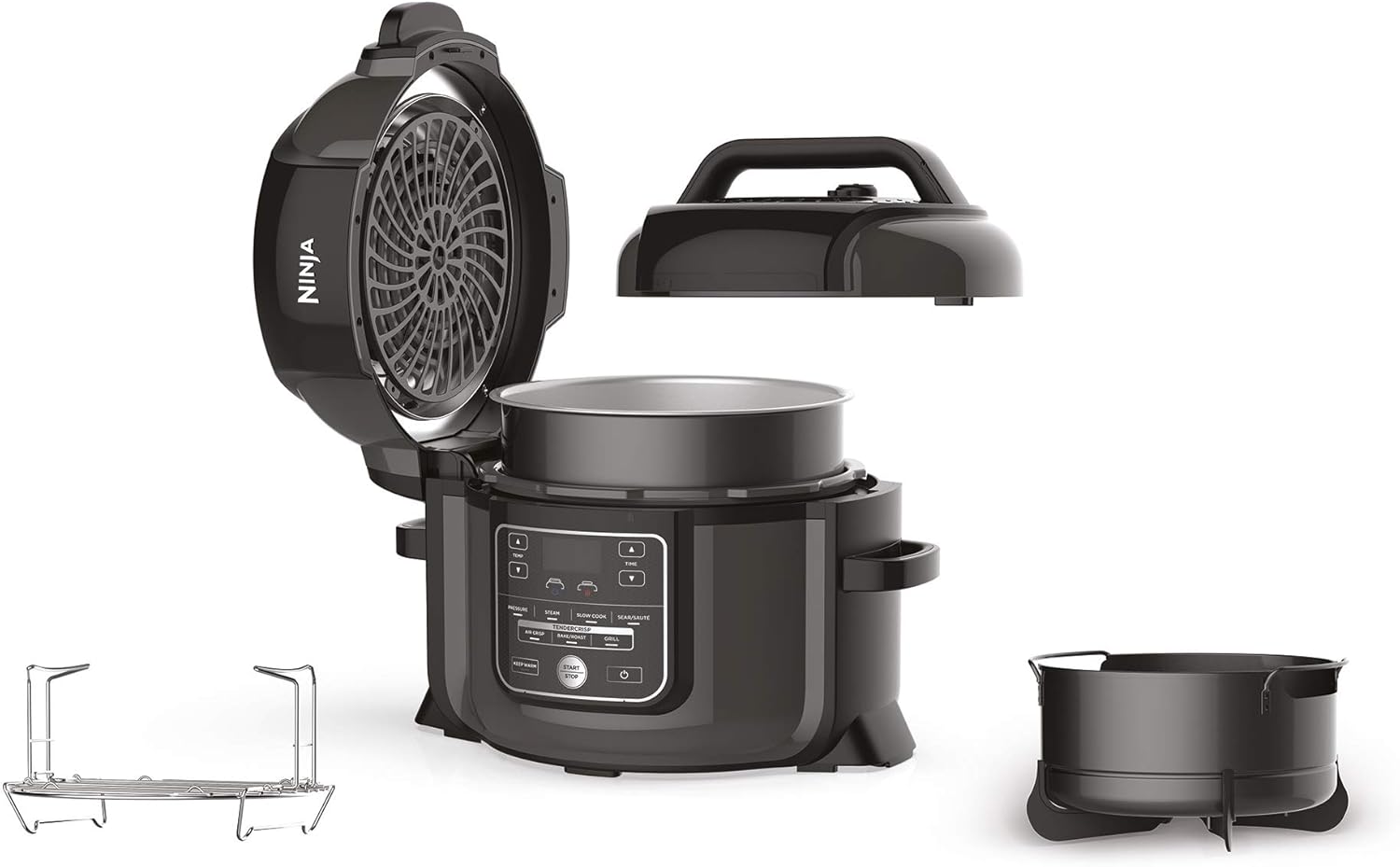
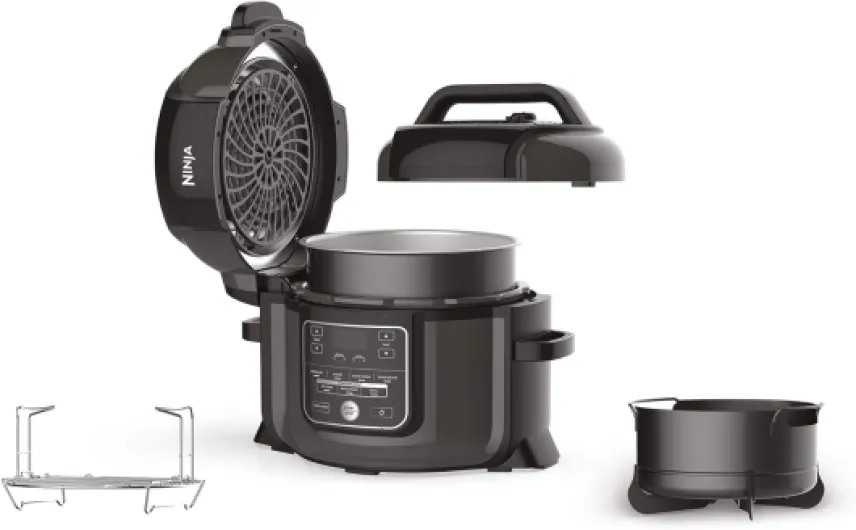
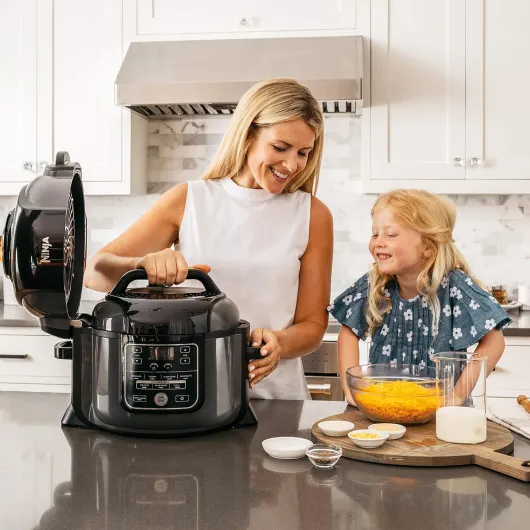
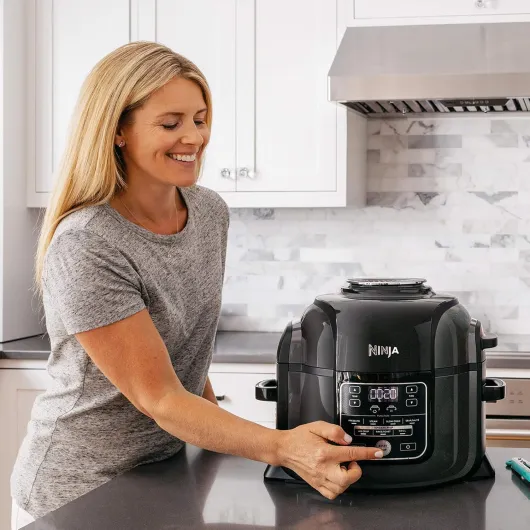
Design-wise, the OP300EU is not discreet. It’s a big black and grey lump: about 36 cm deep, 43 cm wide and 32 cm high, and weighs around 9.5 kg. On a small countertop it dominates the space. If you like minimalist kitchens, this will annoy you. I basically had to dedicate a corner of the counter to it and accept that it’s going to live there permanently, because moving it in and out of a cupboard is a pain due to the weight.
The controls are straightforward though. You’ve got push buttons and a simple digital display, nothing fancy. The different modes (pressure, air crisp, bake/roast, grill, dehydrate on some models, etc.) are clearly labelled. After two or three uses I stopped reading the manual and just set time and temperature by feel. That part is well done: no buried menus, no app, no nonsense. Just push, turn, start.
The second lid – the crisping lid – is attached on a hinge, which is handy because you don’t have to find a place to put it down when it’s hot. The separate pressure lid is the one you have to store somewhere. When both are around, it feels like a lot of pieces, especially if you’re used to a simple pot and pan setup. If you hate clutter, keep that in mind.
Noise-wise, when pressure cooking it makes the usual hissing and some fan noise when it’s preheating or releasing steam, but nothing unbearable. In air fry mode, the fan is audible but not crazy loud; you can still watch TV in the next room. Overall, the design is more about practicality than style. It’s not pretty, it’s not compact, but the layout of the buttons and lids is logical and makes daily use relatively straightforward once you accept the size.
Solid feel but some worrying reports about coating and edges
Out of the box, the Foodi feels sturdy. The outer shell is metal with a chrome-ish finish and plastic trim. The inner pot is metal with a non-stick coating, and the air fry basket has a dark coating too. So at first touch, nothing feels cheap or flimsy. The lids close properly, the seals look decent, and the overall impression is that it’s built to handle pressure and heat without flexing.
But once you look at user reviews and use it a bit, you see some limits. One Amazon user mentioned the black paint on the basket coming off and the rim of the outer pan disintegrating, leaving a sharp metal edge and even causing a cut. That happened after about 16 months for them, which is past the 12-month warranty Ninja apparently enforced, even though the product is advertised with a 2-year manufacturer warranty. That kind of report makes you question the long-term durability of the coatings and the quality control on the metal edges.
In my own use over a few weeks, I didn’t see any peeling, but I was careful: silicone utensils only, no metal spoons, and I avoided scrubbing with anything too rough. The non-stick is decent, food releases easily if you don’t burn it, and cleaning is quick. But with high heat, pressure and air fry use, non-stick coatings are always a weak point. If you’re rough with it, I wouldn’t be shocked to see scratches or chips appear after a year.
So materials are fine but not bulletproof. It’s not junk, but it’s not built like a cast-iron Dutch oven either. If you buy it, treat the inner pot and basket gently, avoid metal utensils, and inspect the rim and edges now and then. And be aware that if something goes wrong after a year, getting help from support may be tricky based on some of the feedback.
Durability and reliability: short-term fine, long-term question mark
In the short term, the Foodi feels reliable. Over a few weeks, I had no issues: no error codes, no leaks, no weird noises beyond the normal fan and steam sounds. The pressure lid locks properly, the silicone seal doesn’t deform, and the buttons still click like new. So if you judge only on the first month, it feels like a solid machine that can handle daily cooking.
The problem is when you look at other buyers’ experiences over a longer period. One user reported that after 16 months, the outer pan rim basically disintegrated, leaving a sharp edge that actually cut them. Another said the fan for the air fryer function didn’t work straight out of the box and they couldn’t get a refund or repair from Ninja. Those are not thousands of reports, but they’re serious enough to keep in mind if you’re spending close to £200.
There’s also a bit of confusion around warranty. The Amazon page mentions a 2-year manufacturer warranty, but one user says Ninja support refused to help after 12 months. That’s not reassuring. When you buy something this heavy and specialized, you expect at least two years of peace of mind. If you’re unlucky and get a faulty fan or a coating issue just after a year, you might be stuck.
So I’d rate durability as “okay but not guaranteed”. The core mechanics (heating element, pressure system) seem robust enough, but the coatings and some metal parts may age badly, especially if you use it daily and are not gentle with cleaning. If you buy it, I’d register the product with Ninja immediately, keep your proof of purchase, and check the warranty terms carefully. And if you see any coating peeling or sharp edges forming, stop using that part – cuts and flakes of coating in food are not worth it.
Cooking performance: fast, efficient and mostly consistent
In terms of pure performance, the OP300EU does what it promises: it cooks fast and fairly evenly. With 1460 W of power and pressure cooking, you really feel the time savings compared to a normal pot on the hob. Dried beans that would normally simmer for ages were done in under an hour including soak, and stews that used to take me an entire afternoon are now weeknight meals.
The air fry mode is what I used the most after pressure cook. Frozen fries at 200°C for about 18 minutes came out crisp on the outside and soft inside, without dripping oil everywhere. Chicken wings and drumsticks got a nice browned skin. You do need to shake or turn things once, otherwise the top browns more than the bottom, which is normal for this kind of device. Compared to a standalone air fryer I had before, I’d say the results are similar, maybe slightly better on volume since the basket is a bit deeper.
The grill mode is actually more useful than I expected. I did simple things: sausages, chops, some vegetables. It browns quickly and doesn’t smoke much, and cleanup is easier than with a pan that splatters. One Italian reviewer mentioned doing meat in 10 minutes with almost no smell in the kitchen, and I had a similar experience: smell is there but not as aggressive as frying in a pan. For risotto, pressure cook + a bit of sauté at the end really gives a nice creamy texture without standing there stirring for 20 minutes.
There are a few downsides. Preheating and pressure build time can be a bit long, so the “70% faster” claim is a bit optimistic once you add that. Also, if you overload the basket, air fry results get less crisp. And if you’re very picky about textures, you’ll still prefer an oven for some dishes. But for everyday stuff – chicken, chips, one-pot meals, rice, curries – performance is pretty solid and consistent enough that you stop worrying about it after a few tries.
What the Ninja Foodi OP300EU actually does day to day
On the box it says “7-in-1”: pressure cook, air fry, slow cook, steam, bake/roast, sear/sauté and grill. In real life, I mainly used four modes: pressure cook, air fry, sauté and grill. The others are more situational. Pressure cook is the one that saves the most time: a beef stew that normally takes 2 hours on the hob is done in about 40 minutes including preheat and depressurising. Rice and risotto are almost too easy; once you get your timings right, it’s very hard to mess them up.
The air fry mode is basically a built-in air fryer. It’s not as big as a full oven, but you can fit a decent batch of chips or wings for 3–4 people. Frozen chips came out crispy in 15–20 minutes with a quick shake halfway. Chicken legs got a nice browned skin without smoking out the kitchen. The grill mode is useful for finishing meat: I did pork chops in 10 minutes with decent colour on top and no splatter all over the hob.
Where it shines is when you combine pressure cook + crisping lid, what Ninja calls TenderCrisp. For example, I did a whole chicken: 20–25 minutes under pressure, then 10–15 minutes with the crisping lid. You get meat that’s cooked through and not dry, with skin that’s actually crisp. Same idea for ribs: pressure to soften, then grill/air fry to brown. It’s not restaurant-level, but for a weeknight dinner it’s more than good enough.
In short, in day-to-day use, it really can replace: a standalone air fryer, a pressure cooker, and for some things, your oven. If you currently have none of these, it’s quite handy. If you already own a good air fryer and a pressure cooker, it’s more of a convenience gadget that merges them into one bulky box rather than a revolution.
Pros
- Combines pressure cooker, air fryer and grill in one unit, saving time and some space overall
- Cooks stews, rice, risotto and whole chicken quickly with consistent, decent results
- Simple, clear controls and programs that are easy to learn after a few uses
Cons
- Bulky and heavy, takes up a lot of counter space and is annoying to move
- Reports of coating peeling and sharp metal edges after 1–2 years
- Customer service and warranty handling reported as poor by some users
Conclusion
Editor's rating
The Ninja Foodi OP300EU is a big, slightly ugly multicooker that ends up being pretty handy if you actually use what it offers. The combination of pressure cooking + air frying + grill works well in practice: stews, rice, risottos, whole chicken, chips, wings, quick grilled meat – it handles all of that with decent speed and consistent results. For everyday family cooking, it really can replace a separate air fryer and pressure cooker, and you’ll probably turn on your oven less often.
It’s not all positive though. It’s heavy and takes a lot of space, so it’s not ideal for small kitchens. Some users have had issues with coatings peeling and sharp edges after a bit more than a year, and a few horror stories about customer service don’t inspire confidence. For the price, you expect better long-term support. So while performance and convenience are strong, durability and after-sales support are the weak points.
If you cook for 2–4 people, like one-pot meals, and want to save time with pressure cooking and air frying in one machine, the OP300EU is a pretty solid choice and can be good value. If you already own a good air fryer and pressure cooker, or if you’re tight on space and budget, I’d skip it and go for simpler, cheaper appliances that do one job well. This Foodi is for people who will actually use several modes regularly, not for someone who just wants to reheat frozen chips once in a while.