
Summary
Editor's rating
Is the Duo Crisp + Air Fryer worth the money?
Big, heavy, not pretty but practical enough
Build quality, inner pot, and that annoying air fryer basket
How it holds up with frequent use and cleaning
Pressure cooking is great, air frying is decent, slow cook surprisingly good
What you actually get in the box and how it works day to day
Does it really replace other appliances or is that just marketing?
Pros
- Very strong pressure cooker performance with fast, consistent results
- Replaces several appliances (pressure cooker, slow cooker, rice cooker, basic air fryer) in one unit
- Good build quality and stainless steel inner pot that feels robust and easy to live with
Cons
- Bulky and heavy, needs permanent counter space and is awkward to move
- Air fryer basket is relatively small and quite annoying to clean
- Not the best choice if you mainly want a high-capacity, dedicated air fryer

Specifications
View full product page →| Brand | Instant Pot |
One appliance to rule the messy weeknight dinners?
I’ve been using the Instant Pot Duo Crisp + Air Fryer 5.7L for a few weeks now, and I’ve thrown pretty much everything at it: stews, whole chicken, chips, reheated leftovers, frozen stuff straight from the freezer, even a bit of baking. I bought it mainly because my old slow cooker was dying and I didn’t want a separate air fryer taking up more space. On paper it does 11 things; in practice I use about 5–6 regularly, which is already a lot.
My first impression: it’s big, heavy, and a bit intimidating with two lids and a bunch of buttons. This is not a cute little gadget you tuck in a corner. You need counter space or a low cupboard you can easily reach. The manual is long, but once you’ve done two or three meals, the basics are actually pretty simple: pressure cook with one lid, crisp/air fry/bake with the other.
The most convincing thing for me is how fast it handles weeknight meals. A beef stew that used to take 3 hours in the oven is done in under an hour including preheat and pressure release, and the meat is properly tender. Then I can switch lids and crisp potatoes or top up the meat with a bit of colour. It’s not magic, but it definitely cuts down cooking time and dishes.
It’s not perfect though. The air fryer basket is on the small side and annoying to scrub, and you really feel the 10 kg when you move it. But overall, as someone who cooks daily and hates clutter, I’d say it’s a pretty solid compromise between versatility and practicality. Not life‑changing, but it does its job and I reach for it almost every day now.
Is the Duo Crisp + Air Fryer worth the money?
Price-wise, this sits above a basic pressure cooker or a cheap air fryer, but below buying several separate decent appliances. For what it does—pressure cooking, air frying, slow cooking, steaming, reheating, some baking—I’d say the value is good if you actually use multiple functions. If you only want it for one thing, like air frying, then no, it’s not the smartest way to spend your money. A standalone air fryer would be cheaper and probably slightly more convenient for that single job.
In my case, it replaced three devices and made me use my oven less. That alone justifies the price over time, especially with energy costs the way they are. Pressure cooking really does save time and power compared to running an oven for hours. I’ve noticed I’m more willing to cook dried beans or tougher cuts of meat because they don’t feel like a whole-day project anymore. That’s a practical benefit, not just a gadget thing.
Where the value drops a bit is if you have a very big family or you cook large batches all the time. The 5.7L capacity is fine for 2–4 people, but the air fryer basket limits how much crispy stuff you can do in one go. If you constantly need to feed six hungry people with mountains of chips and wings, you’ll hit the limits fast and might end up needing another appliance anyway. So for big households, the “one device to rule them all” promise is a bit optimistic.
Overall, I’d call it good value for money for small to medium households that cook regularly and like the idea of consolidating gadgets. It’s not cheap, but it’s also not just a trendy toy. If you use the pressure cooker and air fryer modes several times a week, it pays for itself in convenience and probably in energy savings over time. If you’re a very occasional cook or already happy with multiple separate devices, you can probably skip it.
Big, heavy, not pretty but practical enough
Design-wise, this is definitely more “appliance” than “decorative object”. It’s a chunky stainless steel and black plastic cylinder, about 35 cm tall and wide, and around 10 kg. On the counter, it dominates the space, so if you’ve got a tiny kitchen, measure before buying. The glossy black bits pick up fingerprints, but nothing dramatic; a quick wipe with a damp cloth sorts it out.
The control panel is straightforward: a central display with time and temperature, and clearly labelled touch buttons around it. No fancy colour screen, but it’s easy to read and doesn’t feel cheap. The beep sounds are a bit annoying at first, but you get used to them. The pressure lid has a clear steam release valve and a simple lock/unlock mechanism; if you’ve ever used a classic pressure cooker, this is less stressful. It tells you on the display when it’s building pressure, cooking, and keeping warm, so you’re not guessing.
The air fryer lid is the awkward part. It’s heavy and a bit bulky, and when it’s hot you obviously can’t just toss it anywhere. That’s where the included protective pad is handy: you drop the lid on it to protect the counter. In practice, you need a bit of a “landing zone” next to the unit, which again means this thing likes space. If you’re used to a small drawer-style air fryer, this will feel clunkier to handle.
Overall, the design is more about function than looks. It’s not ugly, just very standard “stainless steel kitchen gadget”. What I liked is that everything feels solid: the handles on the inner pot, the steam rack, the lid mechanisms. Nothing wobbly or flimsy. On the downside, because it’s so big and heavy, you won’t be dragging it in and out of a cupboard every time. It’s the kind of appliance you commit to leaving out, or it’ll just collect dust.
Build quality, inner pot, and that annoying air fryer basket
The main cooking pot is stainless steel, fairly thick, with sturdy side handles. I prefer that over non-stick because I can scrape the bottom with a metal spoon while sautéing without worrying. It does stick a bit if you’re careless with high heat, but a splash of liquid and a quick deglaze usually fixes it. After several weeks, there are the usual faint marks from high heat but no warping or weird stains. So on the core cooking surface, I’m pretty happy.
The accessories are a mix of metal and plastic. The steam rack with handles is basic but practical, especially for lifting out a whole chicken or a cheesecake tin. The dehydrating/grill tray is a thin metal grid that sits in the air fryer basket to create a second level. It feels a bit flimsy but hasn’t bent on me yet. The protective pad for the air fryer lid is a simple but smart addition; it looks like a silicone/foam hybrid and stops you from burning your worktop.
The weak spot for me is the air fryer basket. It’s metal with a non-stick coating and lots of little holes. It cooks fine, but cleaning it is annoying. Even if I soak it straight after cooking, bits of stuck-on potato or chicken fat love to stay in the holes and corners. You need a brush and a bit of patience. Compared to drawer air fryers with smooth non-stick baskets, this is a step down in terms of cleaning comfort. If you’re lazy about washing up, you’ll notice this quickly.
Plastic-wise, the lids and outer shell feel solid enough. Nothing feels like it’s going to snap, and there are no weird smells when heating, which I always check with new appliances. Overall, the materials give a good impression for the price: not luxury, but robust. Just be aware that the non-stick on the basket will probably be the first thing to age if you’re rough with it or use abrasive sponges all the time.

How it holds up with frequent use and cleaning
I’ve been fairly rough with it: using it almost daily, lots of sautéing, pressure cycles, and repeated air frying. So far, the main body and stainless pot are holding up well. No weird noises from the motor or fan, no flickering display, and the rubber sealing ring on the pressure lid is still snug. With Instant Pot stuff, spare parts like seals are easy to find, which is reassuring for long-term use. You’ll probably want to replace the ring every year or so if you use it a lot, just to keep the seal and smells under control.
The finish on the outside has taken a few bumps from moving it around, but no dents, just small scuffs that you only see up close. The handles on the pot and the steam rack haven’t loosened, and the plastic on the lids hasn’t discoloured despite a lot of steam and heat. That’s a good sign. The fan noise on air fry mode hasn’t changed either; it’s not whisper-quiet, but it’s not louder than other air fryers I’ve tried.
The main concern I have for long-term durability is the air fryer basket coating. Non-stick coatings rarely age well with constant high heat and scrubbing. After weeks of use, mine is still fine, but I’m being careful not to use metal utensils or abrasive sponges on it. If you treat it gently, it should last, but if someone in your house goes at it with steel wool, it’ll probably wear out faster. Worst case, you might end up wanting to replace the basket after a couple of years if you use air fry a lot.
Overall, it feels like a product designed to last several years of regular use, not something disposable. It’s not indestructible, but for the price range and the number of functions, the durability seems pretty solid. Just be ready to baby the non-stick parts a bit and to occasionally replace cheap consumables like the sealing ring if you want to keep it running smoothly.
Pressure cooking is great, air frying is decent, slow cook surprisingly good
On performance, the clear winner is the pressure cooker function. It heats up quickly for a 1500W unit, and once it reaches pressure, it keeps a steady cooking profile. I’ve done lentil soup in 12 minutes (plus preheat), beef stew in 25 minutes under pressure, and rice in about 4–6 minutes depending on type. Everything came out evenly cooked, no burnt bottom, and the keep-warm mode actually keeps things warm without drying them out for at least an hour. Compared to doing the same meals on the stove or in the oven, it’s noticeably faster and uses less energy.
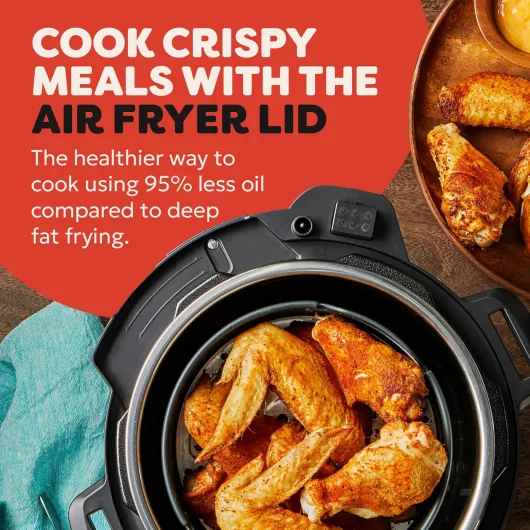
The air fryer function is good but not the best I’ve tested. Chips from fresh potatoes need about 20–25 minutes at 200°C with a shake halfway, and they come out crispy on the outside and soft inside, but you can’t overload the basket. Frozen chips or nuggets are easier and more forgiving. Chicken wings and drumsticks come out nicely browned in 18–22 minutes depending on size. The unit even beeps to remind you to flip/shake, which is handy. The downside is capacity: if you’re cooking for more than 2–3 people and everyone wants crispy stuff at once, you’ll be doing batches.
The slow cooker mode surprised me in a good way. I tried a beef stew and a pulled pork style shoulder on low for 7–8 hours, and both were tender and juicy. I had an old standalone slow cooker before, and honestly this Instant Pot does at least as well, maybe better, probably because the lid seals more tightly. Some people online complain slow mode is weak, but with enough time and not lifting the lid every 10 minutes, it worked fine for me.
Other modes like sous vide and dehydrate are more niche. I tested sous vide once with chicken breasts at 65°C, and they came out moist and evenly cooked, but it’s a bit faffy compared to just pan-frying. Dehydrate works but is slow, as expected; I did apple slices that took several hours. So yes, it does what it says, but these are more “nice extras” than daily drivers. Overall, as a main cooking workhorse for regular meals, the performance is solid, especially on pressure and basic air fry.
What you actually get in the box and how it works day to day
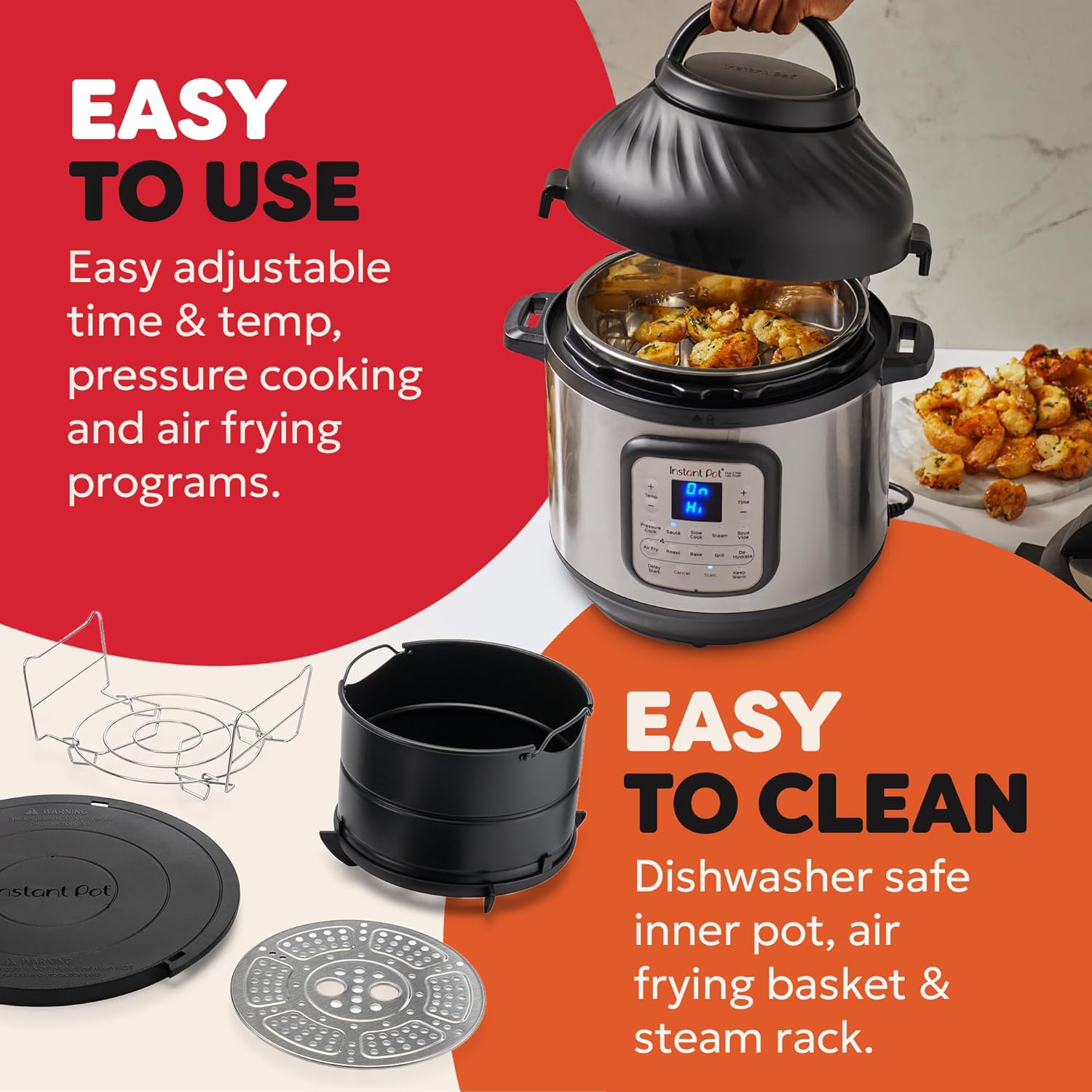
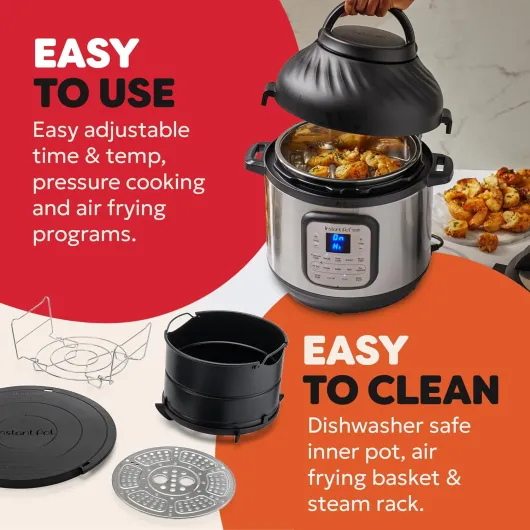
In the box you get quite a bit of stuff: the main base unit, a stainless steel inner pot (5.7L), the pressure cooker lid, the air fryer lid, a steam rack with handles, an air fryer basket, a dehydrating/grill tray, and a silicone-like protective pad/storage mat. It looks like a lot at first, but after a few uses you realise you only juggle 3–4 pieces most of the time. The idea is simple: pressure lid for wet cooking (stews, rice, beans, soups) and air fryer lid for dry/hot air cooking (chips, chicken wings, reheating pizza, finishing a roast).
The front panel is a touch control with labelled programmes: Pressure Cook, Sauté, Slow Cook, Steam, Sous Vide, Air Fry, Roast, Bake, Grill, Dehydrate, and Keep Warm. I’ll be honest: I mostly ignore the fancy names and just use Pressure Cook, Sauté, Air Fry, and sometimes Slow Cook and Bake. You can adjust temperature and time easily with the plus/minus buttons, so you don’t have to be locked into presets. Once you’ve done two or three recipes, it becomes muscle memory.
In daily use, the workflow is usually: sauté onions/garlic/meat in the pot, add liquid and veg, close the pressure lid, cook under pressure, then swap to the air fryer lid to brown the top. For example, I did chicken thighs and potatoes: 10 minutes pressure cook, quick release, drain a bit of liquid, then 10–12 minutes air fry to crisp the skin and potatoes. One pot, two lids, dinner done. That’s basically the main selling point: less faff, less washing up.
If you expect to use every single one of the 11 functions every week, you’re dreaming. But as a pressure cooker + decent air fryer + slow cooker + reheater in one, it’s already quite handy. Just be prepared to give it a permanent parking spot in your kitchen, because packing and unpacking this thing every day would get old very fast.
Does it really replace other appliances or is that just marketing?
In terms of actual effectiveness in my kitchen, it has genuinely replaced a few things: my old slow cooker, my rice cooker, and most of my oven use for weekday dinners. I still use the oven for big trays of roast veg or baking for guests, but for two people or a small family, this pot handles a lot. For example, I now do rice exclusively in it: 1 cup rice, 1 cup water, 4 minutes pressure, natural release for 10 minutes. It’s consistent, and I don’t have to watch it.
Where it really earns its keep is “one-pot meals”. I’ll brown mince on sauté, add pasta, water, and sauce, pressure cook for a few minutes, then finish with some cheese under the air fryer lid. It’s not restaurant-level cooking, but for busy evenings it’s very effective. I dirty one main pot, a chopping board, and that’s it. Compared to juggling several pans and an oven tray, it’s simply easier. That said, if you only cook occasionally or you already love using your oven, this might feel like overkill.
As a straight air fryer replacement, I’d say it’s good but not outstanding. The results are there, but the basket design and capacity make it slightly less convenient than a dedicated drawer-style air fryer. If your main goal is just air frying mountains of chips and wings every weekend, I’d probably go for a big standalone air fryer instead. This one is more of a multitool: decent at air frying, very good at pressure cooking, and acceptable at baking and roasting for small quantities.
So does it really replace half your appliances? For me, yes, to a point. I got rid of three separate devices and don’t miss them. But it doesn’t magically make you stop using your oven or hob completely. It’s a strong helper that takes over a lot of everyday cooking, especially if you like the idea of throwing everything in, pressing a button, and doing something else while it works.
Pros
- Very strong pressure cooker performance with fast, consistent results
- Replaces several appliances (pressure cooker, slow cooker, rice cooker, basic air fryer) in one unit
- Good build quality and stainless steel inner pot that feels robust and easy to live with
Cons
- Bulky and heavy, needs permanent counter space and is awkward to move
- Air fryer basket is relatively small and quite annoying to clean
- Not the best choice if you mainly want a high-capacity, dedicated air fryer
Conclusion
Editor's rating
After living with the Instant Pot Duo Crisp + Air Fryer 5.7L, my honest take is this: it’s a big, slightly clunky appliance that still earns its spot on the counter because it actually gets used a lot. The pressure cooker side is excellent, the slow cooker mode is better than expected, and the air fryer function is decent, even if the basket is a pain to scrub and a bit small for big families. It’s not some miracle gadget, but for everyday stews, rice, one-pot pasta, and quick crispy sides, it does the job well and saves time.
If you’re cooking regularly for 1–4 people, don’t have loads of space for separate devices, and like the idea of throwing ingredients in and walking away, this is a solid option. You’ll get the most out of it if you actually plan to use both pressure cooking and air frying at least a couple of times a week. On the other hand, if you mostly bake in the oven, rarely cook from scratch, or just want a big air fryer for family-sized trays of chips, there are simpler and cheaper choices that will fit you better.
In short: pretty solid multitool, strong on pressure cooking, good enough on air frying, with a few annoyances around size and cleaning. Not perfect, but if you use it properly, it’s good value and can definitely replace a few other gadgets in the kitchen.