Summary
Editor's rating
Is it good value for money?
Big, heavy and not for tiny kitchens
Build quality and parts: solid, but mind the non‑stick
Early signs on durability and everyday wear
Real‑world performance: fast cooking, decent crisping, some quirks
What this Ninja actually does day to day
Does it actually replace other appliances?
Pros
- Very versatile: pressure cook, air fry, sauté and slow cook all in one pot
- Cooks fast and evenly, especially stews, lamb, chicken and frozen foods
- Big 6L capacity suits up to 4 people and works well for batch cooking
Cons
- Bulky and heavy, needs a lot of counter and storage space
- Separate pressure lid and short power cable can be annoying to store and place
- Recipe booklet is limited and printed in very small text, so you rely on online recipes
Specifications
View full product page →| Brand | Ninja |
A big lump of a cooker that I actually use every day
I’ve been using the Ninja Foodi 9‑in‑1 OP350UK for a few weeks now, and I’ll be honest: when I first unboxed it, my first reaction was, “Wow, this thing is huge.” It’s not some cute little air fryer you tuck in a corner. It’s a serious chunk of kit. But once I got over the size and actually started cooking with it, I ended up using it pretty much every day. For me it’s replacing my old air fryer, my slow cooker, and a lot of what I used to do in the oven.
In practice, the big selling points are the pressure cook + air fry combo and the fact you can do almost everything in one pot: sauté, pressure cook, then crisp the top without moving the food. I’ve done stews, pasta, frozen chips, chicken thighs, and even reheated leftovers. It’s not magic, but it really does save time and washing up if you actually use the different modes instead of treating it like a fancy microwave.
It’s not perfect. You need counter space, you need somewhere to dump the pressure lid when you’re not using it, and there is a learning curve, especially with timings. The recipe book is tiny print and a bit limited, so you’ll probably end up on YouTube or blogs to figure out how to cook basic stuff like plain pasta or rice the way you like it. Once you’ve done a few runs though, it gets a lot easier and you start repeating the same settings.
So overall, my first impression turned from “this is overkill” to “ok, this actually earns its place on the counter.” If you live in a small flat or hate having loads of different gadgets, this kind of all‑in‑one makes sense. If you already love your oven and a basic air fryer, then it’s more of a nice extra than a must. I’ll break down what worked well for me and what annoyed me a bit.
Is it good value for money?
Price‑wise, the Ninja Foodi 9‑in‑1 OP350UK isn’t cheap. You’re paying more than you would for a basic air fryer or a simple slow cooker. So the question is: does it earn that extra cost? For me, yes, because it has replaced multiple appliances and a lot of oven use. I’m using it daily, sometimes twice a day, so the cost per use is going down fast. If you’re the kind of person who cooks at home most days, I’d say it’s good value for money, even if the initial hit stings a bit.
If you compare it to buying separate gadgets – an air fryer, a pressure cooker, a slow cooker, maybe even a dehydrator – you’d probably end up spending similar or more, and you’d also need a lot more space. The Foodi bundles all that into one big unit. On top of that, it’s fairly energy‑efficient because it heats a smaller space than a full oven and gets up to temp much faster. I’ve noticed I turn my main oven on far less for smaller meals, which should save a bit on bills over time.
On the flip side, if you’re not going to use the pressure cook or slow cook features, then you’re basically paying premium money just to have a nice air fryer. In that case, it’s harder to call it good value. You could pick up a simpler air fryer for a lot less and be perfectly happy. Same if you cook two or three times a week at most – the Foodi might be overkill and your money might be better spent on a smaller, cheaper device.
So value really depends on your habits. For a busy household, people who batch cook, or anyone trying to cut oven use and washing up, the price makes sense. For casual or occasional cooks, it’s more of a nice gadget than a smart purchase. Personally, given how much I’ve used it already, I’m comfortable saying it’s worth the money in my situation, but it’s not a bargain and it’s not for everyone.
Big, heavy and not for tiny kitchens
Design‑wise, the Foodi 9‑in‑1 is not subtle at all. It’s a big black and brushed steel cube‑ish unit, about 43cm deep, 36cm wide, 32cm tall, and roughly 10–11kg. On my counter it takes as much space as a medium microwave. If you’ve got a small galley kitchen or limited worktop, you need to think hard about where it will live. It’s not the kind of appliance you’ll happily lift in and out of a cupboard every day – it’s too heavy and bulky for that to be practical.
The layout is at least logical. The main body has the hinged crisping lid permanently attached, and the pressure lid is separate, which you clip on only when you need to pressure cook. That means you always have one lid sticking up at the back, and then another lid to store somewhere. In my case, the spare lid lives in a cupboard and comes out when I’m planning a pressure cook day. If you don’t like clutter, that extra lid might annoy you more than you think.
The control panel is on the front with a small display, touch buttons and a central knob. It’s quite clear: modes on the sides, temp and time in the middle, start/stop buttons. No smart features, no app, no Bluetooth nonsense, which personally I’m fine with. One thing to watch is steam and hot air: when pressure cooking or air frying, a lot of heat shoots straight upwards from the top. You really shouldn’t use it under overhead cupboards, or they might get damaged over time. I ended up sliding it forward so it sits in open space when in use.
Noise‑wise, it’s not silent. The fan on air fry mode is noticeable but not crazy loud – quieter than some older Actifry models I’ve used. Pressure cooking is mostly quiet, apart from when it releases steam. That venting can be pretty aggressive, so don’t put it right under a shelf. Overall, the design is practical but bulky. It feels solid and everything clicks into place nicely, but you do pay the price in size and weight. If you’ve got the space, it’s fine. If you’re in a studio flat with one small counter, it might be overkill.
Build quality and parts: solid, but mind the non‑stick
The materials feel pretty solid for the price. The body is mostly plastic with some brushed steel bits, but it doesn’t feel flimsy. The hinges on the crisping lid feel sturdy and open/close with a reassuring clunk. After a few weeks of daily use, I haven’t noticed any wobble or cheap creaking. It’s made in China like most appliances, but it doesn’t have that super light, budget feel you sometimes get with lower‑end air fryers.
The 6L cooking pot is non‑stick and dishwasher safe. Out of the box, the coating looks and feels good. Food doesn’t stick much, even when I brown meat on sauté mode. I usually just soak it with a bit of hot soapy water and it wipes clean easily. That said, long term, non‑stick always needs a bit of care: no metal utensils, don’t scrape it with sharp tools, and avoid super harsh scouring pads. I’d expect the coating to last a good while if you treat it decently, but if you’re rough with your pans, you might end up needing a replacement pot after a couple of years.
The cook & crisp basket and stainless steel rack are both decent quality. The basket has a more open design than some cheap air fryer inserts, so air circulates well. It’s easy enough to clean, but if you cook fatty stuff like bacon, you’ll want to soak it to get rid of the grease in the little corners. The rack is handy for roasting and doing things like bacon or toasties. It also feels sturdy, not like it’s going to bend the first time you put a chicken on it.
One small detail: the seals and valves on the pressure lid seem well made and come apart for cleaning. You do need to remember to clean around them or you’ll end up with smells trapped in there. The power cable is a bit on the short side, which is slightly annoying if your sockets aren’t close to where you want the unit to sit. Overall, materials and build feel reliable enough for everyday use, but like any non‑stick appliance, you have to be a bit careful if you want it to last several years without the pot looking tired.
Early signs on durability and everyday wear
I haven’t had it for years, so I can’t pretend I know exactly how it will age, but after a few weeks of daily use, there are some signs about durability. The outer shell still looks new – no discolouration from heat, no loose buttons, no peeling stickers. The lid mechanism feels as tight as on day one. I’ve opened and closed it a lot, including with some steam still coming out, and it doesn’t feel like it’s going to sag or misalign anytime soon.
The non‑stick pot so far is holding up well. No scratches, no flaking, and no staining, even after tomato‑based sauces and curry. I’m pretty careful with it though: I use silicone or wooden utensils and I don’t stack metal stuff inside it in the cupboard. If you treat it like a normal cheap pan and start using metal spoons, I wouldn’t be shocked if the coating wears faster. The basket and rack are metal and feel sturdy; they might discolour slightly over time from high heat and fat, but that’s cosmetic more than anything.
One point people often miss with these multi cookers is the seals and valves. If you don’t clean around the rubber gasket and the steam valve on the pressure lid, smells and residue build up and can affect performance in the long run. So far, taking it apart and rinsing it has been easy enough. Nothing feels flimsy or like it’s going to rip during normal cleaning. The cable and plug also feel standard and robust, no looseness at the socket.
Given Ninja’s general reputation and how solid this thing feels, I’d expect it to last several years with normal use. The most likely wear point is the non‑stick pot, which you may end up replacing at some point, but that’s available as a spare. Overall, I’d say early durability looks good, but like any kitchen gadget, if you abuse it, throw it around, or never clean it properly, it will show it. Treated normally, it feels like a long‑term appliance, not a disposable gadget.
Real‑world performance: fast cooking, decent crisping, some quirks
In terms of performance, this is where the Foodi actually earns its keep. The pressure cook mode genuinely cuts down cooking time. I’ve done lamb pieces in about 25 minutes under pressure that came out very tender, where in a normal pot I’d be simmering for well over an hour. Beef stew that would usually take 2–3 hours on the hob was done in around an hour including heat‑up and pressure release. Flavours come out rich, similar to slow cooking, but in a fraction of the time.
The air fry function is also strong. Frozen chips, chicken nuggets, fish fingers, that kind of thing come out crispy and evenly browned with a light spray of oil or sometimes none at all. When you do homemade chips from raw potatoes, you need to play with time and temperature a bit; my first batch was a bit uneven, but after shaking halfway through and giving them a couple more minutes, they were fine. I’ve also done bacon on the rack at around 200°C for 8–10 minutes and it comes out nicely crisp without swimming in fat.
The real advantage is combining modes. For example, I did chicken thighs and potatoes by sautéing onions and garlic first, then pressure cooking everything with stock for a short time, then switching to air fry to crisp the skin and edges. All in the same pot, no extra pans. That’s the kind of thing that actually saves time and washing up. You just need to get used to the fact that pressure cooking needs build‑up and release time, so a “10‑minute” recipe is more like 20–25 minutes end to end.
On the downside, it’s not plug‑and‑forget for everything. With air frying, if you load the basket quite full, you still need to shake or stir halfway to avoid pale bits. Also, it’s not quiet. The fan noise is noticeable, and venting steam after pressure cooking is loud and quite dramatic if you’re not used to it. Overall though, in daily use, I’d say the performance is reliably good: it cooks evenly, heats up fast, and hasn’t given me any weird failures or undercooked centres as long as I followed sensible timings.
What this Ninja actually does day to day
On paper, the Ninja Foodi OP350UK is a 9‑in‑1 multi cooker with a 6L capacity. In real life, I’d say there are three modes you’ll actually use a lot: air fry, pressure cook, and sear/sauté. The others (slow cook, bake/roast, grill, yoghurt, dehydrate, steam) are more occasional, at least for me. I’ve used air fry for chips, nuggets, bacon, reheating pizza and quiche. Pressure cook for stews, lamb, chicken, and one‑pot pasta. Sear/sauté for browning meat and onions before pressure cooking. Those three alone already justify the machine more than the extra fancy modes.
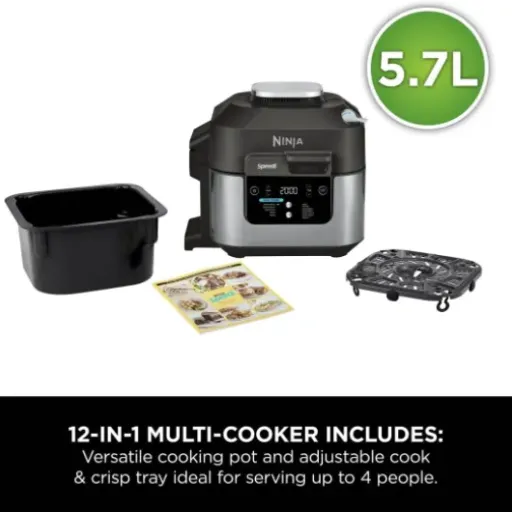
The 6L pot is big enough for a family meal. I’ve done a whole chicken of about 1.8–2kg with room around it, and I regularly cook for 3–4 people in one go. If you’re cooking for 1–2 people, you’ll still use the space, especially for batch cooking. The unit comes with a non‑stick pot, a cook & crisp basket, and a rack. They’re all dishwasher safe, which is handy, but I usually just hand‑wash them because nothing really sticks badly if you soak it for a few minutes.
The controls are simple: a mix of buttons and a dial. You pick the mode (pressure, air fry, etc.), set time and temp, then press start. It’s not the sort of thing where you need to read a 40‑page manual. The only part that needs a bit of thinking is pressure cooking, because you need to lock the lid and set the valve to seal or vent, and then remember that it needs time to build pressure. Once you’ve done it two or three times, it’s straightforward.
In the box you also get a small recipe booklet. The ideas are decent, but the print is honestly too small and it doesn’t cover some basic everyday stuff like plain pasta or boiled potatoes on their own. I quickly ditched the booklet and just used online recipes and common sense. Overall, in terms of what it offers versus what I actually use, I’d say it’s very versatile, but you’ll probably end up using 3–5 of the 9 modes regularly and ignore the rest unless you’re really into experimenting.
Does it actually replace other appliances?
Effectiveness for me is simple: does it replace other gadgets and pans, or is it just another thing on the counter? In my case, it has pretty much replaced my old standalone air fryer and my slow cooker. I barely use the oven for smaller meals now because the Foodi heats up quicker and doesn’t warm up the whole kitchen. For things like weekday dinners – chips and chicken, one‑pot pasta, stews, roast chicken – it’s become my default.
Pressure cooking plus sauté mode means I rarely bother with a separate pot on the hob. I can brown mince for a bolognese, add tomatoes and stock, pressure cook for a short time, then reduce the sauce on sauté if I need to thicken it. Same with chilli. That all‑in‑one approach is where it’s very effective at cutting down on washing up and faffing around. It’s not bulletproof though – you can easily overcook veg if you pressure cook them too long, so there’s a bit of trial and error at first.
The air fry mode is effective enough that my normal oven hardly sees any frozen chips or breaded stuff now. I also use it a lot to reheat leftovers instead of the microwave when I want them to stay crisp: pizza slices, quiche, roast potatoes. A few minutes on air fry and they come back to life without going soggy. I like that it doesn’t need preheating for ages; you can usually just set the temp and time and go.
Where it’s a bit less convincing is for people who only want one function. If all you care about is air frying chips and nuggets, you can get a smaller, cheaper unit that does just that and takes less space. Same if you’re only into slow cooking. The Foodi makes most sense if you’re actually going to use at least 3–4 of its modes regularly. For me, that’s the case, so it’s an effective “main cooker”. If you’re more of a occasional gadget user, it might end up as an expensive dust collector.
Pros
- Very versatile: pressure cook, air fry, sauté and slow cook all in one pot
- Cooks fast and evenly, especially stews, lamb, chicken and frozen foods
- Big 6L capacity suits up to 4 people and works well for batch cooking
Cons
- Bulky and heavy, needs a lot of counter and storage space
- Separate pressure lid and short power cable can be annoying to store and place
- Recipe booklet is limited and printed in very small text, so you rely on online recipes
Conclusion
Editor's rating
The Ninja Foodi 9‑in‑1 OP350UK is a big, capable multi cooker that actually gets used, not just admired on the counter. The combination of pressure cook, air fry and sauté in one pot is genuinely handy. You can go from browning meat to a finished, crispy‑topped meal without dirtying extra pans, and cooking times for stews, lamb, and chicken are noticeably shorter than on the hob or in the oven. For everyday stuff like chips, nuggets, bacon, roast chicken and reheating leftovers, it does the job well and consistently.
It’s not without drawbacks. It’s heavy, takes up serious space, throws steam and heat upwards, and the extra pressure lid plus accessories need storage. The recipe book is basic and printed in tiny text, so you’ll likely rely on online guides at the start. If you only want a simple air fryer or you cook rarely, it’s probably more machine than you need and not the best use of your budget. But if you cook at home a lot, like one‑pot meals, and want to reduce oven use and washing up, it makes sense and feels like good value over time.
In short: great for families or regular home cooks who will use multiple modes (pressure, air fry, sauté, slow cook). People with very small kitchens, very tight budgets, or very simple needs might be better off with a smaller, cheaper air fryer or a basic slow cooker. For everyone else, this is a pretty solid all‑rounder that can quietly take over most of your weekday cooking.