
Summary
Editor's rating
Value for money: good price for a no-nonsense family pressure cooker
Design: twist-lock lid is the star, manual vibe everywhere else
Comfort & ease of use: simple once you’ve done a few runs, but not beginner-proof
Materials & build: stainless steel body, plastic lid parts that you’ll want to treat gently
Durability & cleaning: feels like it’ll last, as long as you respect the lid
Performance: cooks fast and saves energy, but you still need to know what you’re doing
What you actually get out of the box
Pros
- Sturdy 6L stainless steel pot with good capacity for families and batch cooking
- Twist-lock lid with clear pressure indicator and simple steam release feels safe and easy to use
- Works on all hob types including induction and cooks much faster than a regular pot, saving time and energy
Cons
- Poor instruction booklet and weak recipe guidance, especially for beginners
- Lid has plastic components that need careful handling and can’t be fully submerged for cleaning

Specifications
View full product page →| Brand | Tower |
A throwback tool that still makes a lot of sense
I’ve been using electric multi-cookers for a while, but I wanted something simpler and more old-school for big batches of stew, beans and stock. That’s how I ended up with the Tower T920003 One-Touch Ultima 6L pressure cooker. I used it regularly over a few weeks, roughly three to four times a week, on a standard induction hob. I’m not a chef, just someone who cooks a lot of weekday dinners and meal-prep stuff.
In day-to-day use, this thing feels like a straightforward tool: no cables, no screens, no presets, just heat on the hob and a mechanical pressure cooker. I’ve done bone broth, chickpeas, a whole chicken, and a couple of one-pot stews in it. My goal was simple: cook faster than in a normal pot, use less energy, and not have to babysit the pan too much. On those points, it mostly delivers.
It’s not perfect though. The included instructions are pretty bare-bones, and the recipe suggestions are, honestly, not very helpful. You’ll probably end up Googling cooking times and techniques, especially if it’s your first pressure cooker. Also, the detachable timer is a nice idea, but it’s just a basic countdown, not a smart control. You still have to manage the heat and pressure yourself.
If you want a no-nonsense, stove-top pressure cooker with a good safety lid and a big enough capacity for a family, this Tower model does the job well. If you want something that holds your hand with automatic programs and precise timing, you’re better off with an electric pressure cooker. This is more of a solid, manual workhorse than a clever gadget.
Value for money: good price for a no-nonsense family pressure cooker
In terms of value, this Tower pressure cooker sits in a pretty sweet spot. You get a 6L stainless steel pot, safety-focused lid, timer, basket, and trivet for a price that’s usually lower than a decent electric multi-cooker. If you already have a good hob (especially induction), you’re basically paying for solid hardware without electronics that can fail in a few years. For someone who cooks stews, beans, soups, and stocks regularly, it pays for itself over time in energy savings and shorter cooking times.
Compared to older aluminium pressure cookers, this is a step up in materials and safety features, and you’re not paying a massive premium for it. Compared to high-end European brands with fancy valves and thick multi-layer bases, the Tower is more budget-friendly but also a bit more basic. You don’t get multiple pressure settings or ultra-detailed manuals, and the finish, while nice enough, isn’t luxury-level. For the average home cook, though, that’s not a big issue – it still gets the job done.
The weakest point for value is honestly the documentation. At this price, I’d expect a better instruction and recipe booklet. Instead, you get a flimsy leaflet with a few recipes that aren’t even well thought out, and cooking times that can be hit-and-miss. You’ll probably spend some time online building your own reference. That’s not a deal-breaker, but it does slightly take away from the overall package.
Taking everything into account – solid stainless build, big capacity, decent safety features, long guarantee, and the fact it works on all hob types including induction – I’d say it’s good value for money if you’re after a manual pressure cooker. It’s not the cheapest thing on the market, but it feels like something you’ll use for years rather than a throwaway gadget. If you prefer plug-and-play cooking with presets, your money might be better spent on an electric pressure cooker. But if you’re fine with a bit of manual control, this Tower model gives you a lot of function for the price.
Design: twist-lock lid is the star, manual vibe everywhere else
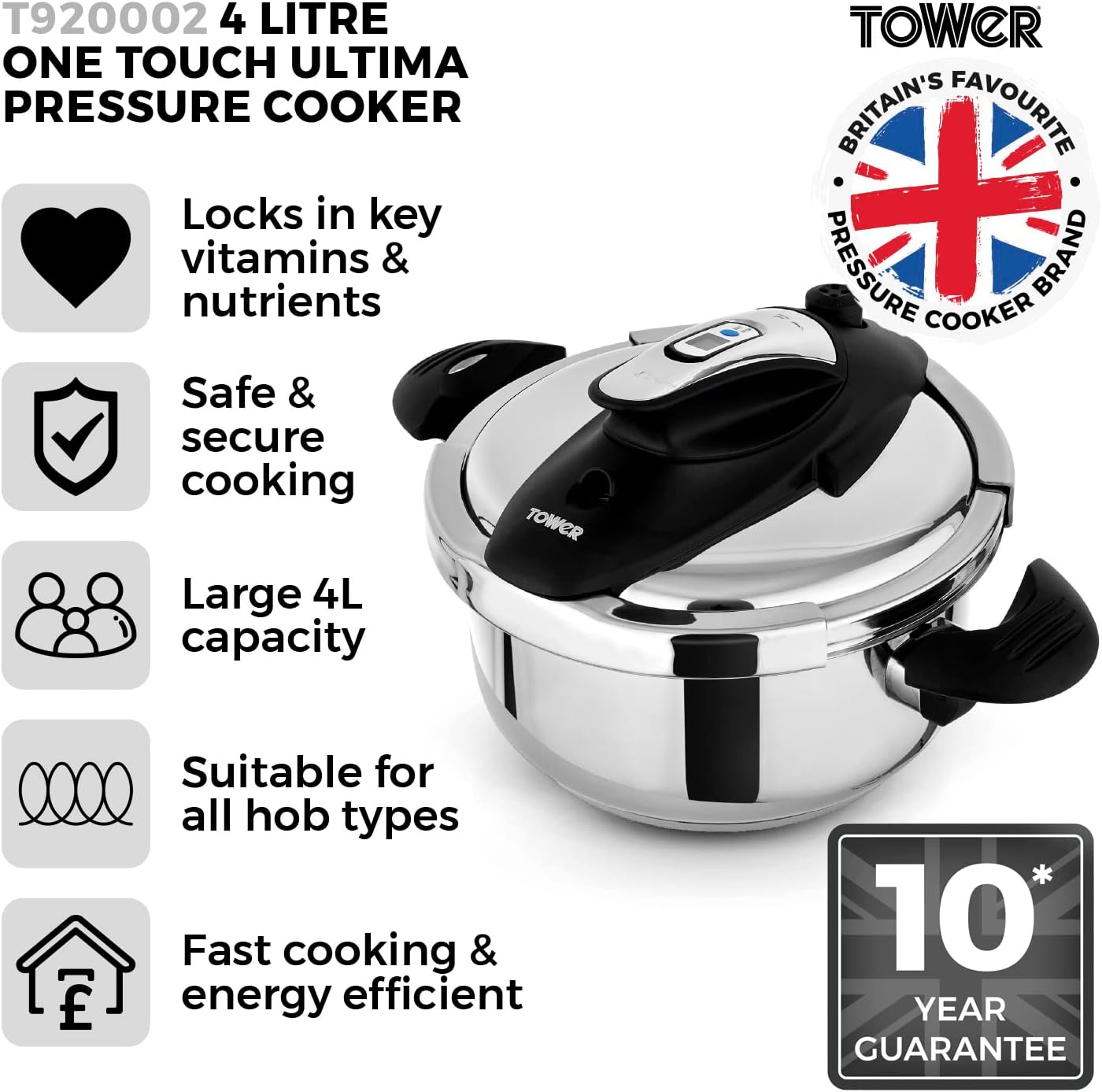
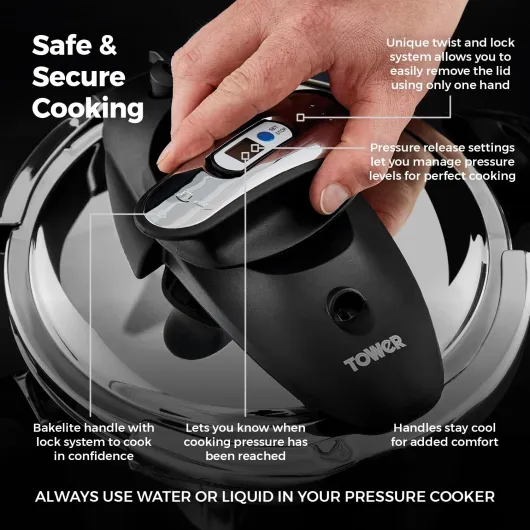
The first thing that stands out is the twist-lock lid system. Compared to the old-school pressure cookers with those awkward clamps or weight-and-pin setups, this one is much more user-friendly. You line up the markings, twist, and it clicks into place. One key detail: the design makes it so you can’t open it while it’s under pressure. The red pressure indicator pops up when it’s pressurised, and you physically can’t twist it open until the pressure drops. That does add a sense of safety, especially if you’re not super confident with pressure cookers.
The handles are another design win. Instead of one long handle, you get two short, stay-cool side handles. This makes the cooker easier to store in a cupboard and easier to lift when it’s full, because the weight is balanced. I had no issues moving it around with oven gloves, even when full of hot stew. The lid itself is on the heavy side, but that’s normal for a pressure cooker lid with all the mechanisms inside. It feels robust rather than flimsy.
On the lid, you’ve got a simple lever to release steam: just a short turn and it vents. It isn’t silent – you absolutely know when it’s letting steam out – but it’s controlled and predictable. No scary rattling weight, just a steady release. The red pressure indicator is easy to see from across the kitchen, so you can tell at a glance whether it’s up to pressure or ready to open. The detachable timer clips onto the handle, which is handy, but again, it’s only a timer, not a control system. It beeps when time’s up; you still have to adjust the hob yourself.
If I’m picky, the weak spot in the design is the instruction booklet. It’s small, flimsy, and light on detail. There are a couple of recipes and very basic guidance, but nothing that really helps you understand pressure cooking times for different foods. I ended up searching online for tables from other brands. So the hardware design is pretty solid, but the documentation feels like an afterthought. For someone brand new to pressure cookers, that gap is noticeable.
Comfort & ease of use: simple once you’ve done a few runs, but not beginner-proof
In terms of everyday comfort, I’d say this pressure cooker is easy enough once you’ve done two or three meals, but the first uses might feel a bit unclear if you’ve never touched a pressure cooker before. The twist-lock lid is genuinely handy: lining up and closing it is quick, and it feels secure. You don’t have to wrestle with clips or guess whether it’s sealed properly. The red pressure indicator gives you a clear visual cue, which helps reduce that usual pressure cooker hesitation.
The side handles are comfortable to grab, and because they stay relatively cool, you can nudge or move the pot a bit without instantly hunting for oven gloves. When it’s full, it is heavy – it’s a 6L metal pot full of food, after all – but the two-handle setup balances the weight better than one long handle. Pouring liquid out directly from the pot is a bit awkward because of the size; I usually ladled soup or stock into containers rather than trying to pour the whole thing.
The detachable timer is a mixed bag. It’s convenient to have a timer clipped to the cooker so you don’t have to reach for your phone or a separate kitchen timer, and it comes with spare batteries, which is a nice touch. But it doesn’t interact with the cooker in any way – it’s just a beeper. You still have to watch the pressure indicator, adjust the hob, and decide when to release pressure. So it’s a small comfort feature, not a control system. If you expected something smarter, you’ll be a bit underwhelmed.
The main comfort downside is the learning curve plus weak instructions. If you’re already used to pressure cookers, you’ll be fine. If not, you’ll probably end up on YouTube or reading other brands’ manuals to figure out cooking times. Once you’ve got your own list of timings, day-to-day use is straightforward. But Tower could have made the first week easier with a better guide and more reliable recipes.

Materials & build: stainless steel body, plastic lid parts that you’ll want to treat gently
The main pot is stainless steel with a metallic finish, and it feels sturdy. It’s not thin or flimsy; when you tap it, you get that solid cookware feel rather than a tinny sound. The base is slightly thicker and flat, which is important on induction: I got even heating, no weird hot spots that burn food in one patch. Inside, the corners are rounded, which actually matters when you’re stirring or scraping the bottom with a wooden spoon – food doesn’t get trapped in sharp edges.
The lid is a mix of stainless steel and plastic components. The twist-lock mechanism is mainly plastic, and that’s both good and bad. Good, because it keeps the lid lighter than a full stainless steel contraption and makes the movement smoother. Bad, because if you drop it from a height, there’s a real chance you’ll crack or break something. One of the Amazon reviewers mentioned smashing the twist-lock after dropping the lid on a road, and I can believe that. It’s not fragile in normal use, but it’s not indestructible either.
The seal is a standard rubber/silicone gasket, easy to remove for cleaning. Replacement seals are available, which is important because that’s usually the part that wears out first on any pressure cooker. After a few weeks of use, my seal still looks fine, no warping or odd smells. The steam basket and trivet are also stainless steel – basic but functional. They’re handy if you want to steam veg or keep meat off the bottom for certain dishes.
Overall, the materials feel pretty solid for the price. It’s made in China, which is normal for this kind of cookware now. The only thing I’d flag is that you have to treat the lid like a precision piece: don’t throw it around, don’t bang it against the sink, and don’t soak it fully in water. The manual says to wipe it rather than submerge, and that’s clearly because of the plastic and internal mechanisms. If you’re rough with your gear, this is something to keep in mind.
Durability & cleaning: feels like it’ll last, as long as you respect the lid
After a few weeks of regular use, there are no obvious durability red flags. The stainless steel body cleans up well and doesn’t scratch easily. I’ve used metal tongs inside a couple of times by accident and didn’t leave visible marks. The base hasn’t warped on induction, which is important, because once a base warps you start getting bad contact and uneven heating. At 3.26 kg, it feels like a proper piece of cookware, not a flimsy pot.
The part you need to baby a bit is the lid and its plastic components. I didn’t drop mine, but given the reports of damage from a fall, I’m careful with it. I always place it gently on the counter and avoid banging it against the sink. As for the seal, it’s holding up fine, and it’s removable for cleaning, which is key if you cook strongly scented stuff like curries or broths. Over time, you’ll probably need to replace the gasket every year or two depending on use, but that’s normal for any pressure cooker.
Cleaning is mostly painless. The pot itself is dishwasher-safe according to the specs, and I did run it through the dishwasher a couple of times without any issues. Usually I just wash it by hand with hot soapy water, and food comes off without too much scrubbing, especially if you deglaze right after cooking. The rounded interior base helps here – no annoying corners where burnt bits hide. The steam basket and trivet also go in the dishwasher without drama.
The lid is where cleaning is a bit more annoying. You’re not supposed to submerge it fully because of the mechanisms and plastic parts, so you have to wipe it down with a soapy sponge and then rinse carefully. It’s not hard, just slightly more fiddly than dunking everything in the sink. If you’re the kind of person who wants to throw everything in the dishwasher and be done, that might annoy you. On the flip side, Tower backs this with a 10-year guarantee (1 year standard + 9 years if you register), which suggests they expect it to last. As long as you don’t abuse the lid and you replace the seal when needed, I don’t see why it wouldn’t keep going for many years.
Performance: cooks fast and saves energy, but you still need to know what you’re doing
In day-to-day cooking, the performance is solid. Compared to a normal pot on the hob, cooking times are much shorter. For example, I did dried chickpeas (soaked overnight) in about 25–30 minutes at pressure, versus over an hour simmering in a regular pan. A whole chicken came out juicy and cooked through in roughly 30 minutes at pressure after a short sear. Bone broth that would usually bubble for three hours was done in about an hour, with a good gel when cooled. So yes, you save both time and gas/electricity. The claim of up to 70% energy saving sounds optimistic, but you definitely use less energy than with long simmering.
Pressure build-up time depends on how much you put in and how hot your hob is. For a half-full pot, it took around 10–15 minutes to come up to pressure on my induction hob. Once the red indicator popped up, I turned the heat down to maintain pressure without overdoing the steam release. That’s the key: you still have to manage the heat yourself. There’s no automatic control like on an electric pressure cooker, so there’s a small learning curve. After two or three meals, I got the hang of it, but the first time I let it vent too much steam and had to top up water later.
Food quality is good. Stews and curries come out with tender meat and thick sauces, beans get soft without falling apart, and the steam basket works fine for vegetables if you don’t overcook them. One reviewer mentioned their beef stew being tough following the included recipe; I’m not surprised, because the timings in the booklet are not very reliable. Once I followed timing charts from other pressure cooker brands, results were much better. So the cooker itself is capable, but the documentation doesn’t help you get the best out of it.
Noise-wise, it’s reasonable. You hear the steam when it’s venting, and there’s the usual hiss when you manually release pressure, but nothing crazy or scary. The red pressure indicator is clear, so you always know where you are. Overall, performance is good if you’re willing to learn a bit. It’s not idiot-proof, but once you get used to it, it’s a very efficient way to cook.
What you actually get out of the box
Out of the box, the Tower T920003 is pretty straightforward. You get the 6L stainless steel pot, the pressure lid with the twist-lock system, a detachable 60-minute timer, a steaming basket, a trivet, and a thin instruction booklet with a few recipes. No fancy extras, no cookbook worth keeping on the shelf. The whole thing weighs about 3.2 kg, so it feels solid but not ridiculous to lift, even when it’s empty.
The 6L capacity is decent for a family: I comfortably cooked a whole medium chicken with veg, and I’ve done big batches of chickpeas and lentil stews for four people with leftovers. Just remember that with pressure cookers you can’t fill to the top – there’s a max fill line – so in practice you’re working with something like 4–4.5L of usable space for most dishes. Still, that’s plenty for weekly meal prep or cooking in bulk for the freezer.
The hob compatibility is a big plus. I tested it on induction, and it heats quickly and evenly. It’s also fine for gas and ceramic hobs according to the spec. There’s no fancy coating inside, just bare stainless steel, so you can sear meat directly in the pot before closing the lid. That’s handy if you like doing proper browning before pressure cooking, instead of dirtying another pan.
In terms of positioning, this cooker sits in that middle ground: more control and more involvement than an electric pressure cooker, but cheaper and simpler. If you’re used to older aluminium pressure cookers, this feels like a modernised version with better safety, nicer looks, and a couple of small extras (like the timer and the steam basket), but it’s still very much a manual tool, not a smart appliance. Overall, the presentation is functional rather than exciting, which I actually prefer for a piece of cookware that’s supposed to last years.
Pros
- Sturdy 6L stainless steel pot with good capacity for families and batch cooking
- Twist-lock lid with clear pressure indicator and simple steam release feels safe and easy to use
- Works on all hob types including induction and cooks much faster than a regular pot, saving time and energy
Cons
- Poor instruction booklet and weak recipe guidance, especially for beginners
- Lid has plastic components that need careful handling and can’t be fully submerged for cleaning
Conclusion
Editor's rating
The Tower T920003 One-Touch Ultima 6L pressure cooker is a solid, no-nonsense stovetop cooker that does exactly what you expect once you’ve learned how to handle it. The stainless steel body, twist-lock lid with safety features, and compatibility with all hob types (including induction) make it a practical option for anyone who cooks big batches of stews, beans, and stocks. It cooks faster than a normal pot and helps cut energy use, and the 6L capacity is well suited for families or for meal prep. The detachable timer and included steam basket are nice extras, even if they’re not life-changing.
It’s not perfect. The instruction booklet is weak, the recipes are poorly thought out, and beginners will probably have to look online for proper cooking times. The plastic parts in the lid mean you shouldn’t treat it roughly, and cleaning the lid requires a bit more care because you can’t fully submerge it. Also, this is a manual pressure cooker: you have to manage the heat and pay attention to the pressure indicator. If you want something completely hands-off, an electric pressure cooker will suit you better.
Overall, if you’re comfortable with basic cooking and don’t mind a short learning curve, this Tower model is good value and pretty reliable. It’s a strong choice for people who want a big, durable pressure cooker without extra electronics. If you’re a total beginner who hates reading or tweaking things, or if you expect detailed guidance out of the box, you might find it a bit frustrating and be happier with an appliance that holds your hand more.
![Ninja Foodi MAX Multi-Cooker [OP500UK], 9-in-1, 7.5L, Electric Pressure Cooker and Air Fryer & Non-Stick Loaf Tin, Cake Tin & Crisper Tray Bakeware Set MAX 9-in-1 Multi Cooker + Tray Bakeware Set](https://www.electric-pressure-cooker-guru.com/storage/1020382/conversions/71lZy-UXhUL._AC_SL1500_-medium.webp)