
Summary
Editor's rating
Value for money: who actually benefits from a 22L cooker
Design: huge footprint and that weird oval lid
Materials and build: solid enough, but not luxury
Packaging: basic, and sometimes a bit rough
Durability and safety impression after real use
Performance: how it actually cooks big batches
What you actually get out of the box
Pros
- Huge capacity for bulk cooking (great for large families, events, or batch cooking)
- Heats and cooks evenly once up to pressure, with a reliable whistle and safety valve
- Sturdy handles and simple, proven Hawkins design with easily available spare parts
Cons
- Very large and heavy, awkward to store and move when full
- Real usable capacity is less than 22L due to inner lid and safety fill limits
- Basic packaging and finish; prone to cosmetic scratches and occasional shipping dents

Specifications
View full product page →| Brand | HAWKINS |
A giant pressure cooker for when a normal one just isn’t enough
I picked up the Hawkings Bigboy 22L because my regular 5L cooker was crying every time I tried to cook for large family gatherings. I wanted something that could handle big batches of stock, biryani, or beans in one go instead of juggling multiple pots. On paper, 22 litres sounded perfect: big capacity, Indian brand known for pressure cookers, and decent Amazon rating around 4.4/5. So I decided to give it a proper run for a few weeks.
First impression: this thing is huge and heavy. It’s not your everyday dal cooker; it’s more like a semi-commercial pot. If you’re used to small kitchen gear, this will feel like equipment for a canteen. I used it on a standard gas stovetop and also on a wider commercial-style burner just to see how it behaved. Between big bone broth batches, chickpeas, and a silly amount of rice, I managed to put it to work around 8–10 times.
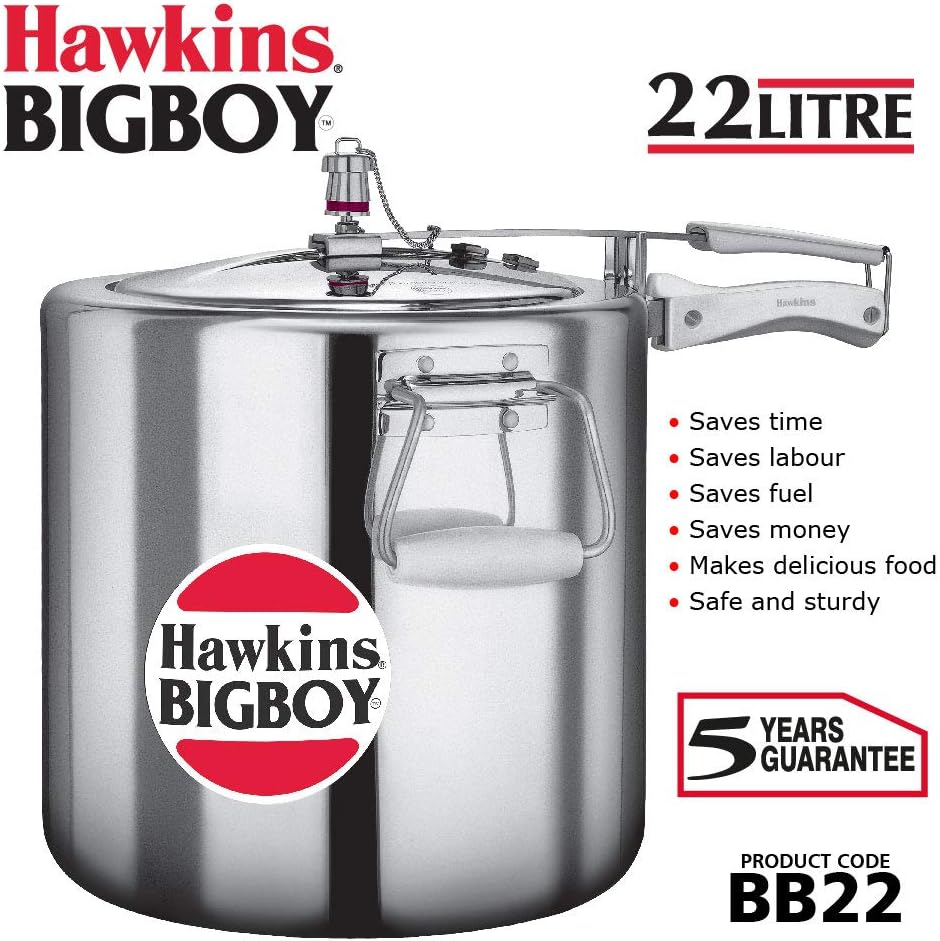
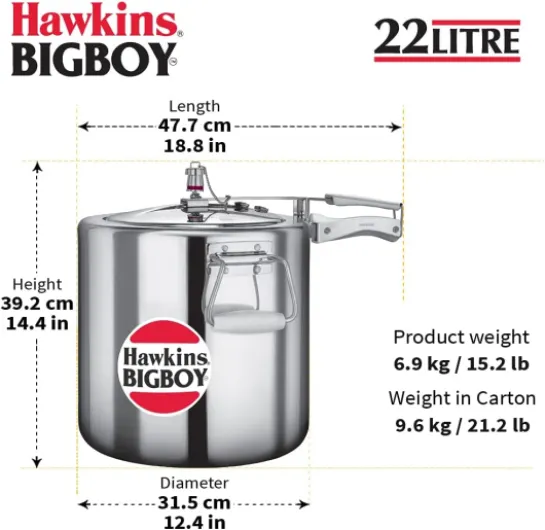
Right away I noticed two things: the oval inner lid design and the overall weight. The oval lid confused one friend who tried to close it and thought it was faulty. Once you get used to how it drops in and turns, it’s fine, but it’s not obvious at first. The weight, at almost 10 kg empty, means you really don’t want to move it around when it’s full of hot food. It’s a cooker you park on a burner and mostly leave there.
Overall, my early feeling was that this is a serious bulk-cooking tool, not a casual daily cooker. It gets the job done, but you need space, a solid stove, and a bit of patience to handle it safely. If you’re in a tiny kitchen or only cook for 2–3 people, it’s probably going to feel like overkill right from day one.
Value for money: who actually benefits from a 22L cooker
On value, I’d say this: for the right person, the Hawkings Bigboy 22L is good value for money; for the wrong person, it’s a waste of space and cash. If you regularly cook for 10–20 people, do batch cooking for the week, or run a small food business, being able to pressure cook this much at once makes sense. You save time and gas compared to running multiple smaller cookers. In that context, the price feels fair, especially given Hawkins’ general reputation for long-lasting cookers.
If you’re a normal household of 3–5 people, it’s probably overkill. You’re paying for capacity you’ll rarely use, and you’ll be stuck storing a giant pot that hogs a whole cupboard. In that case, a 6–8L pressure cooker is more practical and often cheaper. I found myself only reaching for the 22L when I had guests or wanted to cook a huge batch of stock. The rest of the time, it just sat there, acting like a metal monument in the corner of my kitchen.
Compared to other brands, large aluminium pressure cookers of this size don’t have tons of competition in Western markets. If you look at commercial stainless options, they usually cost more and are even heavier. So in that sense, Hawkins sits in a sort of sweet spot: relatively affordable big capacity with a known design. The flip side is you don’t get fancy features, polished aesthetics, or high-end packaging. Just a big, manual, gas-stovetop-compatible cooker that does one thing: cook a lot of food quickly.
So in my opinion, the value is solid if you truly need 15–18L of usable pressure-cooking volume on a regular basis. If you just like the idea of a giant cooker but will mostly cook small portions, save your money and your storage space. This is a tool, not a toy, and it only makes financial sense if you actually use it for what it’s built to do.
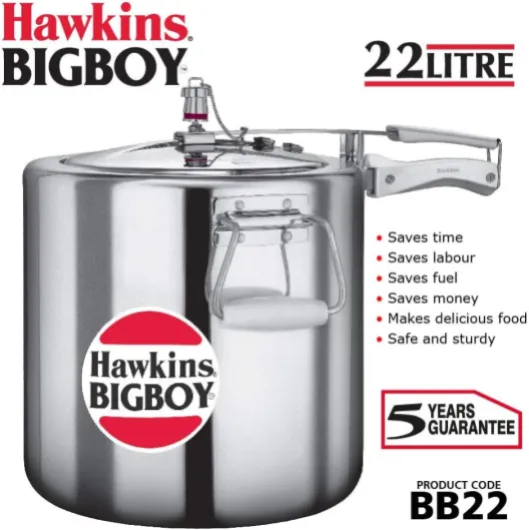
Design: huge footprint and that weird oval lid
The design is dominated by two things: size and the inner-oval lid. At 33.6 cm deep and 47.7 cm wide, this cooker takes up a serious chunk of your stovetop. On my 4-burner gas stove, it basically blocked 2 burners completely and made a third one awkward. So in practice, when this is on the stove, you’re mostly cooking just with this and maybe one small pan. If you’ve got a narrow kitchen or a built-in hob with limited space, be ready to rearrange your usual setup.
The oval inner lid is what confuses most people. It’s not damaged; it’s designed that way. You drop it inside at an angle and then twist it to lock. Once you understand the movement, it’s okay, but the first time I tried it I thought the lid was warped. This design means the lid sits down inside the pot, which is why some users feel they “lose” capacity. You don’t really get the full 22L for liquid; you have to stay below the max fill line for safety, and the lid design eats into the volume. So if you were dreaming of pressure-cooking a full 22L of soup, forget it. Realistic working volume is lower.
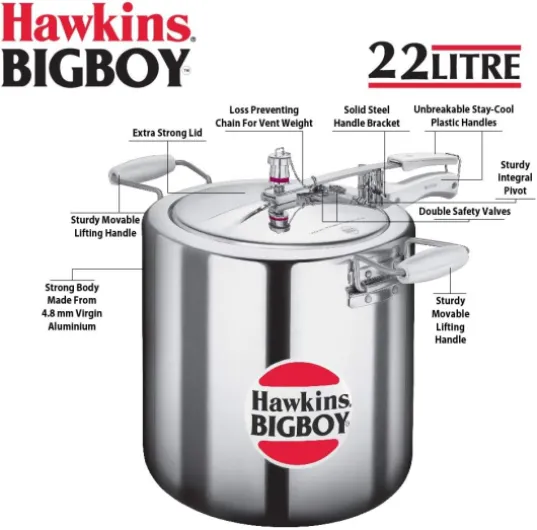
The handles are long, plastic, and stay reasonably cool, even on a gas flame, which is good because you need leverage. The cooker is almost 10 kg empty, and once you add water and food you’re easily lifting 15–18 kg or more. You’re not casually tipping this in the sink with one hand. The handle design at least gives you a decent grip, but I still recommend sliding it instead of lifting when it’s hot and full.
Overall, the design is practical but not friendly. It’s made for big batches, not for comfort. If you know pressure cookers and you’ve used Hawkins before, you’ll adapt quickly. If this is your first pressure cooker, the size and lid system will feel over the top. It’s the kind of gear that makes sense for large families, community cooking, or small catering jobs, not for everyday pasta night.
Materials and build: solid enough, but not luxury
The cooker is made of aluminium with a matte finish, which is pretty standard for Indian-style pressure cookers. Aluminium heats up fast and evenly, which is good for large pots like this. I didn’t have any obvious hot spots during cooking; the whole base seemed to come up to pressure fairly consistently. That said, it’s not the thickest or heaviest aluminium I’ve ever seen. It’s thick enough to feel safe, but it doesn’t give that super heavy-duty, restaurant-grade impression when you tap it.
The handles are unbreakable stay-cool plastic, at least according to the spec sheet. I obviously didn’t try to smash them, but they do feel solid and didn’t flex even when the pot was full. During my tests, they stayed cool enough to grab with bare hands once the cooker had been running for a while, though on high flame the section near the body can get warm. So you still want to be a bit careful. The rivets and joints between handle and body looked clean on my unit, no gaps or wobble.
The gasket is a typical Hawkins rubber gasket. It seated well and didn’t leak during my tests. One thing I like with Hawkins gaskets is they’re easy to find and replace if needed. The pressure regulator (whistle) also felt sturdy. It releases steam in a consistent rhythm once pressure is reached. No weird sputtering or random bursts. The shielded safety valve is there as a backup, which is reassuring on a pot this size. I didn’t have any safety events, and the lid locked and unlocked cleanly every time.
Where the materials feel a bit cheap is in the overall finish. The aluminium marks easily; you’ll see scratches and small scuffs pretty fast, especially if you’re washing it in a crowded sink. Mine arrived reasonably clean, but not perfect showroom quality. Compared to more expensive stainless pressure cookers from European brands, it’s clearly a step down in polish. But for heavy use on a gas stove, I actually don’t mind aluminium. It’s lighter than equivalent stainless at this size and heats quicker. Just don’t expect it to look pretty after a few months of use.
Packaging: basic, and sometimes a bit rough
The packaging is pretty bare-bones. Just a cardboard box, some inner supports to stop it rattling around too much, and basic plastic wrapping around the cooker. It’s enough to get it to you in one piece most of the time, but it’s not heavily protected like high-end cookware. My unit arrived without dents, but there were a couple of light scuffs that looked like they happened either at the factory or during handling, not in my kitchen.
One Amazon reviewer mentioned the box smelling strongly of manure and the cooker arriving scratched and dirty. I didn’t have anything that extreme, but I can believe that quality control on packaging isn’t always tight. My cardboard definitely smelled like a dusty warehouse and not like a clean retail store. Inside, the cooker was clean enough but not spotless; I still washed it thoroughly before first use, which I’d do anyway with any cookware.
There’s no fancy unboxing experience here. No protective cloth bag, no foam around every edge. If the box takes a hard hit in transit, I can see how you might end up with a ding on the aluminium. At this size and weight (almost 10 kg), the box is also a bit awkward to carry, and the cardboard isn’t the thickest. So if you’re buying it as a gift, just be aware it doesn’t look premium when opened; it looks like industrial kitchen gear.
Personally, I care more about how it cooks than how it’s wrapped, but for the price, I do think Hawkins or the distributor could step up the packaging a bit. A thicker box and better inner padding would reduce the risk of cosmetic damage and some of the complaints you see online. As it is, the packaging gets the job done, but just barely, and it matches the overall no-frills vibe of the product.
Durability and safety impression after real use
Durability-wise, after several heavy uses, the Hawkings Bigboy still feels structurally fine. No warping of the base, no lid deformation, and the gasket still seals well. The fixed pivot that holds the lid in place feels solid, and there’s no play or wobble yet. I deliberately let it cool naturally a few times and also did a quick-release under running water (carefully) to see if the sudden temperature change would stress anything. No visible issues so far.
Cosmetically, though, it marks fast. The matte aluminium shows scratches from normal washing and moving it around. If you care a lot about how your cookware looks, this will bother you. I also noticed some slight discoloration inside after cooking acidic stuff like tomato-heavy curry and then leaving it sitting for a while. That’s normal for aluminium, but you do need to clean and dry it properly to avoid stains. It’s not dishwasher safe, and honestly you wouldn’t want to put something this big in a dishwasher anyway.
On the safety side, I never once felt like it was about to blow or anything like that. The CE stamp and the safety valve are there, and the lid lock mechanism does its job. That said, one Amazon reviewer clearly did not trust it and mentioned “severe safety concerns.” My take: the design is old-school but tested. If you use it properly (don’t overfill, keep the valve clean, replace gasket when worn), it feels safe enough. If you’re already nervous around pressure cookers, the sheer size of this one might make you uneasy, but that’s more psychological than anything I saw in use.
Long term, the weak points are likely to be the gasket and possibly the handles if abused. Luckily, Hawkins spares are easy to find, especially if you have Indian shops nearby or are comfortable ordering parts online. I don’t see the body failing under normal home use. This is the kind of cooker that will probably outlive the stove it’s sitting on, but it’ll get uglier over time. So, durable in function, less so in looks.
Performance: how it actually cooks big batches
In practice, the performance is pretty solid as long as you understand what you’re dealing with. This is a huge pot, so it takes time to come up to pressure. On a regular home gas burner, with about two-thirds capacity filled (stock with bones and vegetables), it took around 25–30 minutes to reach full pressure from cold water. On a stronger commercial-style burner, that dropped closer to 15–18 minutes. Once at pressure, it holds it steadily, and the whistle behaves predictably. No scary rattling, just regular releases.
For things like chickpeas and kidney beans, the results were good. Soaked chickpeas cooked through evenly in about 25–30 minutes at pressure. I didn’t find any big difference compared to cooking the same thing in a smaller 5–6L cooker, besides the fact that I could do a much bigger batch in one go. Same for bone broth: after 1.5–2 hours at pressure, the bones were soft and the broth was rich. No undercooked pockets, no burnt bottom, which was one of my worries with such a large surface area.
Where you have to be careful is heat control. Because the base is large, if you leave the flame too high after it reaches pressure, you’ll waste gas and may get some sticking at the bottom with thicker dishes like dal or meat curries. I had one batch of lentils where I was lazy and left the flame medium-high, and the bottom layer caught slightly. Not disastrous, but you smell it when you open. Once I lowered the flame just enough to keep a gentle release on the whistle, it behaved much better.
Noise and steam are what you’d expect from a big pressure cooker: it’s not silent, and when it vents, it vents hard. If you’re cooking in a small kitchen without a good hood, be ready for a lot of steam and heat. But overall, for bulk cooking, it does what it’s supposed to do: cook big quantities thoroughly and faster than a normal pot. It’s not magic, but it’s efficient once it’s up to pressure, and I didn’t have any safety scares or weird behavior during my tests.
What you actually get out of the box
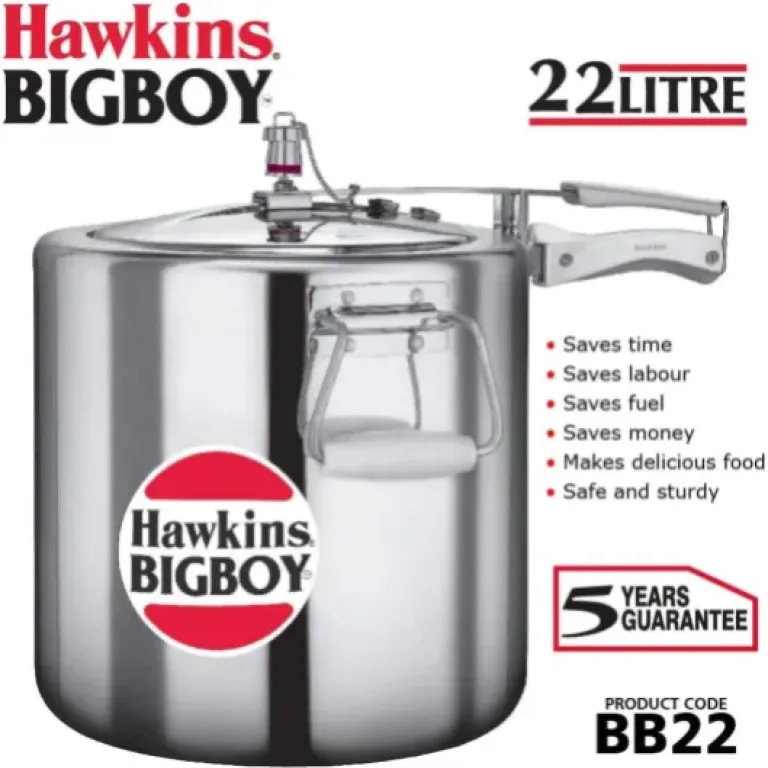
Out of the box, the Hawkings Bigboy 22L is pretty straightforward. You get the cooker body, the oval lid, a whistle (pressure regulator), and a gasket. No fancy steamer baskets, no extra inserts, nothing beyond the basics. There’s also a manual that’s more detailed than I expected, with cooking times and a bunch of recipes. It feels a bit old-school, but it’s actually useful if you’re new to large-capacity cooking.
The cooker itself has a matte aluminium finish and big, chunky plastic handles. Nothing looks premium, but it looks like it’s built for function. Mine arrived in decent shape, but I can see how dents and scratches could happen easily: the aluminium is thick but not bulletproof, and the packaging is just regular cardboard and foam. One of the Amazon reviews mentioned dents, scratches, and a weird smell from the box. Mine didn’t smell like manure, but the cardboard did have that slightly dusty warehouse smell. Not a big drama for me, but if you expect spotless showroom condition, this may annoy you.
On the cooker itself, the main visible safety bits are the shielded safety valve and the fixed pivot system for the lid. The valve is standard Hawkins style, and the pivot feels sturdy enough. You can tell this design is more focused on reliability than looks. No fancy markings, no modern design touches. Just a big aluminium pot that looks like it belongs in a canteen kitchen. The branding is minimal; you get the Hawkins name and some basic markings, nothing more.
In terms of first impression, I’d say it looks functional and a bit rough, which matches the price and the country of origin. If you’re used to shiny stainless steel European cookers with multiple safety buttons and polished handles, this one will feel basic. But it’s clear what it’s for: big quantities, gas stove, manual control, no electronics, no smart nonsense. You either like that straightforward approach or you don’t.
Pros
- Huge capacity for bulk cooking (great for large families, events, or batch cooking)
- Heats and cooks evenly once up to pressure, with a reliable whistle and safety valve
- Sturdy handles and simple, proven Hawkins design with easily available spare parts
Cons
- Very large and heavy, awkward to store and move when full
- Real usable capacity is less than 22L due to inner lid and safety fill limits
- Basic packaging and finish; prone to cosmetic scratches and occasional shipping dents
Conclusion
Editor's rating
Overall, the Hawkings Bigboy Aluminium Pressure Cooker 22L is a big, no-nonsense workhorse. It heats evenly, holds pressure well, and handles large batches of beans, broth, and rice without drama once you get used to the oval inner lid. The materials feel solid enough for long-term use, even if the finish is a bit rough and the aluminium picks up scratches and stains fairly quickly. In my tests, it cooked everything thoroughly and I never felt unsafe, as long as I followed basic pressure cooker rules.
But it’s not for everyone. It’s heavy, takes forever to come up to pressure on a weak burner, and eats a huge chunk of stovetop and storage space. The realistic working capacity is less than the advertised 22L because of the inner lid and the safety fill limits, so if you were counting on a full 22L of food, adjust your expectations. The packaging and cosmetic quality control are also just okay, not premium, and some users clearly had bad luck with dents and dirty units.
If you cook for big groups, run small events, or love doing massive batch cooking, this cooker gets the job done and offers good value. If you’re a small household or easily nervous about big pressure cookers, I’d skip it and go for a smaller, more manageable size. It’s basically a semi-commercial tool that makes sense only if you really need that capacity on a regular basis.