
Summary
Editor's rating
Is it worth the money compared to the alternatives?
Big, chunky, and not exactly pretty – but practical enough
Stainless steel pot with non‑stick: good combo, with a few caveats
Build quality and how it feels after a few weeks
Power, speed, and noise: how it behaves day‑to‑day
What this thing actually is (beyond the marketing buzz)
Does it actually cook well? Yes – with a bit of trial and error
Pros
- Combines pressure cooker, air fryer, and multicooker in one unit, saving space
- Stainless steel inner pot with non‑stick coating makes cooking and cleaning easier
- Good everyday performance and decent energy/time savings compared to using an oven
Cons
- Real usable capacity closer to 5 L than the advertised 6 L, limiting for larger families
- Presets and manual require a learning curve; not fully “set and forget”
- Slight rattle in the air fryer lid on some units, which doesn’t affect cooking but feels a bit cheap

One pot to rule them all… sort of
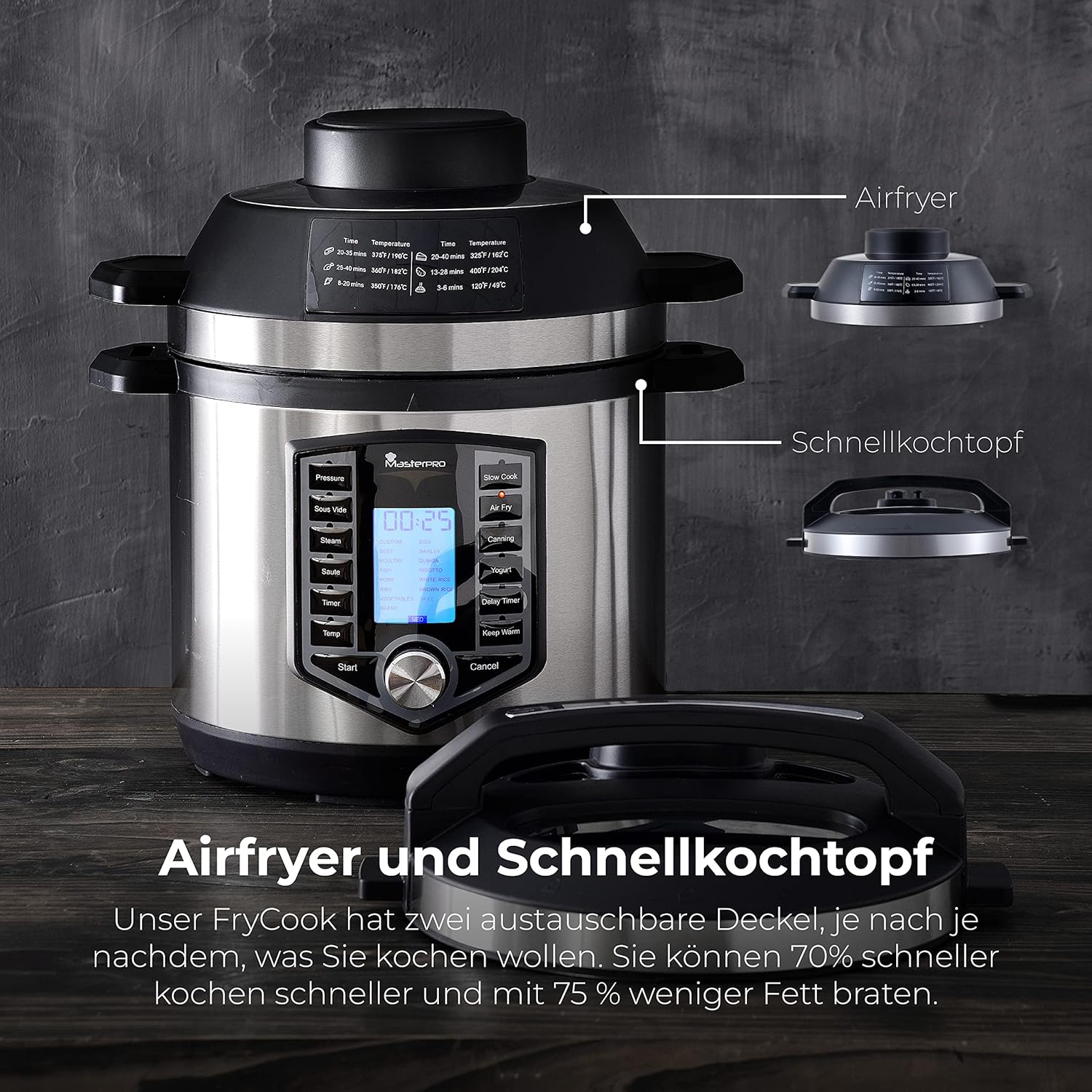
I’ve been using this MasterPro FryCook mainly as a pressure cooker and air fryer for a few weeks in a small flat kitchen. I bought it because I was tired of having a separate air fryer basket, a basic pressure cooker, and a big pan taking up half my counter. On paper, this thing does everything: fries, pressure cooks, roasts, bakes, 44 automatic functions, 12 programmes… the usual long list that sounds great on Amazon.
In practice, it’s a bit less magic and a bit more “big metal box that mostly gets the job done”. It cooks properly, the food comes out fine, and it did help me cut down on oven use. I’ve done chicken thighs, frozen chips, stews, rice, and a couple of cakes in it. Most of it turned out decent – not restaurant level, but good enough for weeknights when I just want something hot and simple.
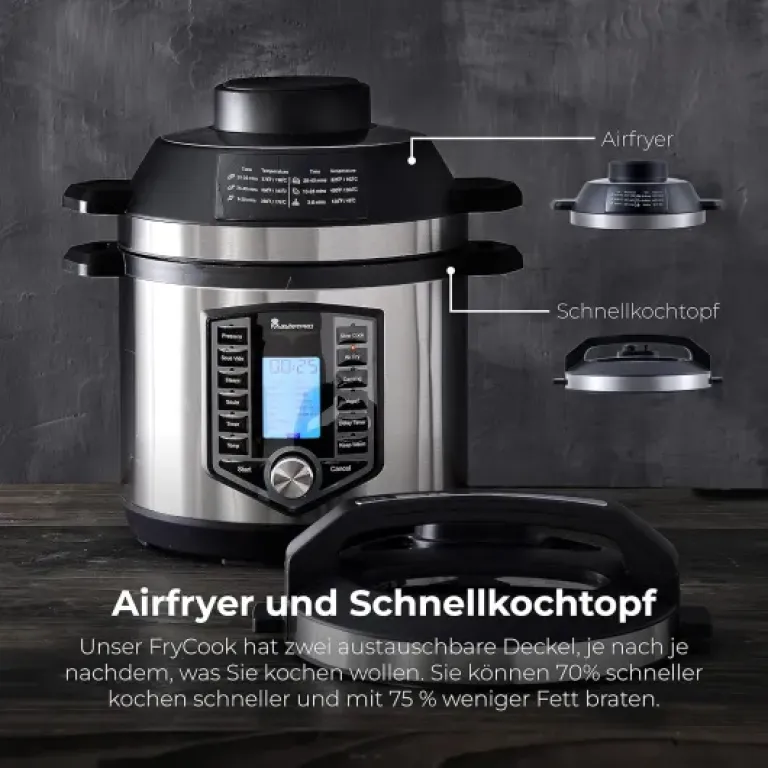
Where it’s interesting is the mix of pressure cooking and air frying in one machine. I could pressure cook a batch of chickpeas and then later use the same bowl to roast potatoes with the air fryer lid. Less washing up, less stuff on the counter. But you do have to get used to the programmes and timings; the manual is thick and not something you read once and forget. I had to go back to it a few times to understand which mode did what.
Overall, my first impression: pretty solid, not mind‑blowing. It’s especially handy if you’ve got a small kitchen and don’t want three separate appliances. But there are a few annoyances, especially the real capacity and the learning curve, that you should know before buying. It’s not a miracle machine; it’s just a fairly capable cooker that can simplify your life if you’re willing to adapt to it.
Is it worth the money compared to the alternatives?
For me, the main selling point of this MasterPro FryCook is the combo: pressure cooker + air fryer + general multicooker in one unit, at a price that’s usually lower than buying two separate branded appliances. If you’re on a budget and short on space, it starts to make sense. You get stainless steel, a decent non‑stick coating, and enough functions to cover most everyday recipes.
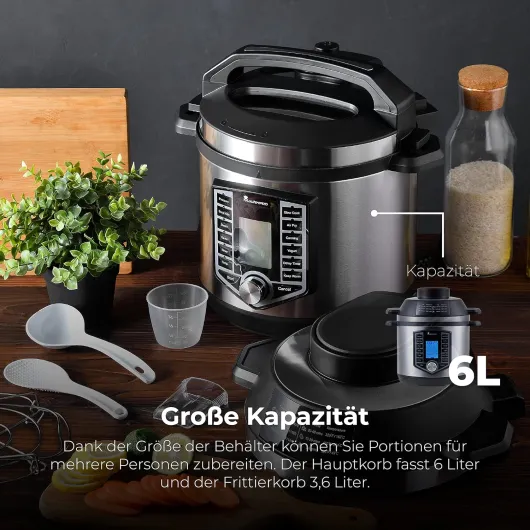
Where the value is a bit mixed is on the capacity and the brand. It’s advertised as 6 L, but in real life you’re looking at roughly 5 L of usable volume, especially if you respect the max fill lines for pressure cooking. For a single person or a couple, that’s fine and even convenient. For a family of four with big appetites, you might find it a bit tight, especially if you want to air fry a lot of stuff at once. One Amazon buyer even returned it for that reason. So if you were hoping to feed a crowd in one go, you might want to look at a larger or better‑known model.
Compared to better‑known brands like Instant Pot or Ninja, you’re basically trading brand recognition and maybe slightly better finishing for a lower price and a stainless steel inner pot at this budget. If you want rock‑solid customer support and a huge community of recipes specific to your device, you might be happier with a big brand. If you just want something that cooks and you’re okay with a bit of trial and error, this one offers good value for money overall.
So, is it worth it? If you’re in a small kitchen, like the idea of one machine doing most of the work, and don’t mind reading the manual and adjusting presets, yes, it’s a sensible buy. If you’re very picky about build quality, want exact capacity, or cook big quantities all the time, I’d either spend more on a known brand or go for a larger model. It sits in that middle ground: not cheap junk, not high‑end either, but a practical option for everyday cooking without breaking the bank.
Big, chunky, and not exactly pretty – but practical enough
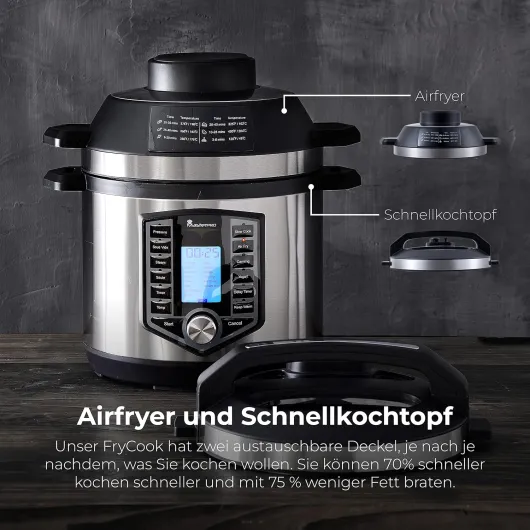
Design‑wise, this is not a discreet appliance. It’s a big stainless steel cylinder with a lid and a control panel on the front. If you’ve seen an Instant Pot or another multi‑cooker, you’ll recognise the style. It’s stainless steel with plastic parts, and the colour is what I’d call “multicoloured” only because of the buttons and display, not because it’s some stylish object. On the counter, it looks like a serious appliance, not décor.
The footprint is something to think about. It does save space compared to having a separate air fryer and pressure cooker, but it’s still tall and quite wide. On my small worktop, it basically claims a corner permanently. When the air fryer lid opens or when you want to remove the pressure lid, you need a bit of height under your cupboards. If you’ve got low wall cabinets, you might have to pull it forward each time, which is slightly annoying.
What I did like is that the control panel is clear enough once you’ve used it a couple of times. Buttons are labelled, there’s a basic display with time and temperature, and you don’t need to be an engineer to start it. The first two or three uses, I had the manual open to check which programme to pick, but after that I mostly used manual mode or the same 3–4 programmes. The build feels solid enough for the price: no wobbly handles, the pot sits well, and the lids lock properly. One user mentioned a small sound from the air fryer lid (probably a loose screw); mine also has a slight rattle when you move it, but during cooking it doesn’t cause any problem.
To sum up the design: practical, a bit bulky, not stylish. If you want something that looks premium on your counter, this isn’t it. If you just want something you can grab, fill, and start cooking with, the design is fine. Just make sure you have the space, especially in terms of height, because you’ll be opening and closing the lid a lot.
Stainless steel pot with non‑stick: good combo, with a few caveats
The materials are one of the reasons I went for this model. The inner pot is stainless steel with a non‑stick coating, which is a nice middle ground. Pure stainless steel tends to stick like crazy if you’re not careful, but full non‑stick aluminium can feel cheap and doesn’t always age well. Here, the pot feels reasonably thick and solid, and the coating does help with cleaning and day‑to‑day use.
In practice, food doesn’t weld itself to the bottom like it does in a bare metal pressure cooker. When I sauté onions or brown meat before pressure cooking, I still get some bits stuck on the bottom, but they deglaze easily with a splash of water or stock. After pressure cooking, stews and sauces don’t cling too much. For air frying, you usually use the basket or a rack, so the main pot doesn’t get too dirty. After a few weeks, I don’t see any scratches in the coating, but I’m being careful: no metal utensils, only soft sponges, and no brutal scrubbing.
The outer body is stainless steel with plastic trim. It looks and feels like most mid‑range kitchen appliances: not cheap toy plastic, but clearly not high‑end either. It doesn’t flex, and the handles feel safe enough when the pot is full. The lids are mostly plastic with metal parts where it matters (pressure ring, inner components). The sealing ring for pressure cooking is silicone, standard stuff. It does pick up smells a bit (curry, garlic), which is normal for these rings. A soak in hot water with a bit of vinegar helps, but if you’re very sensitive to odours, it’s something to know.
Overall, I’d say the materials are pretty solid for the price bracket. You’re not getting luxury, but you’re not getting a flimsy gadget either. The key is to treat the non‑stick coating decently: no abrasive sponges, no knives in the pot, and avoid overheating it empty. If you do that, it should last a while. The fact that the pot is stainless steel underneath is reassuring compared to some very thin aluminium pots you see on cheaper devices.
Build quality and how it feels after a few weeks
I obviously can’t judge long‑term durability after just a few weeks, but I can at least talk about the first signs of wear and overall feel. Out of the box, the machine feels solid enough: no loose parts, the pot fits snugly, the lids close and lock properly, and the buttons respond well. After regular use (several times a week), nothing has broken, no error messages, and no obvious change in performance.
The non‑stick coating inside the stainless steel pot still looks good, but I’ve been careful: wooden or silicone utensils only, and I avoid stacking other metal stuff inside the pot when storing it. If you’re rough with it, I can see the coating getting scratched over time, like any non‑stick. The silicone gasket for the pressure lid still seals fine, no steam leaks. It does keep some strong smells (curries, stews), but that’s standard for these rings. You can buy replacements if it bothers you too much.
The only slight worry is the small rattle in the air fryer lid that another user mentioned too. Mine also has a faint noise when you move or tilt the lid, as if something is a bit loose inside. It doesn’t affect operation at all, but it does raise a question about internal assembly quality. Time will tell if that turns into a real issue or just stays as a harmless quirk. For now, it’s just a detail that makes it feel less “tight” than some more expensive brands.
Given that it’s made in China and not from a big name like Instant Pot, I’m not expecting it to last 15 years. But for the price, if it gives me a few solid years of regular use without major breakdowns, I’ll consider it decent value. So far, after several weeks, it’s holding up fine, with no obvious weak point apart from that slightly noisy lid and the usual care you need with any non‑stick surface.
Power, speed, and noise: how it behaves day‑to‑day
With 1500 W of power, the MasterPro FryCook heats up reasonably fast, but it’s not lightning quick either. For pressure cooking, it usually takes around 10–15 minutes to come up to pressure depending on how full the pot is and whether the ingredients are cold or room temperature. Once it’s there, it holds pressure fine and finishes the cooking in the expected time. For air frying, it preheats in a few minutes, similar to other air fryers I’ve used.
In terms of energy and time saving, compared to using a traditional oven plus a pan, it’s clearly more efficient. I’ve done roast potatoes and chicken thighs in here instead of heating up a full‑size oven, and you can feel it on the electricity bill over time, especially if you cook for 1–2 people. One Amazon user mentioned saving energy, money, and time, and I’d agree. It’s not miraculous, but for small quantities it’s more sensible than firing up a big oven for 30–40 minutes.
No big issue with noise, but it’s not silent either. The air fryer fan makes a steady whooshing sound, like most air fryers. The pressure cooking phase is quieter, with some occasional hissing when steam is released. One user mentioned a slight sound from the air fryer lid when moving it, which I also noticed – a small rattle as if a screw or piece is slightly loose inside. It doesn’t affect cooking or safety, but it doesn’t give a premium feel. During normal operation, it’s not too loud; you can still watch TV in the next room without being bothered.
Overall performance is reliable and consistent once you’ve figured out your favourite settings. It doesn’t randomly shut off, it doesn’t burn everything, and the temperature seems stable. It’s not faster than every competitor out there, but it’s in the right ballpark. If you’re coming from a basic stovetop pressure cooker and a small cheap air fryer, you’ll probably notice the convenience more than any performance gap.
What this thing actually is (beyond the marketing buzz)
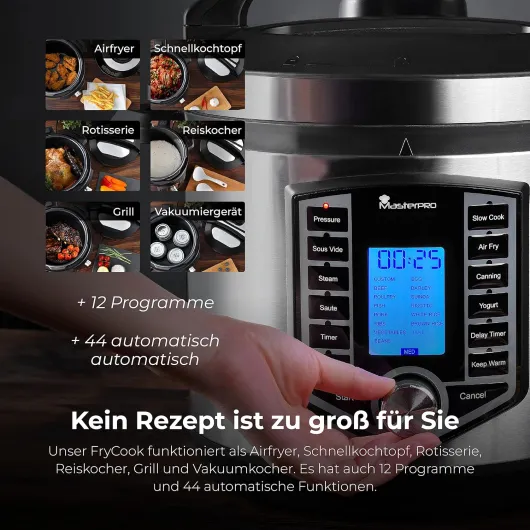
On the box and on Amazon, the MasterPro FryCook is sold as a hot air fryer, pressure cooker, and general multi‑cooker with 44 automatic functions and 12 programmes. In normal language: it’s a big electric pot that can cook under pressure, and it also has an air fryer lid so you can crisp food with hot air instead of deep frying. Power is 1500 W, capacity is advertised at 6 litres, and the inner pot is stainless steel with a non‑stick coating.
In day‑to‑day use, I’d describe it as a mix between an Instant Pot and a classic air fryer. You’ve got a panel with buttons for different modes (rice, stew, meat, fries, etc.), and you can adjust time and temperature if you don’t like the presets. The presets are handy to start, but like with all these machines, you end up tweaking them because every recipe and every brand behaves a bit differently. I burned the first batch of frozen chips by trusting the default time, so now I always shave off a few minutes and check.
One important point: the capacity claim is optimistic. It’s sold as 6 L, but in reality it’s more around 5 L of useful space, and that matches what another buyer said. For a couple or a small family, it’s fine. For 4–5 big eaters, you’ll be cooking in two rounds if you want to air fry a big batch of chips or do a large stew. If you were planning to replace a big family pressure cooker, keep this in mind.
Function‑wise, it covers the basics well: pressure cook, slow cook, sauté, steam, bake, and air fry. The famous “44 functions” is mostly a list of variations of those (rice, porridge, soup, etc.), not 44 totally different cooking methods. So don’t be fooled by the number; it’s not a professional kitchen in a box. But for everyday stuff – pasta, curry, chicken, frozen food – it’s more than enough.
Does it actually cook well? Yes – with a bit of trial and error
On the core question – does it cook food properly? – I’d say yes. It’s not magic, but it does what you expect. As a pressure cooker, it cooks stews, lentils, chickpeas, and tougher cuts of meat much faster than on the hob. A beef stew that would usually take 2 hours on low heat is done in about 35–40 minutes under pressure (plus the time to come up to pressure and release). The meat comes out soft enough, the sauce reduces nicely if you take a few extra minutes to simmer at the end.
As an air fryer, it’s decent. Frozen chips come out crispy on the outside and soft inside if you don’t overload the basket and if you shake halfway. Fresh potatoes with a bit of oil work too, but like all air fryers, it’s not the same as proper deep frying. You get a light crunch, not the same fat, heavy feel as a chip shop. I’ve also done chicken wings and drumsticks: with the pressure cooker first to cook through, then a quick air fry to crisp the skin. That combo works well and is where the all‑in‑one aspect actually makes sense.
The issue is that the presets are not always spot on. The first times, I either overcooked or undercooked things because I trusted the automatic programmes too much. For example, the default chips programme was a bit too long for my taste and dried them out. For stews, I now manually set the time depending on the meat. Once you’ve done a few recipes and written down what worked, it’s fine, but don’t expect to just press a button and get perfect food every time.
Another thing: the advertised 44 functions sound impressive, but in reality you’ll probably use 5–6 regularly and ignore the rest. That’s not a drama, just manage your expectations. The machine is effective for everyday cooking: weeknight dinners, batch cooking, reheating leftovers without drying them out. If you’re into very precise cooking or baking, you’ll still want your oven and your pans. But for basic family food, it delivers.
Pros
- Combines pressure cooker, air fryer, and multicooker in one unit, saving space
- Stainless steel inner pot with non‑stick coating makes cooking and cleaning easier
- Good everyday performance and decent energy/time savings compared to using an oven
Cons
- Real usable capacity closer to 5 L than the advertised 6 L, limiting for larger families
- Presets and manual require a learning curve; not fully “set and forget”
- Slight rattle in the air fryer lid on some units, which doesn’t affect cooking but feels a bit cheap
Conclusion
Editor's rating
The MasterPro FryCook is a practical all‑in‑one cooker that does what most people need: pressure cooking, air frying, and basic multicooker tasks in a single appliance. It cooks well enough, saves space in a small kitchen, and can help you use your oven and hob less. The stainless steel inner pot with non‑stick coating is a nice touch at this price, and cleaning is straightforward as most parts are detachable. You’ll need a few runs to understand the best settings, but once you’ve got your timings, it’s easy to live with.
It’s not perfect. The real capacity is closer to 5 L than the advertised 6 L, which may be too small for bigger families. The presets are not always accurate, the manual takes some getting used to, and the air fryer lid can have a small rattle that doesn’t inspire huge confidence, even if it doesn’t affect cooking. Also, you’re buying from a lesser‑known brand, so you don’t get the same ecosystem and reputation as with the big names.
I’d recommend this to people with limited space who want one main cooker on the counter, small households (1–3 people), and folks who are okay with a bit of experimenting. If you’ve got a big family, are very picky about build quality, or want something you never have to think about, I’d consider a larger, better‑known model instead. Overall, for the price and what it does, it’s a pretty solid, no‑nonsense machine that gets the job done without being anything fancy.