
Summary
Editor's rating
Is it worth the price and who actually benefits from 8L
Big, basic, and functional – but check your counter space
Inner pot, coating and cleaning: what’s actually durable
Everyday handling, controls and learning curve
How it actually cooks: pressure, rice, slow cook and everyday use
What you actually get and what it really does
Pros
- Large 8L capacity is genuinely useful for families and batch cooking
- Cooks stews, soups and meat quickly and evenly with decent pressure performance
- Inner pot is non‑stick, dishwasher‑safe and easy to clean after most dishes
Cons
- Bulky appliance that takes up a lot of counter or cupboard space
- Rice mode is basic and doesn’t guide you on water ratios or rice types
- No real recipe booklet or detailed guidance, so beginners have to experiment

Specifications
View full product page →| Brand | KOMORE |
A big all‑in‑one cooker that actually gets used, not just stored
I’ve been using this KOMORE 8L multi cooker for a few weeks now, mainly for weekday dinners and some batch cooking on Sundays. I already had a smaller 4L pressure cooker and a basic rice cooker, so I wasn’t exactly missing appliances. I got this one because my old gear felt too small and I was tired of juggling pots when cooking for more than 3–4 people.
First thing: this thing is big. Not just the capacity, the whole unit. If you live in a tiny flat with no counter space, think twice. But once I cleared a corner for it, I found myself using it more than I expected: stews, rice, whole chicken, a big pot of bolognese, even chickpeas from dry. It doesn’t magically cook for you, but it does cut down the number of pots on the hob.
In practice, I’ve mostly used the pressure cooking, rice, soup, slow cook and sauté functions. The yogurt and dessert modes are there, but I’ll be honest, those are lower on my list. What I wanted was something that could handle big batches without burning or needing constant stirring. On that, it does a pretty solid job. Not perfect, but good enough that my old slow cooker is basically retired.
If you’re expecting a super smart device that tells you exactly how much water and time for every recipe, you’ll be a bit disappointed. It’s closer to a classic pressure cooker with presets than a hand-holding smart gadget. You still have to think a bit, especially for rice and beans. But once you get the hang of it, it’s a reliable workhorse, especially for families or meal-preppers.
Is it worth the price and who actually benefits from 8L
In terms of value, I’d say this cooker sits in a decent middle zone. It’s not the cheapest multi cooker on the market, and it’s also not in the high-end bracket like some big-name competitors. For what you pay, you get a large 8L capacity, a decent amount of power, a dishwasher‑safe coated pot, and enough functions to realistically replace a separate slow cooker and probably your rice cooker if you’re not too picky.
Where it really makes sense is for larger households or people who meal prep. If you’re cooking for 5–7 people regularly, the size is genuinely useful. I could easily cook a full dinner for six in one go, or make a huge pot of chili and freeze half. In those scenarios, it saves time and also probably some energy compared to running the oven for hours. If you live alone or as a couple and rarely cook big batches, this 8L model is honestly a bit much; a 4–6L cooker would be easier to store and still enough for your needs.
Compared to my older, smaller branded multi cooker, the KOMORE feels slightly less polished in terms of interface and accessories, but it wins on volume and price per litre of capacity. You don’t get fancy programs that detect food weight or ultra‑precise rice profiles, but you also don’t pay for those extras. You’re basically paying for a big, fairly robust pot with electric brains that handle timing and pressure.
So, is it good value? If you’ll actually use the 8L capacity for stews, soups, big rice batches and batch cooking, yes, it’s good value for money and gets the job done. If you live in a small flat, cook small portions and just want perfect rice, then no, it’s not the best use of your budget or your counter space. In that case, a smaller, more specialised cooker would make more sense.
Big, basic, and functional – but check your counter space
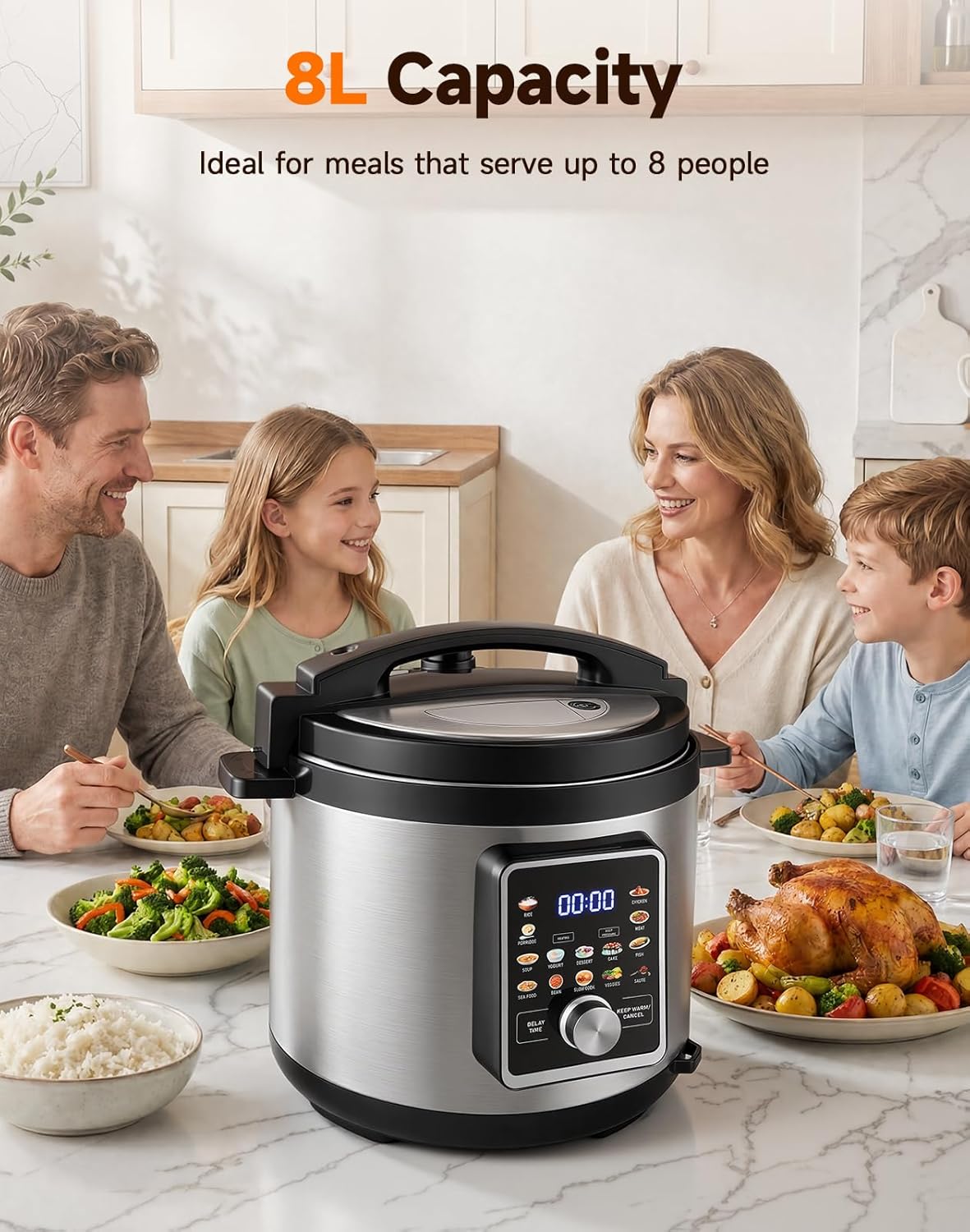
Design-wise, this cooker is pretty straightforward: silver stainless steel exterior, black plastic lid and base, and a central control panel with a simple display and icons. No fancy colours, no touchscreen, no app connectivity. It looks like what it is: a big electric pressure cooker. If you want something that looks stylish on the counter, this is more on the practical side than the pretty side.
The dimensions (about 33 x 33 x 35 cm) don’t sound huge on paper, but in a real kitchen it’s a chunky unit. On my counter it takes roughly the space of a stand mixer. If you’re used to a 5–6L cooker, this 8L definitely feels bulkier. The flip side is that you’re getting a genuinely large usable volume inside, so you can do big batches, a whole chicken, or a big piece of meat without wrestling it in.
The control panel is clear enough: you’ve got icons around the central display and simple buttons for time, start/stop, and adjustments. There’s also a rotary knob which makes scrolling through options and times quicker than spamming buttons, which I liked. The auto‑resume after a few seconds of inactivity is handy, but sometimes it jumps ahead before you’re done fiddling with the time, so you need to be a bit quick the first few times you use it.
The lid mechanism feels solid. The steam release valve is a simple lever you flick to vent pressure manually, which is fine, but it’s not the most refined system I’ve seen. When you quick‑release steam, it’s quite loud and you get a strong jet of steam straight up, so you really want it under an extractor or away from cupboards. Nothing unusual for a pressure cooker, but worth knowing. Overall, the design is functional and robust, just not compact or fancy.
Inner pot, coating and cleaning: what’s actually durable
The cooker body is stainless steel, which is pretty standard and feels sturdy enough. The inner pot is where it matters more. Here you get an 8L pot with a double‑layer painted / coated surface. It’s not bare stainless steel; it’s a non‑stick style coating. The brand says it’s food‑grade and dishwasher‑safe. I’ve mainly hand‑washed it but did run it through the dishwasher once to see how it held up.
In daily use, the coating behaves well. I did a tomato‑based beef stew that simmered for over an hour (with pressure) and nothing stuck badly. Rice also came out without a burnt layer at the bottom, as long as I used enough water and gave it a quick stir before starting. When I sauté onions and meat directly in the pot, bits do stick a little, but they come off easily with a soft sponge and a bit of soaking. I haven’t seen any scratches or peeling yet, but I’m also not attacking it with metal utensils.
The lid has a removable silicone ring, typical for pressure cookers. It seals fine and hasn’t absorbed strong smells yet, although with things like curry I expect some smell to linger over time (that’s normal for these). The steam valve and inner components are mostly plastic and metal; they don’t feel cheap, but also not premium. Just standard, functional parts. I appreciate that the pot and some accessories are dishwasher‑safe; after a long cooking session, dumping it in the dishwasher is convenient.
Long‑term durability is hard to judge after only a few weeks, but compared to cheaper no‑name multi cookers I’ve used, this one feels a bit more solid, especially the pot thickness and the exterior shell. If you treat the non‑stick surface normally – no metal spoons, no harsh scrubbing – I’d expect it to last a decent amount of time. If you want something you can really abuse with metal tools, a bare stainless inner pot would be safer, but you’d lose the easy cleaning.
Everyday handling, controls and learning curve
Using this cooker day to day is fairly straightforward, but it’s not completely idiot‑proof. The interface is simple enough: pick a mode, adjust time if needed, close lid, check the steam valve, and press start. After 5 seconds of not touching anything, it auto‑confirms and starts building pressure. The first two or three times I used it, I had to double‑check the manual to remember which icon meant what, but after that it was fine.
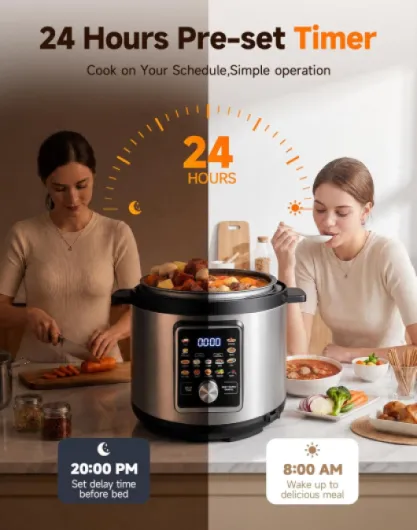
The delay start is handy for things like porridge or a stew you want ready when you get home. I tried it overnight for a porridge‑style oats dish: loaded it in the evening, set delay so it would start early morning, and it worked as expected. The keep‑warm function also does its job; it doesn’t dry food out massively if you leave it for an hour or so after cooking, although I wouldn’t leave rice sitting for many hours because it tends to get a bit clumpy.
Where it’s less plug‑and‑play is for people who have never used a pressure cooker. You still need to understand basic things: don’t overfill, always have enough liquid, make sure the valve is in the right position, be careful when venting steam, etc. The manual explains this but it’s not a full cooking course. There’s no recipe booklet, which I think is a shame for beginners. You either search online or experiment. I’m used to pressure cookers, so it wasn’t a big deal, but I can see some people being a bit lost at first.
Cleaning is easy: inner pot out, a quick soak if something stuck, soft sponge and it’s done. The fact it’s dishwasher‑safe is a plus when you’ve done a big batch. The lid needs a bit more attention: you occasionally remove the sealing ring and wash it, and wipe any condensation around the edge. Nothing complicated, just an extra step. Overall, once you’ve done 3–4 meals with it, it becomes a routine. Not stupidly complex, but also not “press one button and never think again”.
How it actually cooks: pressure, rice, slow cook and everyday use
Performance-wise, this cooker is pretty solid once you accept that it’s mainly a pressure cooker with extra modes. The 1300W power is enough to bring 4–5L of liquid up to pressure in roughly 10–15 minutes, depending on how full it is and the starting temperature. For example, my 8‑minute rice took about 5 minutes to pressurise, then 8 minutes cooking, then around 5 minutes for natural release before I could open. So the displayed time is only part of the total; you need to factor in the heat‑up and cool‑down phases.
For stews and meat, it does a good job. I cooked about 1.5 kg of beef chunks in a tomato and wine sauce: 35 minutes under pressure plus natural release, and the meat came out tender without falling apart into mush. A whole chicken (~1.8 kg) took 30 minutes under pressure and was fully cooked, moist, and good for shredding. Compared to doing the same on the hob or in the oven, you’re easily saving an hour or more, and you don’t need to babysit it.
The rice mode is usable but basic. It lets you set a time between 5 and 25 minutes, but it doesn’t ask you what type of rice or give you water ratios. You need to know your own rule of thumb. With standard long‑grain and basmati, I used roughly 1 cup rice to 1.3–1.4 cups water and 8–10 minutes, and it came out fine. Not restaurant-perfect, but totally acceptable for family meals. For more precise or fancy rice, my dedicated rice cooker still does a better job.
Slow cook and soup modes are also fine. I did a lentil soup on the soup preset and it was evenly cooked, no burnt bottom. The sauté function heats up quickly, so you can brown meat and onions directly in the pot before pressure cooking, which saves washing an extra pan. Overall, the cooker is strong on volume and time‑saving. It’s not ultra‑smart, but once you’ve done a couple of trial runs with your usual recipes, it becomes a practical tool that genuinely reduces active cooking time.
What you actually get and what it really does
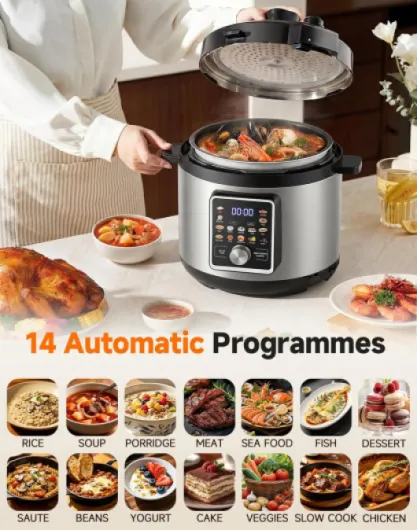
On paper, this KOMORE unit is a "14‑in‑1" multi cooker with an 8L capacity, 1300W power, stainless steel body and a coated inner pot that goes in the dishwasher. In reality, think of it as a large pressure cooker that can also do rice, slow cooking, sautéing, steaming and yogurt. The 14 modes are mostly presets for different types of dishes, not 14 completely different machines in one.
The front panel has icons for things like rice, soup, beans, porridge, cake, yogurt, vegetables, meat, fish, seafood, stir‑fry, slow stew, desserts etc. You choose an icon, it sets a default time, and you can tweak it with +/– buttons. There’s a 24‑hour delay start and a keep‑warm mode that kicks in after cooking. After a couple of uses, the interface becomes pretty straightforward, even if the icons aren’t always crystal clear at first glance.
In terms of what I’ve actually cooked: about 2 kg of chicken thighs in sauce (pressure mode), 1.5 kg brisket, 2 full loads of rice for 6–7 people, lentil soup, chickpeas from dry, and a big vegetable stew. For all of these, the 8L capacity is more than enough; you can feed a large family or cook for the week in one go. For a small household, it’s honestly overkill unless you’re heavily into batch cooking and freezing portions.
One important point: this is not a specialist rice cooker. There is a rice mode, but it doesn’t babysit you with water ratios or rice types. You still need to know roughly what you’re doing. Treated as a multi‑purpose pressure/slow cooker that also does decent rice, it makes more sense. If all you care about is perfect Japanese rice every time, I’d still say get a dedicated rice cooker and use this for everything else.
Pros
- Large 8L capacity is genuinely useful for families and batch cooking
- Cooks stews, soups and meat quickly and evenly with decent pressure performance
- Inner pot is non‑stick, dishwasher‑safe and easy to clean after most dishes
Cons
- Bulky appliance that takes up a lot of counter or cupboard space
- Rice mode is basic and doesn’t guide you on water ratios or rice types
- No real recipe booklet or detailed guidance, so beginners have to experiment
Conclusion
Editor's rating
Overall, the KOMORE 8L multi cooker is a solid, practical appliance if you need to cook large quantities without fussing over several pots. It shines as a big pressure/slow cooker that can handle family‑sized stews, soups, rice for 6–7 people, and batch cooking for the week. The 1300W power and 8L capacity are genuinely useful, the inner pot is easy to clean, and the basic presets cover most everyday dishes. It doesn’t feel flimsy and the controls are simple enough once you’ve used it a few times.
On the downside, it’s not a specialist rice cooker, despite what some titles suggest. The rice mode is basic, and you still need to know your own water ratios and times. There’s also a bit of a learning curve if you’ve never used a pressure cooker before, and the lack of a proper recipe booklet means you’ll be relying on trial and error or online recipes at the start. Plus, the size is a double‑edged sword: great for families, slightly ridiculous for a small kitchen.
If you’re a family of 4–7, someone who likes to batch cook, or you want one appliance to replace a slow cooker and a basic rice cooker, this is a good, no‑nonsense option. If you’re in a studio flat, cook small portions and mainly care about perfect rice or compact size, I’d skip this and look at a smaller, dedicated rice cooker instead.
![Ninja Foodi MAX Multi-Cooker [OP500UK], 9-in-1, 7.5L, Electric Pressure Cooker and Air Fryer & Non-Stick Loaf Tin, Cake Tin & Crisper Tray Bakeware Set MAX 9-in-1 Multi Cooker + Tray Bakeware Set](https://www.electric-pressure-cooker-guru.com/storage/1020382/conversions/71lZy-UXhUL._AC_SL1500_-medium.webp)