
Summary
Editor's rating
Not cheap, but can replace several appliances if you actually use it
Big, heavy, and clearly designed for right‑handed people
Easy enough to use, but bulky and not very left‑hand friendly
Build feels solid, non-stick is good but needs respect
Feels sturdy, but there are some reliability question marks
Cooks fast, crisps well, and mostly does what it promises
What you actually get and what it really does
Pros
- Very versatile: pressure cook, air fry, roast, slow cook and more in one unit
- Large 7.5L capacity suitable for families and batch cooking
- Cooks faster than the oven and can reduce energy use for everyday meals
Cons
- Bulky and heavy, needs permanent counter space and is awkward for small kitchens
- Hot basket/rack handles and left‑hand‑unfriendly lid design
- Potential reliability issues like pot sensor faults and not‑cheap accessories

Specifications
View full product page →| Brand | Ninja |
A big noisy pot that made my oven feel a bit useless
I’ve been using the Ninja Foodi MAX 7.5L for a while now, pretty much daily, and I’ll be blunt: it’s not perfect, it’s not small, but it’s very hard to go back to cooking without it. I bought it mainly as an air fryer upgrade, then realised the pressure-cook + air-crisp combo is where it really shines. Whole chickens, stews, and quick weekday meals are where this thing earns its spot on the counter.
My kitchen isn’t huge, so at first I honestly thought I’d end up storing it in a cupboard and only dragging it out occasionally. That didn’t happen. It just lives on the worktop now, because it saves me time and keeps the oven off most days. If you’re expecting a compact gadget, forget it. This is more like adding a small extra appliance, almost like a mini-oven with a lid, not a cute little fryer.
I’ve mostly used it for pressure cooking + crisping meat, air frying potatoes and veg, and doing one-pot pasta and rice dishes. I also tried yoghurt and dehydrating, more to see if they actually work than because I needed them. Some modes I’ll use a lot, some are more of a bonus, but overall the unit does what it says. The main surprise for me is how consistent the results are once you get your timings sorted.
If you’re the type who hates learning new gadgets, there is a small learning curve, especially with pressure cooking and the different lids. But after a few tries it becomes fairly automatic. For me, the big question was: is it just a bulky toy, or does it actually replace the oven, slow cooker and air fryer? In my case, it really has reduced how often I use all three, which is why I’m pretty positive about it despite a few annoying details.
Not cheap, but can replace several appliances if you actually use it
Price-wise, the Ninja Foodi MAX 7.5L sits in the higher bracket compared with basic air fryers and simple pressure cookers. You’re paying for the big capacity, the multiple functions, and the brand name. On its own, the price stings a bit, but when I compare it to owning a separate air fryer, slow cooker, pressure cooker, and maybe a small countertop oven, it starts to look more reasonable. The key question is whether you’ll actually use most of what it offers or just treat it as a glorified chip maker.
In my case, it’s good value because it’s on several times a week and my main oven is used a lot less. It heats faster, uses less energy than firing up a full-size oven for small to medium meals, and it cuts down on washing up. For a family of 3–5, it makes sense. For a single person who only cooks occasionally, it might be overkill and you’d probably be fine with a smaller, cheaper air fryer and a basic pan.
One thing to factor into the value is accessories and potential replacements. A spare pot is handy if you want to cook multiple dishes back to back, but it’s around £30 and not always in stock. Same for racks and extra bits. Also, if something like the sensor fails after the warranty, repairs may not be worth it, which is the downside of these all-in-one machines. So the value is good as long as you get heavy use out of it during those first few years.
Overall, I’d say it’s pretty solid value for people who cook a lot at home and want to save time and energy. If you’re just curious about air frying, this is probably too much. But if you’re replacing an old air fryer and also thinking about getting a pressure cooker or slow cooker, then combining everything into this one unit makes more financial sense than buying three separate gadgets.
Big, heavy, and clearly designed for right‑handed people
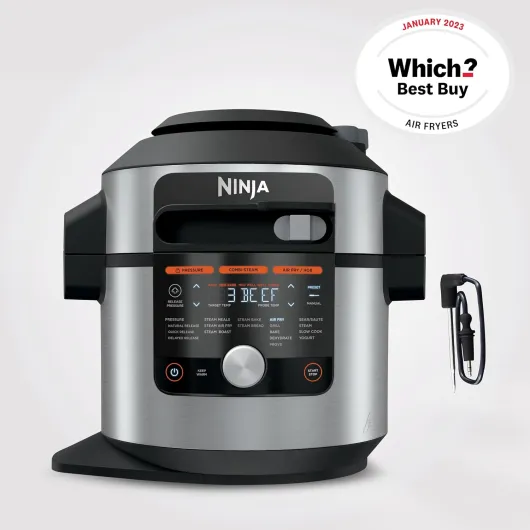
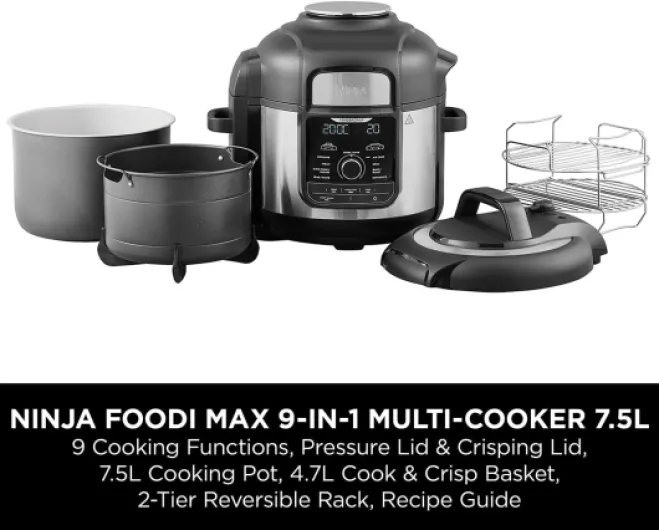
Physically, this thing is a unit. Roughly 35D x 42W x 38H cm and over 11kg – it’s not something you casually move around every day. I tried storing it away after the first week and quickly gave up. If you buy this, plan for it to live on a countertop. On the plus side, for its size, it doesn’t feel cheap. The brushed steel and black plastic combo looks fine, nothing flashy, but it feels solid enough that I’m not worried about the lid snapping off or the handle breaking.
The hinged air-crisp lid is permanently attached, which is both handy and slightly annoying. Handy, because you never lose it and you can just flip it up and down. Annoying, because it takes extra vertical space and the unit is clearly laid out for right-handed use. The lid opens to the left, so if you’re left-handed or your kitchen layout is weird, you might find yourself twisting around it. I got used to it, but I can see why left-handed users complain.
The pressure lid is separate and locks on easily once you understand the markings. The pressure valve itself feels a bit loose when you switch between vent and seal, which at first made me think it was broken, but it’s just how it’s built. Once pressure builds, it does seal properly. The handles on the basket and rack are a weak point though: they get hot. You absolutely need oven gloves or small silicone mitts to pull things out comfortably. If you’re thinking you’ll just grab it bare-handed, forget it.
One good design point: it vents hot air upwards and a bit to the back, not straight at your face or cabinets. The outer shell gets warm but not scary hot, so I’m not worried about kids brushing past it. It’s still a big noisy box on the counter, but functionally the layout makes sense. Buttons are clear, the screen is readable, and you don’t need to be techy to figure it out. Just don’t buy it expecting a neat little cube; it’s more like a compact oven with a lid stuck on top.
Easy enough to use, but bulky and not very left‑hand friendly
From a usability point of view, it’s a mix of very practical and slightly annoying. On the practical side, the interface is clear: you select the function, set time and temperature with the dial, and press start. Switching from pressure cook to air crisp is just a matter of releasing pressure, removing the pressure lid, and closing the crisping lid. After a few runs, it becomes automatic, and I barely look at the manual anymore.
The annoying bits are mainly physical. The unit is heavy, so if you don’t have permanent counter space, getting it in and out of a cupboard will get old quickly. The hinged lid opens to the left, which is fine if you’re right-handed and the unit is on your right side, but awkward if you’re left-handed or stuck in a corner. I’m right-handed and even I sometimes find myself reaching around the lid in tight spaces. It’s not a deal-breaker, but it’s something to think about.
Another comfort issue: the basket and rack handles get hot. You absolutely need mitts or silicone pinch gloves to pull hot baskets out. Ninja could have done better with insulated handles. Also, the interior stays very hot for a while after cooking, so if you want to do back-to-back dishes, you need to be careful not to burn yourself reaching in. I use silicone tongs most of the time to avoid contact with the hot walls and to protect the non-stick.
Day to day, the biggest comfort benefit is the one-pot aspect. I can sauté onions, pressure cook a stew, and then keep it on keep-warm without dirtying three different pans. Less washing up, less moving food around. For families or anyone who cooks a lot after work, that’s the main selling point for me. It’s still a big chunk of kit on the counter, but once you get used to how it operates, it’s pretty straightforward and doesn’t feel fiddly.
Build feels solid, non-stick is good but needs respect
The main body is alloy steel with plastic trim, and it feels sturdy enough to survive daily use. I’ve moved it around a few times and nothing creaks or feels flimsy. The inner 7.5L pot has a thick base with a non-stick coating that reminds me of decent mid-range non-stick pans. It heats evenly and I haven’t had any sticking issues as long as I use a bit of oil and don’t burn food to death. I’m careful with metal tools though; I stick to silicone and wood to avoid scratching.
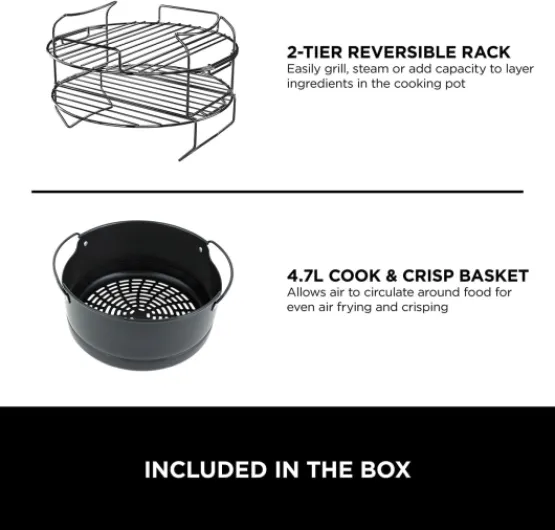
The Cook & Crisp basket is metal with a coating as well, and it lets air circulate nicely around chips and veg. Again, use silicone or plastic tongs, not sharp metal, or you’ll mark it. The reversible rack is basic but fine. It’s not fancy stainless-steel restaurant gear, but it gets the job done. I wouldn’t overload it with something ridiculously heavy, but for chicken, veg, and a bit of layering, it holds up well.
One thing that’s a bit confusing is the whole dishwasher-safe claim. The spec sheet says “dishwasher safe parts”, but also “Is the item dishwasher safe? No.” In practice, the inner pot and basket are officially dishwasher-safe, but I mostly wash them by hand to protect the coating. Food usually comes off easily anyway. The lids and main body obviously are hand-wash only (well, wipe-down only for the body). The rubber sealing ring on the pressure lid feels solid, similar to what you get on standalone pressure cookers, and so far it hasn’t warped.
Overall, the materials feel pretty solid for the price. It’s not luxury cookware, but it’s not flimsy budget stuff either. If you treat the non-stick with a bit of care and don’t attack it with steel wool, I’d expect it to last a few years without drama. My only real complaint is that spare pots and accessories are often out of stock or not cheap, so if you want a second pot to swap mid-cook, factor that into the total cost.
Feels sturdy, but there are some reliability question marks
Build-wise, the Foodi MAX feels like it’s meant to last a few years at least. The hinges are solid, the lid mechanism doesn’t feel like it will snap off easily, and the buttons haven’t gone mushy with use. The non-stick pot still looks good on mine with regular, careful use. I avoid metal tools and harsh sponges, and so far no peeling or obvious damage.
That said, looking at other user feedback, there are a few recurring issues. One is the pot detection sensor failing, where the machine thinks the pot isn’t in even when it is, and then refuses to start. That’s not something you can fix yourself easily. Another is the usual non-stick wear if people use metal tongs or scrub too hard. To be fair, that’s the case with most non-stick cookware, but it’s worth mentioning because replacements aren’t the cheapest and are sometimes out of stock.
The good point is that Ninja’s customer service seems responsive. People report getting video calls to diagnose issues and then being offered replacements or refunds if the unit is faulty within warranty. The model I have comes with a 1-year manufacturer warranty by default, and you can extend it to 2 years by registering in the UK/ROI. For a product in this price range that’s used almost daily, I’d definitely register it and keep the box for at least the first year in case you need to send it back.
In my case, I haven’t had failures yet, but I’m aware it’s an appliance with a lot of electronics, heat, and moving parts, so it’s never going to be indestructible. If you want something that will last 20 years like a cast-iron pot, this isn’t that. But if you treat it reasonably and you’re covered by warranty, I think the durability is acceptable for what it is. Just don’t abuse the non-stick and don’t expect zero issues ever, especially with heavy daily use.
Cooks fast, crisps well, and mostly does what it promises
In terms of performance, this is where the Foodi makes sense. The 1760W power and pressure cooking combo actually save time. A whole chicken that would take 1.5–2 hours in my oven is done in about an hour here, including crisping. I usually pressure cook for 25–30 minutes, then switch to air crisp for 10–15 minutes to get the skin golden. Same story with pork shoulder or beef joints: pressure first to get it tender, then finish under the crisping lid. The meat comes out soft and the outside has a decent crunch.
The air fry (Air Crisp) mode works well. Chips, roast potatoes, and frozen snacks come out properly crispy if you don’t overload the basket and you shake things halfway. Compared with my old cheap air fryer, this one is faster and more even. You can easily do sides for 4–5 people in one go. For veg, a bit of oil spray and 10–15 minutes usually gives you nice roasted peppers, courgettes, etc. The grill function is basically a stronger top heat; I use it to finish off cheese toppings or brown things quickly.
Pressure cooking is straightforward once you get your timings right. Stews that used to take 2 hours on the hob are done in 30–40 minutes including preheat. Rice dishes and pasta bakes also work well, as long as you follow liquid guidelines. The slow cook mode is decent but not mind-blowing; it does the same job as a regular slow cooker, just in the same pot. Yoghurt works, but you need to be patient and follow a recipe properly. Dehydrating is okay for small batches of croutons or fruit, but the capacity isn’t huge for that, so don’t expect industrial-level drying.
Noise-wise, it’s not quiet. The fan during air fry and the steam release during pressure cooking are noticeable. It’s not unbearable, but you’ll hear it. Preheating is fairly quick, and I like that it doesn’t blast hot air into the room as much as using the oven. Overall, in daily life, I trust it for most things now. It cooks evenly, doesn’t burn edges as easily as my old oven, and once you note down your favourite settings, it’s pretty consistent.
What you actually get and what it really does
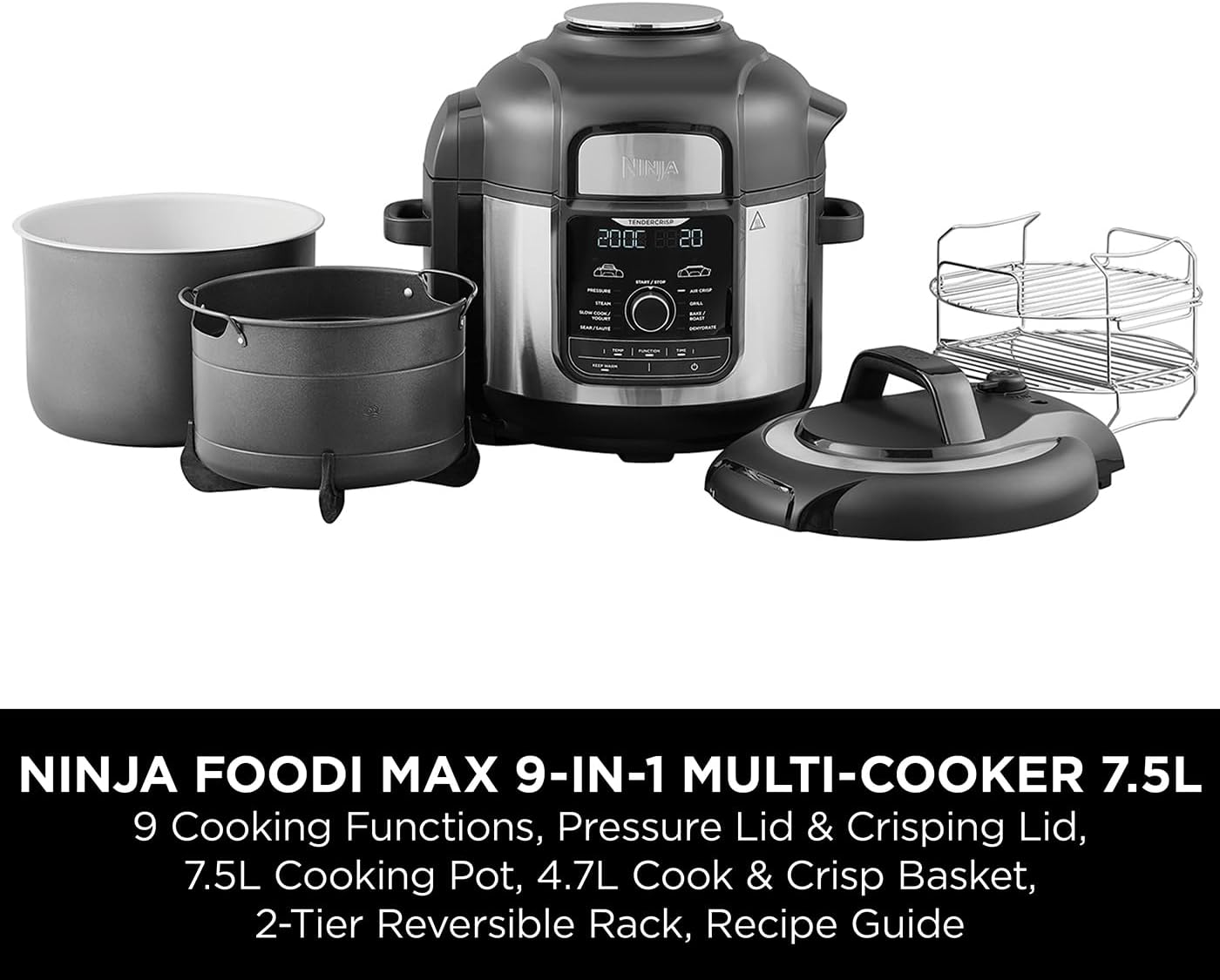
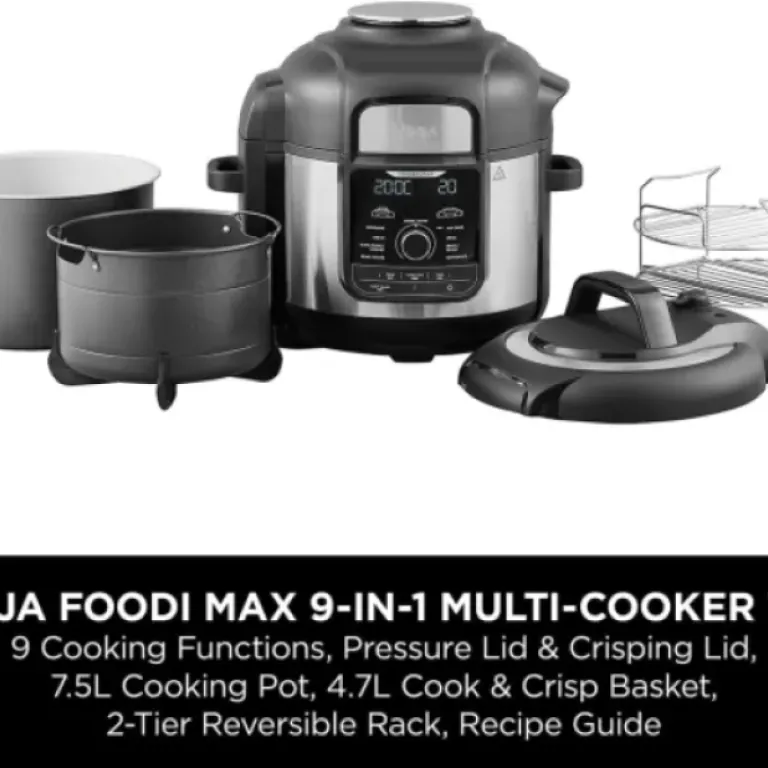
The version I have is the 7.5L MAX model (OP500UK), so it’s the larger one that claims to feed up to 6 people. In the box you get the main unit with the hinged crisping lid, the separate pressure lid, a 7.5L non-stick cooking pot, a 4.7L Cook & Crisp basket, and a two-piece reversible rack. There’s also a small recipe booklet that’s basic but handy for first attempts. No fancy accessories beyond that, so if you want extra racks or spare pots, that’s extra cost.
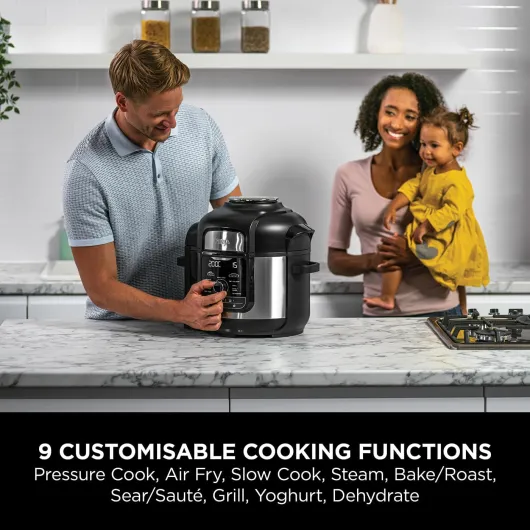
On paper it has 9 functions: Pressure Cook, Air Fry (Air Crisp), Slow Cook, Steam, Bake/Roast, Sear/Sauté, Grill, Yoghurt and Dehydrate. In practice, I’d say I regularly use 5–6 of those. The pressure cook + air crisp combo is what sells it. You can cook a 3kg chicken in under an hour, then crisp the skin without moving it to a different tray. Same for pork shoulder: pressure first for tenderness, then lid swap to crisp the outside. It’s straightforward and saves washing extra pans.
The control panel is simple enough: push buttons and a dial, with time and temperature controls. It’s not a smart device, no app, no Wi‑Fi nonsense, which I actually prefer. Everything is manual, so you have to remember your favourite timings or note them somewhere. The instructions are clear enough, but you still need a couple of evenings of testing to really feel confident, especially if you’re new to pressure cooking.
In daily use, the Foodi ends up acting like a small oven, a pressure cooker and a frying pan replacement. I do chips, roast potatoes, chicken thighs, veg, frozen snacks, and full meals in it. It’s not magic, you can still overcook or dry things out if you push it too long, but once you learn how it behaves, it’s pretty reliable. If you’re expecting every single function to be perfect, that’s not the case. Some modes (like dehydrate) feel more like a bonus rather than a serious dedicated machine, but they still work if you’re not too demanding.
Pros
- Very versatile: pressure cook, air fry, roast, slow cook and more in one unit
- Large 7.5L capacity suitable for families and batch cooking
- Cooks faster than the oven and can reduce energy use for everyday meals
Cons
- Bulky and heavy, needs permanent counter space and is awkward for small kitchens
- Hot basket/rack handles and left‑hand‑unfriendly lid design
- Potential reliability issues like pot sensor faults and not‑cheap accessories
Conclusion
Editor's rating
The Ninja Foodi MAX 7.5L is a big, practical workhorse rather than a cute gadget. It cooks fast, handles large portions, and genuinely can take over from your oven, air fryer and slow cooker for a lot of everyday meals. The pressure cook + crisp combo is the main selling point: whole chickens, joints of meat and stews come out tender inside with a decent crust on the outside, and you only use one pot. If you actually use the different modes, it earns its price.
On the downside, it’s heavy, takes up a lot of space, and isn’t the friendliest layout if you’re left-handed or short on counter room. The basket handles get hot, the non-stick needs a bit of care, and there are some reports of sensor failures, so the warranty and customer service matter. It’s not the right choice if you just want to reheat chips twice a week or live in a tiny kitchen with no spare surface.
I’d recommend it to families, people who batch cook, and anyone who likes cooking but wants to cut down on time and energy use. If you’re replacing a worn-out air fryer and also thinking about a pressure cooker, this hits both needs in one go. If you’re a light user or on a tighter budget, a simpler air fryer plus a regular pot on the hob will still get the job done without taking over your countertop.