
Summary
Editor's rating
Value: expensive, but makes sense if you cook rice a lot
Design: compact enough, but the housing scratches easily
Materials and build: solid where it counts, cheaper where you see it
Durability: great track record, with some cosmetic compromises
Daily performance: slow but reliable, with some noise
What you actually get out of the box
Effectiveness: rice quality and keep-warm are the real strengths
Pros
- Consistently well-cooked rice across different types, especially brown and jasmine
- Keep-warm function keeps rice usable for many hours without drying out
- Solid inner pot and inner lid build, easy to clean and likely to last
- Lots of useful programs for rice, oats, congee, and other grains
Cons
- Very expensive compared to basic rice cookers
- Plastic housing scratches easily and feels less premium than the price suggests
- Slightly noisy fan during cooking and no retractable power cord
- Steamer basket is mediocre and not a real replacement for a dedicated steamer

Specifications
View full product page →| Brand | ZOJIRUSHI |
A very expensive rice cooker I actually kept
I’ve been using the Zojirushi NW-QAC18 at home for about a month, a few times a week, mostly for white rice, jasmine, and steel-cut oats. Before this, I had a basic cheap rice cooker and sometimes used a pot on the stove. So I didn’t buy this on a whim – the price hurt, and I was ready to return it if it felt like just a fancy timer with a bowl.
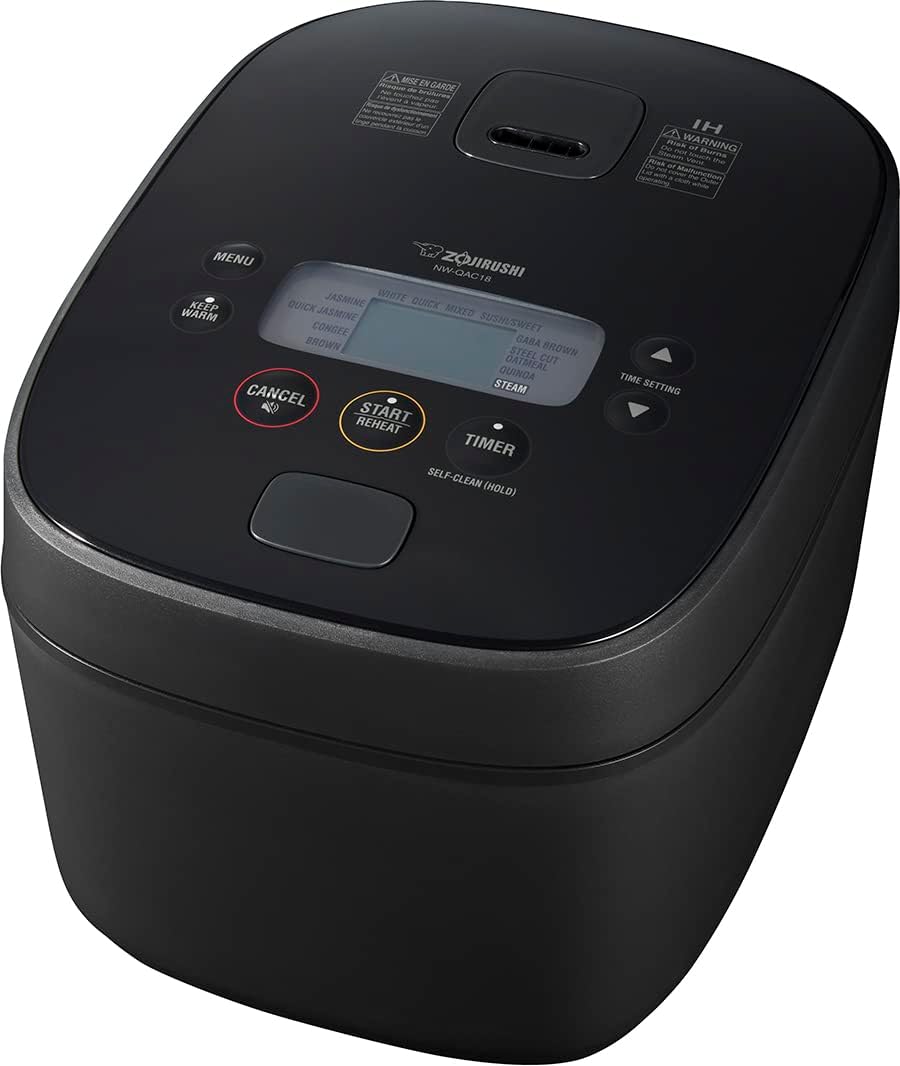
In practice, this thing is closer to a small rice “appliance” than a simple cooker. It’s induction, it uses pressure, and there are a ton of modes: white, quick white, mixed, sushi, jasmine, congee, brown, GABA brown, quinoa, steel-cut oatmeal, steam, etc. At first it feels like overkill, but if you actually cook rice often, you end up using more of those modes than you’d think. I was pretty skeptical about all the marketing talk (AI, premium convection, whatever), so I focused on two simple questions: does the rice come out better than my old cooker, and is it easy to live with?
Short answer: the rice is clearly better, especially for brown and jasmine, and the keep-warm is way ahead of the cheap cookers I’ve used. The trade-offs are the price, the slightly louder operation, and a body that scratches easier than I’d like for this budget. It’s not magic, but it’s genuinely a step up from entry-level and mid-range cookers I’ve tried at friends’ places.
If you cook rice once every couple of weeks, this is probably overkill. If you cook rice several times a week and actually care about texture and convenience, then it starts to make sense, even if the price still stings. That’s basically where I landed after a month: expensive, not perfect, but it earns its spot on the counter.
Value: expensive, but makes sense if you cook rice a lot
Let’s be blunt: this rice cooker is not cheap. You can easily find rice cookers for a fraction of the price that will cook rice “fine”. So the question is really whether the extra money buys you something tangible or if you’re just paying for a fancy brand name. After using it regularly, I’d say you’re mostly paying for three things: consistency, versatility, and long-term reliability.
On consistency, the difference is clear. If you cook rice once in a while, a cheaper cooker might be enough. But if you cook multiple times per week and you’re tired of random mushy or dry results, this one starts to justify its cost. The brown and GABA brown modes alone might be worth it if you’re trying to eat healthier but hate badly cooked brown rice. The steel-cut oats mode is also genuinely handy – throw it in at night or early morning, and you get proper oats without babysitting a pot.
On versatility, I wouldn’t buy it as a steamer – the included steamer basket is honestly just “meh” and a regular pot with a steamer insert does the job just as well or better. But if you like having one appliance that handles different grains (quinoa, congee, oats, several rice types) with presets that actually work, then it starts feeling more like a small grain cooker station than a single-use tool.
In terms of long-term value, Zojirushi units tend to last years, so the cost spreads out over time. If you keep this for 8–10 years, the yearly cost is not crazy, especially if it replaces eating out or instant sides. Still, if you’re on a tight budget or only eat rice occasionally, there are cheaper options that get the job done. I’d say the NW-QAC18 is good value for heavy users who care about texture and convenience, and poor value if you’re just looking for “rice that’s not raw” once in a while.
Design: compact enough, but the housing scratches easily
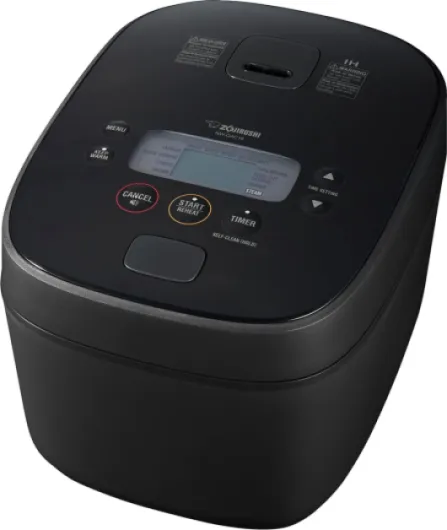
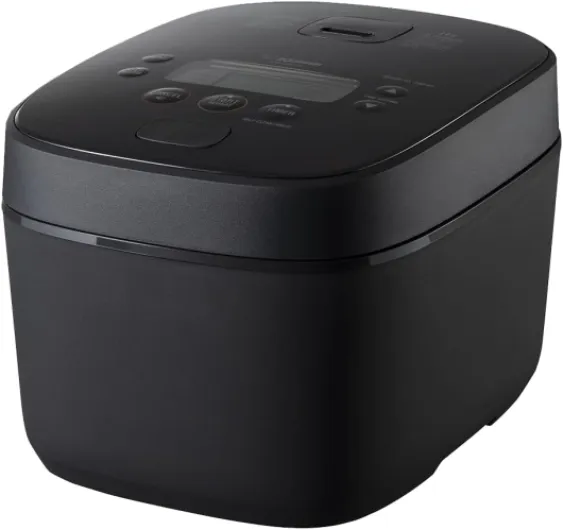
Design-wise, the NW-QAC18 is pretty sober: black body, curved top lid, and a front-mounted control panel. It’s not ugly, but it’s also not something you’ll stare at for fun. It looks like a serious appliance, which I actually prefer over shiny chrome that fingerprints instantly. The footprint is fairly compact for a 10-cup machine, and the height is low enough to open the lid under upper cabinets, which is practical in a small kitchen.
The main thing that stood out to me is the housing material. It’s a kind of polycarbonate/plastic shell, not stainless steel. That’s nice for weight and it’s easy to wipe down, but it does scratch faster than I expected at this price. Just sliding it a bit under a cabinet or brushing it with another appliance left some light marks. It doesn’t affect performance, but visually it feels a bit cheap for the money. Compared to older Zojirushi units I’ve seen in friends’ homes (stainless or thick plastic), this one looks more modern but feels less tough on the outside.
The lid has a detachable stainless steel inner lid, which is easy to pop off and wash. That’s good because rice steam can get gross over time if you don’t clean it regularly. The vent is built-in and you don’t have a separate removable cap like on some older models, which means fewer parts to lose and clean. On the flip side, the cooker is a bit noisier while cooking, with air being sucked in from the back and pushed out the front. It’s not outrageous, but you do hear it in a quiet kitchen.
Little design choices: the detachable power cord is practical for storing the unit, but I would have preferred a retractable cord like on some older Zojirushis. For a premium price, that feels like a downgrade. The control labels are clear, and the screen is easy to read from across the kitchen. So overall: design is functional, compact for the capacity, but the outer shell’s scratch-prone nature is the weak point.
Materials and build: solid where it counts, cheaper where you see it
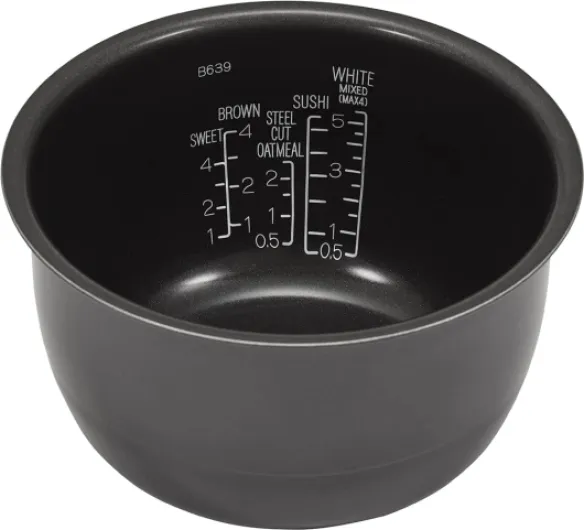
The parts that actually touch food and heat are where Zojirushi clearly spent the money. The inner pot is iron-coated and platinum-infused with a nonstick surface that feels thicker and more robust than regular nonstick. It has clear water lines for different types of rice and grains, and after repeated use, I didn’t see any peeling or early wear. I’m careful with it (no metal utensils, wash rice in a separate bowl), but it still feels sturdier than average. Several long-time users also mention that this generation’s pan holds up better than older models, which is reassuring.
The inner lid is stainless steel and fully removable, which is a big plus. You just pop it out, rinse it, wipe it, and put it back. The gasket around it feels solid and seals well. No weird smells or trapped water once you get into the habit of drying it properly. Inside the cooking chamber, the metal surfaces feel thick and well insulated. The exterior stays cool-touch, so you can bump into it while it’s running without burning yourself.
On the outside, as mentioned, the plastic/polycarbonate housing is where it feels a bit cheaper. It’s light, which is nice for moving the cooker, but it gives off more of a mid-range vibe than a high-end one. It scratches faster than I’d like, and after a year (based on other users’ feedback), it apparently shows cosmetic wear even if performance stays strong. So: strong build where heat and pressure are involved, slightly cost-cut feel where your eyes and hands interact most.
The accessories are basic but fine. The steaming tray and basket are usable but nothing special; they feel more like a bonus than a reason to buy the cooker. The rice paddle and spatula are lightweight but do their job and don’t scratch the pot. Overall, materials are clearly optimized for durability inside the machine and safety, with some compromises on the outer shell and accessories to presumably keep costs from going even higher.
Durability: great track record, with some cosmetic compromises
I obviously haven’t owned this specific unit for ten years, but Zojirushi as a brand has a long track record in my family and among friends. People are still using 10+ year old Zojirushi rice cookers that work fine, just looking a bit tired. Based on that, and on what I see here, I expect the NW-QAC18 to last a long time mechanically, even if the outside starts to look worn earlier than I’d like.
The inner pot feels like the most important part for durability, and here it’s solid. The coating is thicker, doesn’t feel flimsy, and other users report it holds up better than older pans that used to scratch and lose nonstick faster. If you treat it reasonably (no metal, no scrubbing with harsh pads, rinse rice in a separate bowl), it should last several years without drama. The inner lid and gasket also feel sturdy and easy to clean, which helps avoid build-up that can cause smells or affect sealing over time.
The weak point is cosmetic durability. The plastic housing scratches, and while that doesn’t change how it cooks, it does make the unit look older faster. One long-term user mentioned that the plastic is easy to clean but marks up quickly, especially compared to older hard plastic or stainless shells. If you’re picky about your appliances staying pristine, this will annoy you. If you only care about function, you’ll probably shrug and move on.
There is also a small internal backup battery that keeps the clock and timer settings when unplugged. On this model, the battery is not user-replaceable; you’d need service to change it. When it eventually dies, the cooker still works fine when plugged in, you just lose clock memory. To extend battery life, you can keep the unit unplugged when not in use, but honestly I don’t see that as a huge deal. In short: I trust this thing to work for many years, with the expectation that it will age visually faster than it fails mechanically.
Daily performance: slow but reliable, with some noise
On day-to-day performance, the NW-QAC18 is basically a “set it and forget it” device, as long as you accept that it takes its time. The induction and pressure system seems to manage heat very precisely, so you don’t have to babysit anything. You put in rice, rinse (ideally in another bowl), fill to the right line, choose the program, and walk away. It handles 1 cup just as well as a big batch, which is nice if you cook for one or two people but sometimes host more.
Cooking times depend on the mode, but in general, the regular cycles are on the slower side compared to cheaper cookers. That’s not a bug; it’s how it gets the texture right. If I know I want rice for dinner, I just start it earlier or use the timer. The timer function is simple to use and hasn’t failed me yet – I’ve set rice in the morning to be ready for lunch or dinner and it was ready right on time, still hot and not overcooked.
Noise-wise, it’s not silent. You can hear the fan pulling air from the back and pushing it out the front, especially during heating and near the end of the cycle. It’s not vacuum-cleaner loud, more like a small fan or a microwave with a strong vent. In a small quiet apartment you’ll notice it, but it’s not unbearable. If you were used to older, quieter Zojirushi models, you might be a bit surprised by the extra noise, but I wouldn’t call it a deal-breaker.
The self-cleaning function is a nice touch. You run it every now and then with some water and it helps clear out odors and steam residue. It doesn’t replace actual wiping and washing the lid and pot, but it does help keep that “old rice cooker smell” from building up. Overall, from a performance standpoint, it’s stable, predictable, and clearly designed for people who cook rice regularly and want consistent results more than raw speed.
What you actually get out of the box
Out of the box, the NW-QAC18 is a 10-cup (uncooked) induction rice cooker with pressure and a bunch of automatic programs. It’s made in Japan, runs at 120V with 1310W, and the footprint is about 34 x 26.4 x 22.9 cm. In real life, it’s not as huge as I feared for a 10-cup model, but it’s still a decent block of gear on the counter. It’s more of a semi-permanent appliance than something you’ll constantly move in and out of a cupboard.
In terms of accessories, you get the iron-coated, platinum-infused nonstick inner pot (fancy name, but it does feel thicker and more solid than cheap pots), a steaming tray, steamer basket, measuring cup, rice paddle, and a self-standing spatula. The manual is actually useful, especially for water lines and cooking times, and you do need it at first because of the number of modes. The cord is detachable (not retractable), which is a bit annoying for storage but fine in daily use.
The control panel is pretty straightforward once you’ve done two or three cooks. There’s a clear LCD screen, menu buttons, timer, and start/cancel. No nonsense touch panel or app stuff, just physical buttons that actually respond. The cooker also has a self-cleaning cycle using steam, which I ran once at the start to get rid of the plastic/new smell – it worked fairly well, and I haven’t had any weird lingering odors since.
Overall the product feels like a serious kitchen tool, not a toy. It’s not flashy, it’s not meant to impress anyone visually, but it’s clearly built around cooking performance and lots of modes. Whether all those modes matter to you is another story, but at least they’re there and do what they say.
Effectiveness: rice quality and keep-warm are the real strengths
On effectiveness, this is where the NW-QAC18 actually justifies its existence. The core point: the rice is consistently very well cooked, and not just white rice. I’ve done standard long-grain, jasmine, sushi rice, brown rice, and steel-cut oats. Every time, the texture was even from top to bottom, no wet soggy layer at the bottom and no dry crust up top like with cheaper cookers. For white and jasmine, the grains come out separate but still soft, not chalky or mushy. For sushi mode, the rice is slightly stickier and works well for rolls or bowls.
Where I really noticed a difference was brown and GABA brown rice. I usually hate brown rice because it often ends up hard in the center or weirdly gummy. In this cooker, it’s firm but not hard, and actually pleasant to eat. I found myself eating brown rice more often simply because it wasn’t a punishment anymore. That lines up with other users saying they basically switched from white to brown after getting this model. It does take longer to cook than white, but the result is much more reliable than what I’ve seen from basic cookers.
The keep-warm function is also strong. The standard keep-warm is meant for about 12 hours, but in reality the rice stays decent for much longer. I tried leaving white rice in there for around 24 hours just to see, and it was still moist and totally fine to eat, not dried out or crusty. Other users even push it to two days. I wouldn’t do that regularly, but if you cook once a day and eat from the pot several times, it’s very practical. No water dripping from the lid and no nasty condensation issues either, thanks to the venting system.
The main downside is time. This cooker prioritizes quality over speed. The regular white rice cycle is not fast compared to a cheap on/off cooker or a quick boil on the stove. There is a quick cook mode, but even then it’s not instant. If you’re the type who decides to make rice at the last minute, you’ll have to adjust and start it earlier. For me, the trade-off is worth it: better texture, more reliable results, and rice that actually keeps well for hours.
Pros
- Consistently well-cooked rice across different types, especially brown and jasmine
- Keep-warm function keeps rice usable for many hours without drying out
- Solid inner pot and inner lid build, easy to clean and likely to last
- Lots of useful programs for rice, oats, congee, and other grains
Cons
- Very expensive compared to basic rice cookers
- Plastic housing scratches easily and feels less premium than the price suggests
- Slightly noisy fan during cooking and no retractable power cord
- Steamer basket is mediocre and not a real replacement for a dedicated steamer
Conclusion
Editor's rating
The Zojirushi NW-QAC18 is a serious rice cooker for people who actually use one often. It’s not about flashy design or gimmicks; it’s about very consistent cooking, especially for white, jasmine, and brown rice, plus a keep-warm function that keeps rice usable for a long time without drying it out. It also handles steel-cut oats and other grains well, which makes it more versatile than a basic on/off cooker. If you’re willing to plan ahead a bit and accept that it cooks slower to get better texture, it’s a pretty solid daily tool.
It’s not perfect. The housing scratches easier than it should at this price, the unit is a bit louder than older models, the steamer basket is nothing special, and there’s no retractable cord. The internal backup battery not being user-replaceable is also slightly annoying, even if it doesn’t stop the cooker from working. But the core – the pot, the heating system, the programs – feels reliable and well thought out. Zojirushi’s history with long-lasting cookers also helps justify the investment if you plan to keep it for years.
I’d recommend this to anyone who eats rice or grains multiple times a week, cares about texture, and wants something they can trust to just work for a long time. If you’re a casual rice eater or on a tight budget, you’re better off with a simpler, cheaper cooker. For regular use in a household that actually lives on rice, the NW-QAC18 is expensive but sensible, and it gets the job done very well where it counts: in the bowl.
![Ninja Foodi MAX Multi-Cooker [OP500UK], 9-in-1, 7.5L, Electric Pressure Cooker and Air Fryer & Non-Stick Loaf Tin, Cake Tin & Crisper Tray Bakeware Set MAX 9-in-1 Multi Cooker + Tray Bakeware Set](https://www.electric-pressure-cooker-guru.com/storage/1020382/conversions/71lZy-UXhUL._AC_SL1500_-medium.webp)