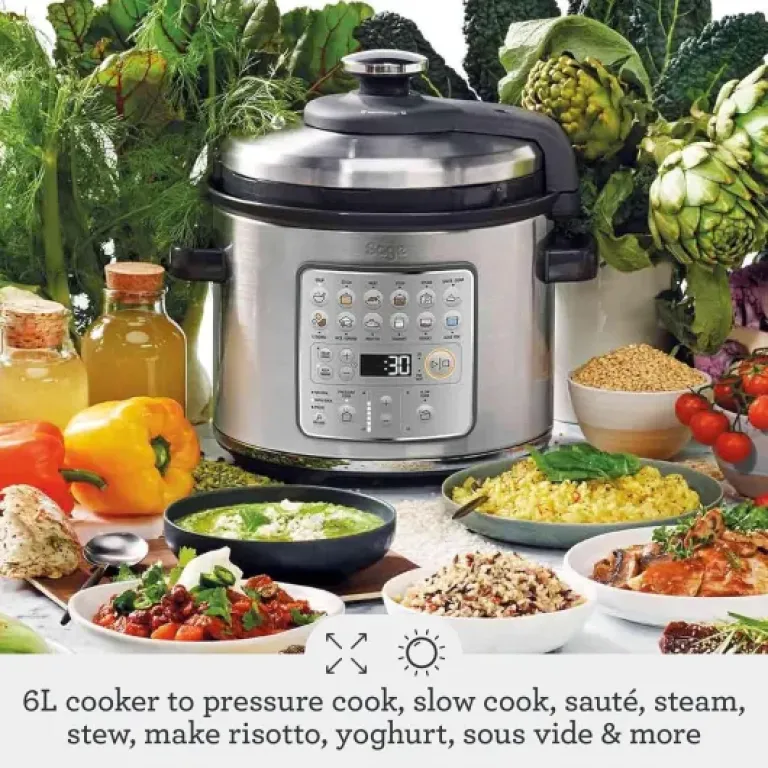

Summary
Editor's rating
Is it worth the money, or are you paying for buttons you won’t use?
Big, stainless, and not exactly subtle
Stainless steel bowl: better than non-stick, but not perfect
Built solid, but some doubts from other users
Cooking performance: good results, with a bit of trial and error
What this thing actually does in real life
Does it actually simplify cooking, or just add buttons?
Pros
- Replaces several appliances (pressure cooker, slow cooker, rice cooker, steamer) in one 6L stainless pot
- Hands-free steam release and safety system make pressure cooking less stressful and easier to control
- Stainless steel bowl and trivet are durable and dishwasher safe, no non-stick coating to scratch or peel
Cons
- Bulky and fairly heavy, needs permanent counter space and good vertical clearance for the lid
- Learning curve with presets and timings; first few dishes may need trial and error
- Pricey if you only need basic slow cooking or already own similar appliances; some doubts about long-term reliability from user reviews

Specifications
View full product page →| Brand | Sage |
A multi-cooker for people who don’t want 5 different gadgets
I’ve been using the Sage Fast Slow GO 6L for a few weeks, mostly to replace three things crowding my counter: a basic slow cooker, a cheap pressure cooker and a rice cooker that was on its last legs. I cook most evenings, but I’m not a pro chef, just someone who wants dinner on the table without hovering over the stove for an hour. So I went into this looking for something practical, not some fancy toy I’d use twice and forget.
First impression: it’s a fairly big unit, and it looks like a serious bit of kit. This isn’t a cute little appliance you tuck in a corner; you need space for it. I mainly tried it for stews, chilli, rice, steaming veg and one attempt at yoghurt. I didn’t go crazy with sous vide, just a couple of chicken breasts to see if it actually worked.
What stood out pretty quickly is that it’s versatile and fairly easy to drive once you’ve done two or three meals. The presets are actually useful; they’re not perfect, but you’re not spending ten minutes programming every time. On the other hand, it’s still a multi-cooker: there’s a learning curve, and if you want instant plug-and-play with zero thought, this isn’t magic. You’ll need a bit of trial and error with timings and liquid amounts.
Overall, my feeling after these weeks is: it’s a pretty solid all‑rounder, not cheap, not perfect, but it does replace several appliances and the food comes out good. The big question is whether you’ll actually use the extra modes (yoghurt, sous vide, etc.) enough to justify the price. If you just want to slow cook once a month, there are cheaper options that will do the job just as well.
Is it worth the money, or are you paying for buttons you won’t use?
On the value for money side, the Sage Fast Slow GO sits in that mid-to-high range of multi-cookers. It’s not bargain-bin cheap, and it’s not the most expensive either. For the price, you’re getting a 6L stainless steel pot, a decent amount of power, lots of presets, and a brand that usually sits above the budget stuff. The question is whether you’ll actually use enough of the features to justify it, or if a simpler slow cooker and a saucepan would do most of what you need.
If you currently have nothing (no slow cooker, no pressure cooker, no rice cooker) and you cook at home a few times a week, I’d say the value is pretty solid. It genuinely replaces at least two or three appliances, saves counter space in the long run, and lets you do quick weekday meals that would otherwise take ages. In that context, paying a bit more upfront is easier to swallow, because you’re consolidating gear.
However, if you already own a working slow cooker and a rice cooker, you really need to ask yourself how much you’ll use pressure cooking, sous vide, yoghurt, etc. If you’re only going to slow cook the occasional stew and make rice now and then, then this is probably overkill. You’re paying extra for features you won’t touch, and a cheaper model from another brand or even a basic Crock-Pot would cover your needs for less.
Considering the mixed reviews (including that 1‑star about it not lasting a year), I wouldn’t call it amazing value. It’s fair value if you actively use the versatility and you like the stainless steel bowl. If you’re on a tight budget or you’re not sure you’ll use pressure cooking much, I’d either wait for a discount or go for a simpler, cheaper cooker and accept having fewer options. It’s good, but not some unbeatable deal.
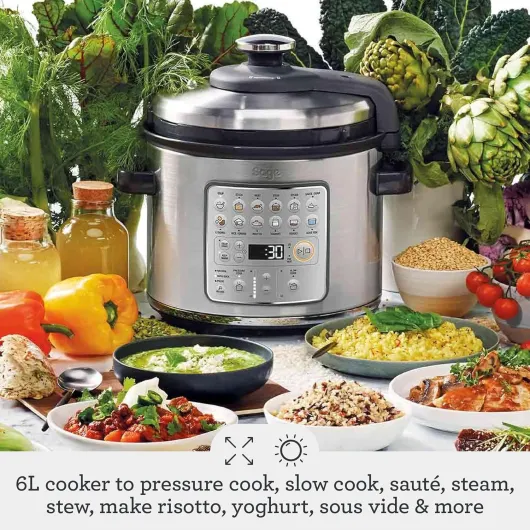
Big, stainless, and not exactly subtle
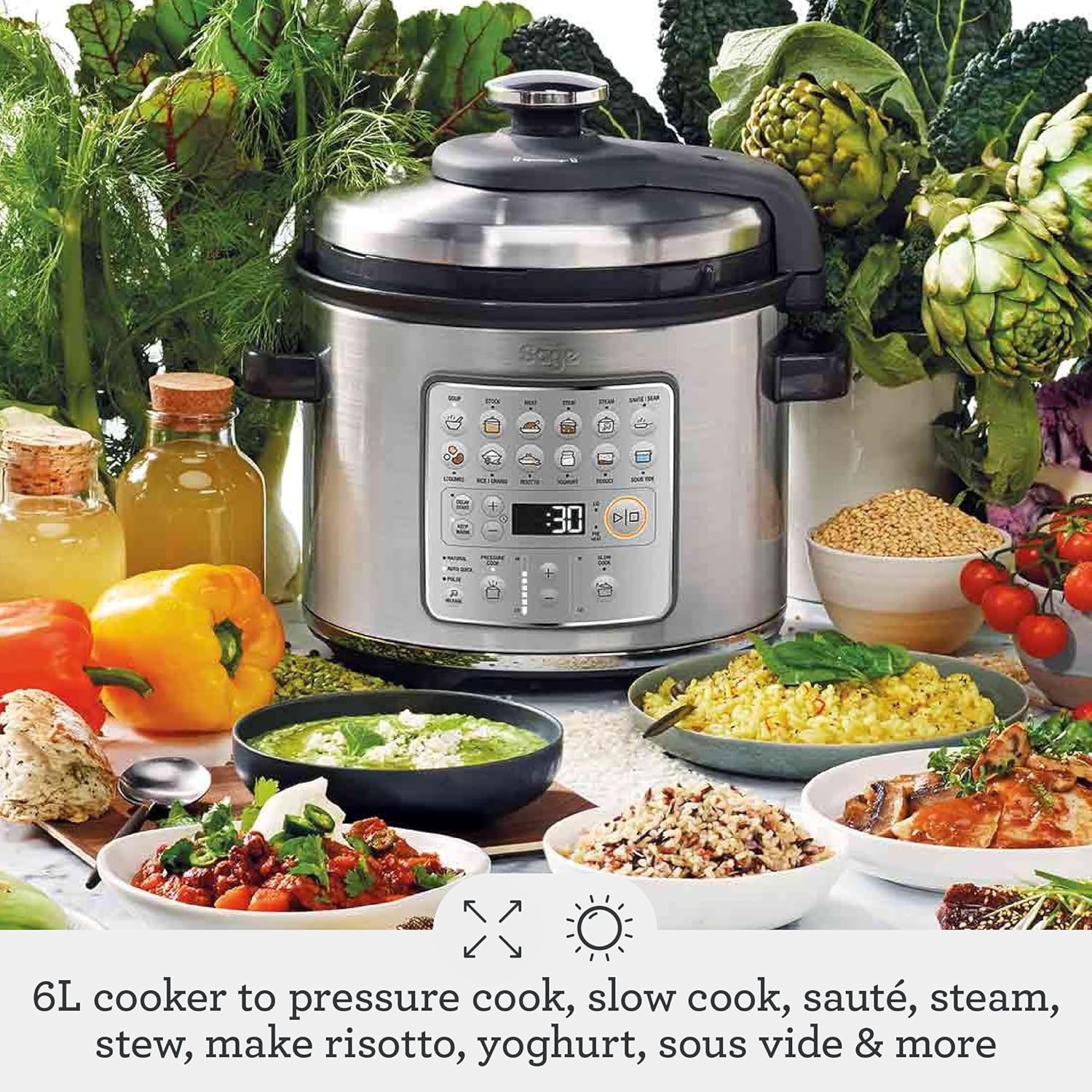
Design-wise, the Sage Fast Slow GO is solid but bulky. It’s brushed stainless steel with a polished finish in places, and it looks more like serious kitchen gear than a cute gadget. That’s good if you like your appliances to look robust, less good if you have a tiny kitchen. The official dimensions are about 48 x 44.5 x 43.5 cm, and you feel every centimetre on the counter. It’s not the kind of cooker you move in and out of a cupboard every day without swearing a bit.
The lid is hinged (outer lid closure) and stays attached, which I actually liked: you’re not hunting for a hot lid with nowhere to put it when you open under pressure. But that also means you need vertical clearance under your cupboards to open it fully. In my kitchen, I had to slide it forward each time to open the lid comfortably, which got old pretty fast. If you’ve got deep wall cabinets, measure your space before buying.
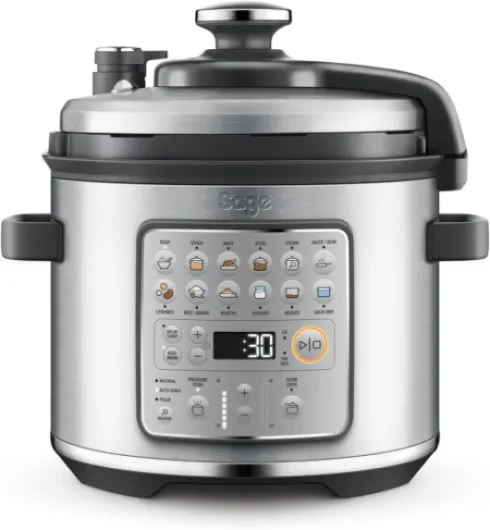
The control panel is front-facing and pretty clear: big central dial, touch buttons around, and a decent screen. You can see the remaining time and the mode without squinting. The icons and labels are understandable; I didn’t feel lost. That said, there are quite a few buttons and options, so the first two uses feel a bit like flying a small plane. After that, it’s fine, but don’t expect your grandma to nail it on the first try without any guidance.
In terms of overall design, it feels sturdy. The handles on the side are handy to shift it a bit, but at 4.9 kg you’re not casually moving it with one hand when it’s full. It’s not a minimalist object; it’s a big cooking tool that wants a permanent spot. If you’re short on space or prefer very light, compact devices, this will probably annoy you. If you like the feel of something that looks built to last a few years, you’ll probably be okay with the size trade-off.
Stainless steel bowl: better than non-stick, but not perfect
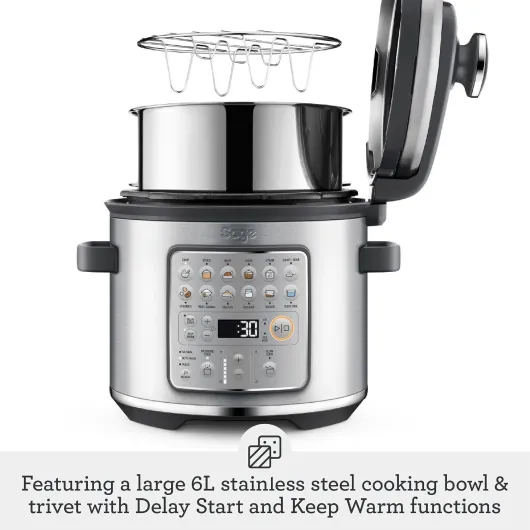
The cooking bowl is stainless steel, 6 litres, and that’s one of the main reasons I was interested. I’m a bit tired of cheap non-stick coatings that scratch after six months and start peeling. With this, you don’t have that stress. You can use normal wooden or silicone utensils, and even if you slip with a metal spoon once, you’re not destroying a coating. For everyday stews, soups, rice and steaming, the bowl handled everything fine.
The flip side: stainless steel sticks more than non-stick, especially when sautéing. My first attempt at browning onions and chicken thighs, I used too little oil and had the heat on high; the bottom caught a bit. Not a disaster, but I had to deglaze properly and soak the pot afterwards. Once I started using a bit more oil and stirring more often, it was okay. So you get durability, but you do have to adjust how you cook, especially if you’re coming from very slippery non-stick bowls.
The inner trivet is also stainless and feels decent. I used it for steaming veg and once for keeping a small dish above water for a pseudo bain-marie. No bending, no weird flex, it just does the job. Both the bowl and trivet are dishwasher safe, which is a big plus. I tested that several times: no warping, no stains, they come out clean. Hand washing is fine too, but if something sticks, a short soak and a scrub with a non-abrasive sponge is needed.
On the outside, the brushed stainless steel body looks nice enough but does show fingerprints and smudges. You’ll be wiping it down regularly if you care about looks. Overall, materials feel decent for the price range. It doesn’t feel cheap or flimsy, but it also doesn’t feel like some indestructible tank either. For a home kitchen, it’s more than adequate, as long as you accept that stainless steel means a bit more scrubbing effort compared to non-stick.
Built solid, but some doubts from other users
Physically, the Fast Slow GO feels well put together. The hinges, lid and locking mechanism don’t feel flimsy, and after several weeks of almost daily use, I haven’t noticed any odd noises, leaks or issues with the seal. The silicone ring still sits properly and doesn’t smell terrible, which is usually what goes first on cheaper pressure cookers. The stainless bowl is obviously not going to chip like non-stick, so that’s one less thing to worry about long term.
That said, the Amazon reviews are a bit mixed: an overall rating around 3.7/5 with at least one person saying it didn’t last a year. I can’t confirm that from my own short-term use, but it’s something to keep in mind. With these electronic multi-cookers, what usually fails is the electronics or sensors, not the metal pot. There’s a 2‑year limited warranty, which is decent, but you still don’t want to be sending it back after 10 months because a board died.
The 3‑way safety system (pressure release valve, safety valve and locking pin) worked as intended in my tests. The lid won’t open under pressure, and I never had any scary moments with steam shooting out randomly. That’s reassuring if you’re a bit nervous about pressure cooking. Compared to old-school stovetop pressure cookers, this feels much safer and more controlled. But of course, that also means more parts that could, in theory, fail over time.
Overall, my gut feeling is that it should last a few years if you treat it normally: don’t slam the lid, don’t force it open, clean the valve and ring now and then, and don’t drop it. But I wouldn’t call it indestructible. If long-term reliability is your top priority and you don’t care about all the extra modes, a simple mechanical slow cooker or a basic stovetop pressure cooker will probably outlive this. Here, you’re trading some durability for convenience and features.
Cooking performance: good results, with a bit of trial and error
In terms of cooking performance, I’d say the Fast Slow GO is strong where it matters: it cooks evenly, it holds pressure properly, and it doesn’t burn everything to a crisp as long as you’re not careless. I did several beef stews and a chilli using pressure cook mode. Compared to my old slow cooker, I got similar tenderness in about a third of the time. A 1kg beef chuck stew that used to take 7–8 hours on low was done in around 50–60 minutes at pressure, plus heat-up and release time. The meat was soft, the sauce thick enough, and the flavours came through well.
Rice mode was a bit more hit and miss at first. The first batch of white rice came out slightly too soft for my taste, not mush but close. I adjusted the water down a bit the second time and it was fine. It’s not better than a dedicated rice cooker, but it’s good enough if you’re not obsessed with perfect grains. Steaming veg was easy: I used the trivet, added a bit of water, and the broccoli and carrots came out cooked but not mushy, as long as you don’t overdo the time.
The hands-free steam release options (Natural, Pulse, Auto Quick) are actually useful. For soups and stews, I usually let it do natural or pulse release so things don’t splatter everywhere. For quick veg or rice, the auto quick release is handy and saves a few minutes. It’s also less stressful than fiddling with a manual valve and getting a face full of steam. The cooker manages that part automatically, which is one of the nicer quality-of-life features.
I did run into one annoyance: for some recipes you find online, the suggested times are off for this model. You’ll probably need a few test runs to find your own timings. Once you dial them in, it’s consistent, but don’t expect your very first dish to be perfect without any tweaking. Also, it’s only 1000W for a 6L pot, so bringing a full pot up to pressure can take a bit, especially with lots of liquid. Not crazy slow, but you notice it if you’re in a rush.
What this thing actually does in real life
On paper, the Fast Slow GO is one of those “do everything” machines: pressure cook, slow cook, sauté, steam, sous vide, yoghurt, rice, risotto, legumes, plus a few extra presets like soup and stew. In practice, I mostly used five of them: pressure cook, slow cook, sauté, rice and steam. The rest are nice to have, but if I’m honest, they’re not going to change my weekly routine.
The control panel is a digital display with touch buttons and 14 shortcuts. You pick a mode (soup, rice, yoghurt, etc.), then you can tweak time and, for pressure modes, the pressure level and steam release style. It sounds complicated, but after two or three uses, I wasn’t even looking at the manual; I just tapped the same sequence for my usual dishes. Compared to older pressure cookers where you guess the time and hope for the best, this is much more straightforward.
What I liked is that it really does cover a lot of cooking styles in one pot. For example, for a beef stew I could sauté the onions and brown the meat directly in the bowl, then switch to pressure cook and be done in under an hour. Before, I’d dirty a pan, then transfer to a slow cooker. Same with chilli: brown, deglaze, pressure cook, done. The switch between modes is just a couple of button presses.
On the downside, the marketing makes it sound like every preset will give perfect results without thinking. That’s not true. You still need to adapt recipes a bit, especially for pressure cooking (more liquid, slightly shorter times than some internet recipes suggest) and for rice (first run was too soft, second run with less water was fine). Also, it only cooks one thing at a time. Sounds obvious, but if you dream of doing meat, veg and rice all together in layers, you’ll hit the limits pretty quickly unless you start juggling trivets and accessories.
Does it actually simplify cooking, or just add buttons?
For everyday use, the big question is: does this thing make life easier, or is it just another gadget gathering dust? For me, it did simplify a few routines. The ability to sauté, then pressure cook or slow cook in the same pot means fewer dirty pans and less fiddling with the stove. On weeknights, I could throw in onions, garlic, meat, spices, sauté, add liquid, hit pressure cook and walk away. No babysitting, no worrying about boiling over. That alone already makes it more effective than how I used to cook certain dishes.
The presets help, but they’re not magic. I used the soup, stew and rice presets the most. They’re a good starting point, but I still adjusted times depending on what I was cooking. For example, lentil soup needed a bit more time than the default, and a lighter veg soup needed less. Once you know your preferences, you basically treat the presets as templates and tweak them. If you expect to press one button and always get perfect results without thinking, you’ll be disappointed.
One thing that works really well is the set-and-forget aspect. When it’s under pressure or slow cooking, you’re free to do something else without worrying about the pot burning dry every five minutes. Compare that to cooking a stew on the hob where I’d check and stir every 10–15 minutes. Here, I set a timer and only come back when it beeps. That really does make evenings more relaxed, especially if you’ve got kids or other things going on.
However, it’s not all positive. There’s definitely a learning curve: first week, I had one overcooked rice, one slightly under-seasoned stew (pressure cooking sometimes needs a bit more salt/spice than slow cooking), and one yoghurt that was okay but not great. Over time, I got better, but if you’re not willing to experiment a bit, you’ll probably get frustrated. In short, it’s effective once you invest a bit of time; if you’re expecting brainless cooking from day one, this isn’t that.
Pros
- Replaces several appliances (pressure cooker, slow cooker, rice cooker, steamer) in one 6L stainless pot
- Hands-free steam release and safety system make pressure cooking less stressful and easier to control
- Stainless steel bowl and trivet are durable and dishwasher safe, no non-stick coating to scratch or peel
Cons
- Bulky and fairly heavy, needs permanent counter space and good vertical clearance for the lid
- Learning curve with presets and timings; first few dishes may need trial and error
- Pricey if you only need basic slow cooking or already own similar appliances; some doubts about long-term reliability from user reviews
Conclusion
Editor's rating
After a few weeks with the Sage Fast Slow GO, my overall verdict is that it’s a good, versatile multi-cooker that genuinely makes certain meals easier and faster, but it’s not flawless and it’s not for everyone. The pressure cooking and slow cooking work well, the stainless steel bowl is a nice change from fragile non-stick, and the hands-free steam release takes a lot of the fear and hassle out of pressure cooking. For stews, chilli, soups, rice and basic steaming, it gets the job done with solid results once you learn the timings.
On the flip side, it’s bulky, there’s a learning curve, and some of the extra modes (yoghurt, sous vide) are more of a bonus than a daily essential for most people. The price is reasonable if you’re genuinely replacing multiple appliances, but if you already own a slow cooker and a rice cooker, the upgrade is harder to justify. The mixed durability feedback from other buyers is also something to keep in mind, even though I didn’t hit problems myself during testing.
In short: it suits people who cook often, like the idea of pressure cooking without drama, and want one main pot to do almost everything. If you’re a very occasional cook, short on space, or on a tight budget, you’re probably better off with a simpler, cheaper slow cooker and a separate pan. This Sage cooker is decent to good, but not magic.