
Summary
Editor's rating
Value for money: quality vs convenience trade-off
Design: compact, quiet, but with a couple of quirks
Materials and build: where most of your money goes
Durability and maintenance: built to last, but not maintenance-free
Real-world performance: beans, stews, veg and the daily grind
What you actually get with the Duromatic 4L
Effectiveness: fast, quiet cooking if you’re willing to babysit a bit
Pros
- Very solid build with thick base and 18/10 stainless steel, feels like it will last many years
- Quiet operation with clear pressure indicator and multiple safety features
- Cooks beans, grains and stews quickly, often faster than typical electric pressure cookers
Cons
- High price for a 4L manual cooker, especially compared to electric alternatives
- Requires active supervision to adjust heat; not a set-and-forget appliance
- Usable internal diameter is smaller than the 24 cm lid, limiting whole chicken sizes

Specifications
View full product page →| Brand | Kuhn Rikon |
A pricey Swiss pressure cooker I actually kept on the counter
I’ve been using the Kuhn Rikon Duromatic Inox 4L for a while now, mainly for beans, stews and batch cooking. I bought it because I was tired of noisy, rattling pressure cookers and didn’t really want yet another electric gadget taking up space. This one is a classic stovetop model, made in Switzerland, and the price definitely made me hesitate. It costs more than many electric pressure cookers and way more than the basic whistling models you see everywhere.
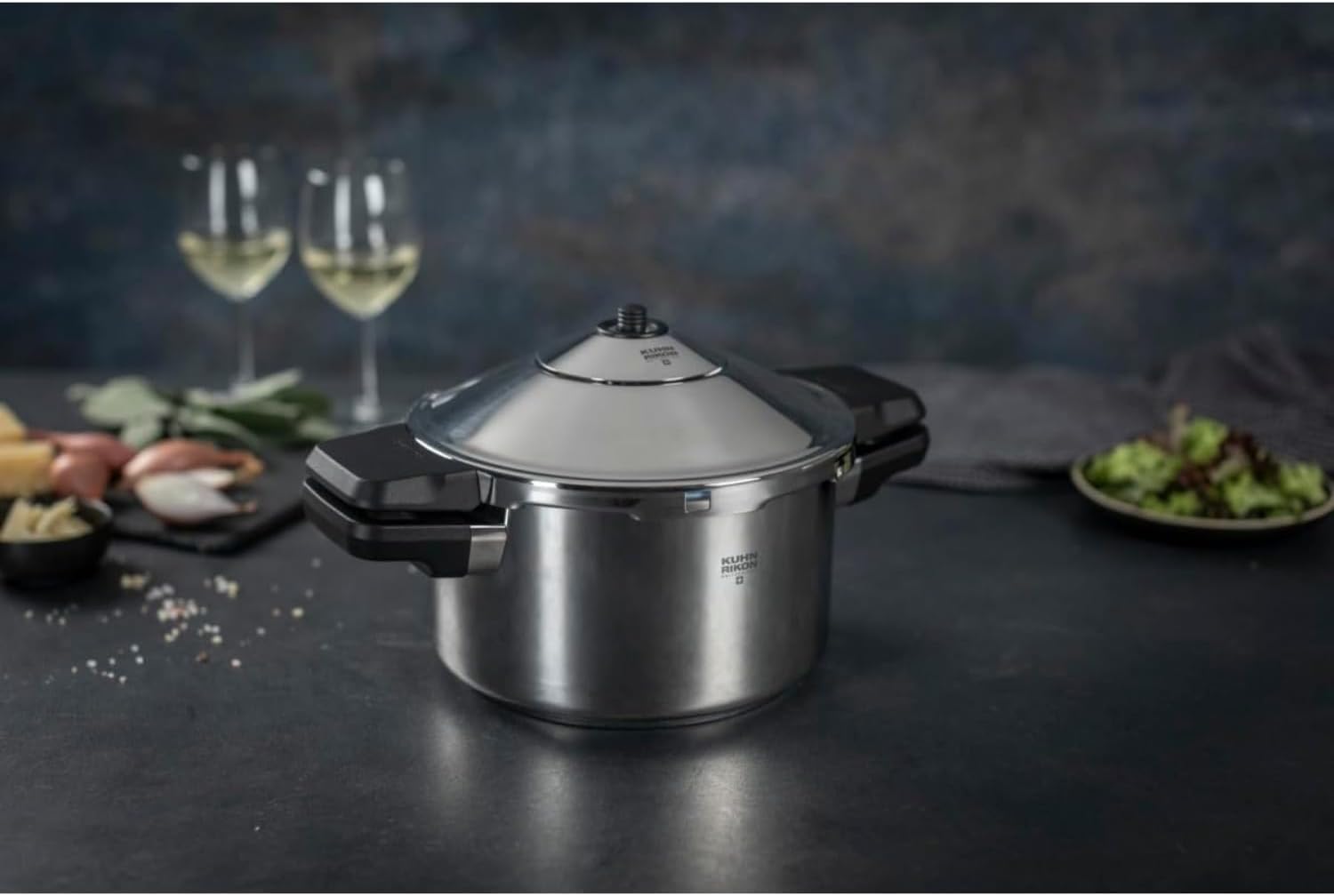
My first impression when I unboxed it was: this thing feels serious. It’s quite heavy for its size, the lid mechanism is tight, and the handles don’t feel like they’ll snap off if you load it up. It’s a 4L version with side grips (no long handle), which I chose on purpose because I have limited cupboard space and a smallish hob. I use it on induction and sometimes gas, so compatibility was important for me.
In day-to-day use, it’s not perfect, but it’s very clear where the money goes: build quality, safety features, and quiet operation. Compared to cheaper stovetop cookers I’ve tried, it’s almost silent once it’s at pressure. No constant rattling weight, no feeling that it might blow up if you look at it wrong. On the other hand, it’s still a manual cooker: you need to pay attention to the heat and you can’t just walk away like you would with an Instant Pot.
If you’re expecting a magic pot that cooks and thinks for you, you’ll probably be disappointed. If you want a solid, long-term bit of cookware that cooks fast and doesn’t feel flimsy, this one starts to make sense. It’s more like buying a good pan than buying a gadget: you pay once, you keep it for years, but you do have to learn how to use it properly.
Value for money: quality vs convenience trade-off
Let’s be straight: this cooker is expensive for a 4L pot. You can easily find cheaper stovetop pressure cookers and even electric multi-cookers for less. So the real question is whether the extra cost makes sense for how you cook. In my case, I see it as paying for a long-term piece of cookware with solid materials, quiet operation and a decent safety system. If I spread the cost over 10 years of use, it doesn’t look so bad. But if you’re not sure you’ll stick with pressure cooking, the price can be hard to justify.
Compared to an Instant Pot-type device in the same budget range, the Kuhn Rikon gives you better build quality and slightly faster cooking, but you lose all the convenience features: no built-in timer, no keep-warm, no presets, no set-and-forget. It’s also just a cooker; it doesn’t sauté on its own timer or do yogurt or whatever else those gadgets claim. Personally, I think most people overestimate how many of those functions they’ll actually use, but still, it’s a factor. If you want one device to do everything with minimal effort, this is not it.
Where it starts to feel like decent value is if you cook beans, grains and stews several times a week and you care about noise levels, speed, and longevity. The energy use is low once it’s at pressure, especially on induction, because you can keep the heat very low and still maintain pressure. Over years, that adds up a bit, but let’s be honest, you’re not going to recover the whole purchase price in saved energy alone. The value is more in time saved and not having to replace a cheap pot every few years.
So, in my view: good value if you’re serious about cooking and want something that will last, average value if you’re a casual user who might have been fine with a mid-range electric cooker. It’s not a rip-off, but it’s definitely not the budget option either. You’re paying for quality and the Kuhn Rikon name, and that only makes sense if you actually plan to use it often.
Design: compact, quiet, but with a couple of quirks
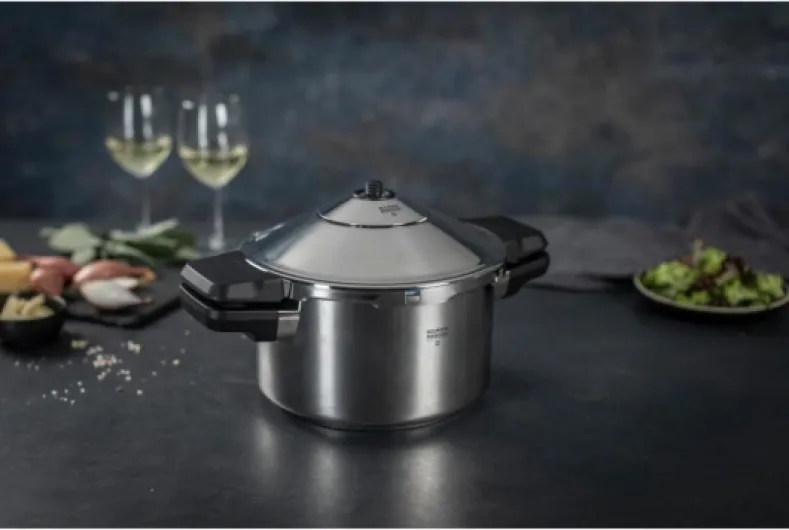
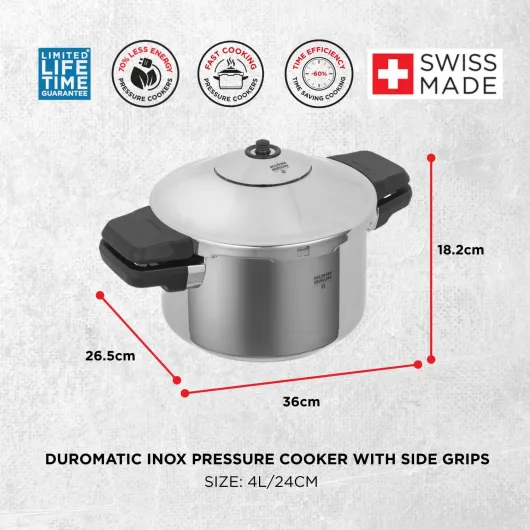
The design is pretty compact for a pressure cooker. The side grips instead of a long handle are a big plus if you’re short on space. I can fit it easily on a pan rack and it doesn’t stick out awkwardly from the hob. The 24 cm lid size sounds big, but inside it’s closer to 23 cm of usable width, which can be annoying if you like to cook whole chickens that are on the larger side. One user on Amazon mentioned this, and I ran into the same thing: some supermarket chickens simply don’t fit comfortably unless you spatchcock or cut them up.
On the hob, the cooker sits stable, and the weight feels reassuring rather than annoying, at least for me. At 3.4 kg empty, you definitely notice it when you move it around, but once it’s on the stove it doesn’t wobble or feel flimsy. The handles are short but wide enough to get a good grip with oven gloves. They don’t get too hot on induction at medium heat, but on gas with a big flame they can warm up a bit, so you still need a cloth or mitt for safety.
From a usability point of view, the pressure indicator is simple but effective. You have marks that show when you’ve reached the cooking zone, and you just adjust the heat to keep it there. If it goes higher, it starts to vent a bit of steam, but nothing like the loud whistling of older models. I found the cooker very quiet in normal use – you mostly hear the gentle bubbling inside rather than any external noise. That was one of the main reasons I went for this brand and it delivers on that front.
The only design annoyances for me: the markings for fill levels and such are a bit faint inside the pot, and as mentioned the internal diameter being smaller than the advertised 24 cm can be misleading if you’re planning specific dishes. Also, there’s no clear visual timer or anything like that, so you absolutely need a separate kitchen timer or your phone. Not a big deal, but worth mentioning if you’re used to plug-in devices that handle everything for you.
Materials and build: where most of your money goes
The main reason to consider this cooker over cheaper brands is the materials and build quality. The body is 18/10 stainless steel with a thick aluminium core in the base (their "superthermic" base). In practice, that means it heats up evenly and quickly, especially on induction. I didn’t get hot spots or burnt rings on the bottom like I’ve seen with thinner pots. I’ve cooked thick lentil stews and bean dishes that would normally catch if the base was too thin, and this held up well as long as I used enough liquid and didn’t blast the heat.
The lid mechanism and valve assembly feel solid too. The spring-loaded valve doesn’t rattle around; it just rises smoothly as pressure builds. The gasket is thick and seats well into the lid. I did have one or two times where I hadn’t placed the gasket perfectly and a bit of steam escaped from the handle area, but that was user error – once I checked the seal, it was fine. It’s also reassuring that spare parts are easy to find and the brand has a reputation for keeping them available for years. For a product with a 10-year guarantee, that matters.
The stainless steel finish is classic: not flashy, but it feels like proper cookware, not a toy. It handles regular use without scratching too easily, though obviously if you go at it with metal tools you’ll mark it. I’ve put the pot (not the lid) in the dishwasher a few times. It comes out clean, but I still prefer hand-washing to keep it looking nicer. The manufacturer says it’s dishwasher safe, but I personally wouldn’t put the lid and valve system in there – too many small parts, and I don’t fully trust harsh dishwasher detergents on seals long-term.
In short, you’re paying for thick steel, a heavy base, and a serious valve system, not fancy colors or gimmicks. If you’re the kind of person who keeps pans for 10–20 years, this will make sense. If you usually replace cookware every few years and don’t care much about build, then the premium here might just feel like overkill.
Durability and maintenance: built to last, but not maintenance-free
One of the big selling points is the 10-year guarantee and the fact it’s made in Switzerland. That doesn’t magically make it indestructible, but it does show in how it feels after regular use. The body hasn’t warped, the base is still flat on my induction hob, and the handles haven’t loosened. I’ve banged it around a bit – normal family kitchen use, not lab conditions – and it still feels tight and solid. I can see this easily lasting many years if you don’t abuse it.
However, like any pressure cooker, you do have consumable parts: the gasket (rubber seal) and the small valve components. These will eventually need replacing, especially if you cook a lot. The good news is that Kuhn Rikon does a decent job of keeping spares available, even for older models. That matters, because some cheaper brands are almost throwaway once the seal wears out. Here, you can just order a new gasket and keep going. Cleaning the lid and valve is straightforward but you should actually do it – if you let food dry in there, you’re asking for trouble later.
On the care side, I’d say: treat it like good cookware, not like a cheap pot. I mostly hand-wash, avoid super abrasive pads, and don’t crank the heat to the maximum for no reason. When releasing pressure with starchy foods inside, I sometimes let it drop naturally for a few minutes before doing a quick release, just to avoid forcing foam into the valve. With that routine, I’ve had no real issues. The only minor maintenance annoyance is checking the little valve parts every now and then to make sure nothing is clogged, but that’s a pressure cooker thing in general, not specific to this model.
So in terms of durability, I’d rate it high. It feels like something you buy once and keep for a long time, rather than something you replace every few years. If you’re careful with it, the weak points are just the normal rubber and small metal parts, which are expected wear items. If you throw cookware around and never maintain it, you’ll probably still get a few years, but you won’t get the full benefit of what you paid for.
Real-world performance: beans, stews, veg and the daily grind
In daily use, I threw the usual suspects at this cooker: dried beans, brown rice, lentils, soups, stews, and basic vegetables. For beans, it’s honestly one of the best tools I’ve used. Soaked beans cook very fast and evenly; I regularly do big batches three times a week and freeze them. As long as you don’t overfill and you respect the water levels, you don’t get much foaming or clogging. One Amazon reviewer did mention occasionally needing to lift the weight if it got stuck – I had that happen once when I really pushed the fill level on a very starchy bean mix. Keeping some headroom and adding a bit of oil helps a lot.
For soups and stews, the 4L size is enough for 3–4 people with leftovers. If you cook for a big family or want to batch cook massive quantities, you might find this size a bit limiting and should probably look at 6L or 8L. Heat-up is quick, and because the cooker is quiet, you don’t feel like it’s dominating the kitchen. I’ve had old-school pressure cookers that hiss so much you can’t hear anything else; this one just gently vents if you overshoot the pressure, which is way more comfortable.
Vegetables like broccoli, carrots, and potatoes also come out well, but you have to respect the very short times. Broccoli, for example, needs just a minute or two once at pressure, otherwise you get mush. The good thing is that pressure release is easy and controlled – you just press down on the vent to let steam out quickly, so you can check doneness and add another minute if needed. After a week or two, you start to know your timings and barely touch the booklet.
Compared to an Instant Pot-style cooker, my honest take is this: the Kuhn Rikon wins on speed, silence, and long-term robustness, but it loses on unattended cooking. I now use the stovetop one when I’m actively cooking and want results fast, and the electric one when I want to throw something in and go do something else. If I had to pick only one for a small kitchen, I’d really have to think about my habits. For someone who likes to be hands-on, this Duromatic performs very well. For someone who wants dinner to cook while they’re out of the room, it’s less ideal.
What you actually get with the Duromatic 4L
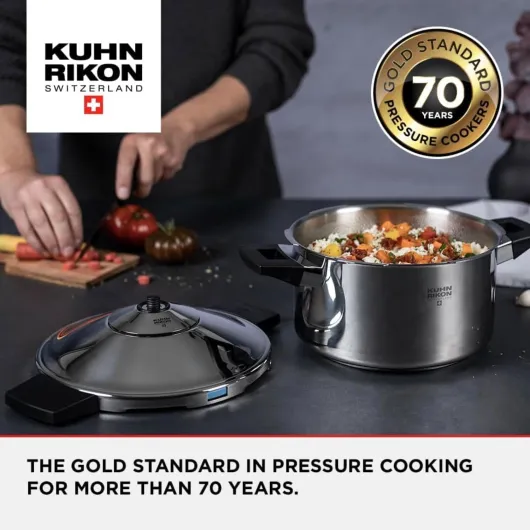
The Kuhn Rikon Duromatic Inox 4L is a stovetop pressure cooker with a 24 cm lid and two short side handles instead of a long handle. The usable capacity is 4 litres, which in practice means you’ll cook about 2.5–3L comfortably once you respect the max fill lines for pressure cooking. It’s made of 18/10 stainless steel with a thick aluminium sandwich base, which is meant to spread heat evenly and work on all hobs, including induction. I used it mainly on induction and occasionally on gas, and it worked fine on both.
The lid has a spring-loaded precision valve and a clear visual indicator with rings that show when you’ve hit the correct pressure. There’s also an integrated lid lock and multiple safety releases, which is reassuring if you’re a bit wary of pressure cookers. The closure is a bayonet system: you place the lid, twist slightly, and it locks in. Once there’s pressure inside, the lid cannot be opened until the pressure drops, which is what you want.
In the box, you basically get: the pot, the lid, the gasket and valve assembly, and an instruction booklet with cooking times. No fancy accessories, no steamer basket in my case (you may need to buy that separately if you want to steam regularly). For a product at this price, part of me expected at least a basic trivet or basket, but it’s really just the core cooker. The manual itself is useful though – it gives decent guidance on times for beans, grains, vegetables and meats, and pressure levels.
Overall, the presentation is very straight to the point. No app nonsense, no digital panel, no recipes booklet pretending to change your life. It’s just a solid pot with a smart lid. If you’re used to electric multi-cookers full of presets and buttons, this feels almost old-school. That’s not a bad thing, but you need to know what you’re buying: this is cookware, not a smart device, even if some listings weirdly mention “app control” which is just wrong in practice.
Effectiveness: fast, quiet cooking if you’re willing to babysit a bit
In terms of pure cooking performance, this pressure cooker gets the job done very well. It reaches pressure quickly, especially if you follow the tip of starting with boiling water from the kettle. On induction, I can get soaked beans to pressure in about 2–3 minutes from boiling, and then they cook through in 8–12 minutes depending on the type. From start to finish, a batch of soaked chickpeas is easily under 20 minutes, which is far quicker than a normal pot and feels very practical for weekday cooking.
Compared to an electric pressure cooker (like an Instant Pot), this Duromatic runs at a slightly higher pressure, so cook times are shorter. You really notice it with beans and whole grains: what takes 30–35 minutes in an electric often takes 20–25 here, including heat-up and natural release. Stews, curries, and soups also benefit – meat becomes tender quickly, and because you can control the heat directly, you can get a stronger simmer at the end if you want to reduce the sauce after depressurizing.
The downside is that you have to stay nearby. On gas, you need to tweak the flame as it reaches pressure so it doesn’t overshoot and vent too hard. On induction, it’s easier but you still have to remember to turn it down at the right moment. This is where electric cookers win: you set a time, walk away, and come back when it beeps. With the Kuhn Rikon, you’re more involved. If you get distracted and leave the heat too high, it will vent more steam, waste energy, and in worst cases could cause foamy foods (like some beans) to try and climb into the valve area.
Overall, effectiveness is very good for someone who actually likes cooking and doesn’t mind paying attention. If your goal is pure convenience and you want to set-and-forget, this is not the perfect match. But if you care about speed, control and quiet operation, and you don’t mind using a timer and adjusting the heat yourself, it’s a strong performer.
Pros
- Very solid build with thick base and 18/10 stainless steel, feels like it will last many years
- Quiet operation with clear pressure indicator and multiple safety features
- Cooks beans, grains and stews quickly, often faster than typical electric pressure cookers
Cons
- High price for a 4L manual cooker, especially compared to electric alternatives
- Requires active supervision to adjust heat; not a set-and-forget appliance
- Usable internal diameter is smaller than the 24 cm lid, limiting whole chicken sizes
Conclusion
Editor's rating
The Kuhn Rikon Duromatic Inox 4L is a solid, well-built stovetop pressure cooker that does exactly what it’s supposed to do: cook food faster and more quietly than old-school models. The materials are good, the base is thick, the valve system feels safe, and the whole thing gives the impression it will last a long time. For beans, stews, soups and basic veg, it performs very well and genuinely cuts cooking times to around a third of normal boiling. If you like to cook and you don’t mind paying attention to the hob, it’s a very capable tool.
On the flip side, it’s not cheap, and it doesn’t have the convenience of an electric multi-cooker. You still need to manage the heat, use a timer, and stay nearby, especially on gas. The 4L size is fine for 2–4 people but not ideal for huge batch cooking, and the internal width is a bit less than the advertised 24 cm, which matters if you want to fit whole chickens. Also, there are no real extras in the box, so you may end up buying a steamer insert separately.
I’d recommend this cooker to people who see it as long-term cookware rather than a gadget: home cooks who do a lot of beans, grains and stews, care about build quality, and prefer a quiet, reliable pot over a feature-packed electric device. If you want something you can set, forget and leave running while you’re out, you’ll probably be happier with an Instant Pot or similar. Overall, it’s a strong 4/5 for me: not perfect, not cheap, but very competent and likely to outlast most of the stuff in your kitchen.