
Summary
Editor's rating
Value for money: worth it if you actually use the features
Design: compact-looking, but actually a chunky little box
Ease of use, cleaning, and everyday comfort
Materials and coating: ceramic now, but check which batch you get
Durability and long-term concerns (based on early use and build)
Performance: rice, grains, sauté, and slow cook in real use
What this COSORI cooker actually offers in real life
Pros
- Consistently good rice and grains with minimal effort, thanks to fuzzy logic and clear presets
- Non-stick ceramic inner pot (newer units) and detachable lid/steam cap make cleaning very easy
- Versatile: handles rice, oats, quinoa, steaming, sauté, and simple slow-cooked meals in one appliance
Cons
- Bulky 10-cup size takes up a lot of counter or cabinet space
- Water level markings are hard to see and steamer basket is too deep for cooking rice and steaming veggies together
- Past confusion about inner pot coating (Teflon vs ceramic) and need to confirm you have the newer ceramic batch

Specifications
View full product page →| Brand | COSORI |
A rice cooker that tries to replace half your small appliances
I’ve been using this COSORI 10-cup rice cooker for a few weeks now, mostly for weeknight dinners and meal prep on Sundays. I didn’t buy it to worship perfect grains of rice — I bought it because I was sick of babysitting pots on the stove and scrubbing burnt bits off the bottom. I wanted something I could dump rice and water into, press a button, and forget. On that front, it definitely delivers: the rice comes out consistent, and I don’t have to hover over it.
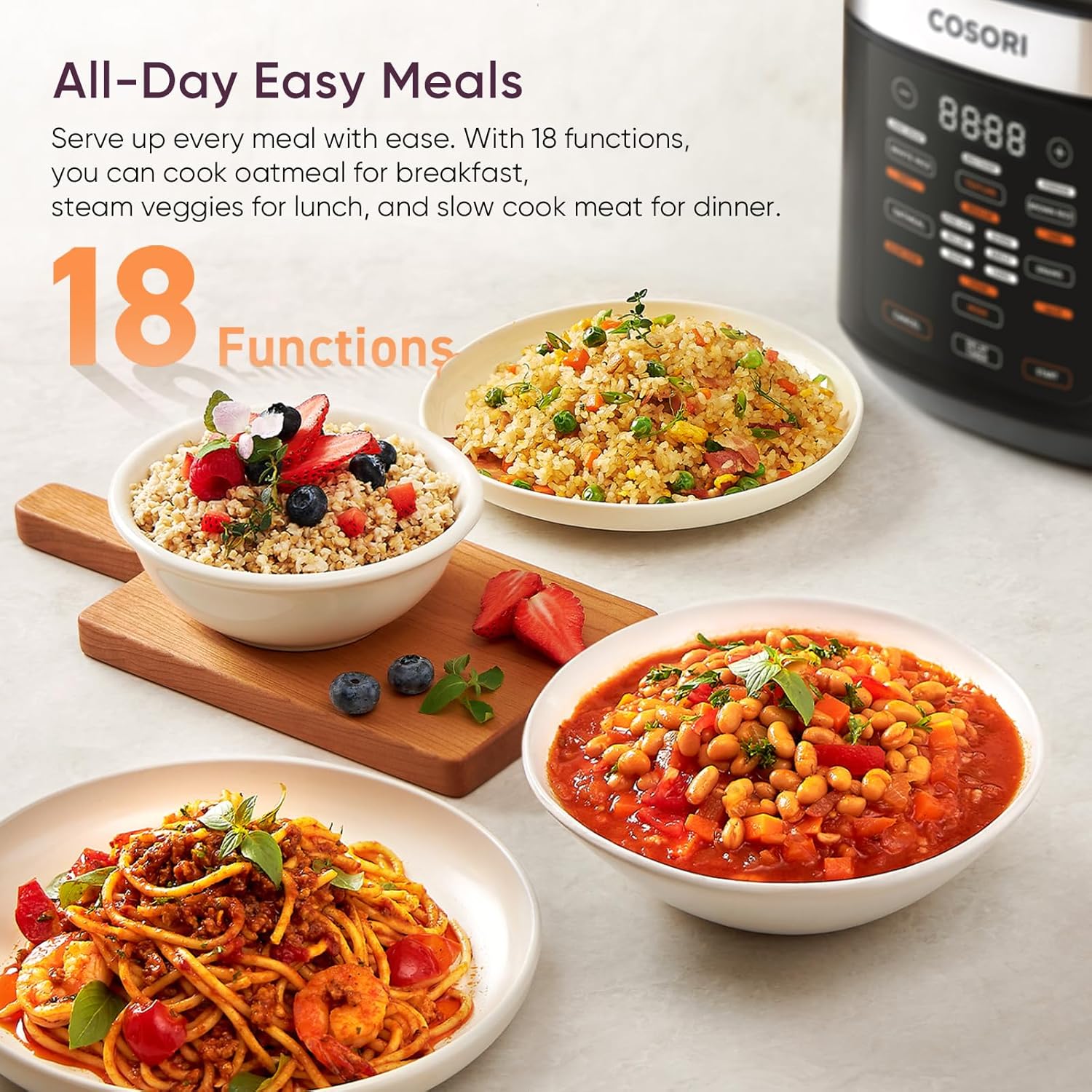
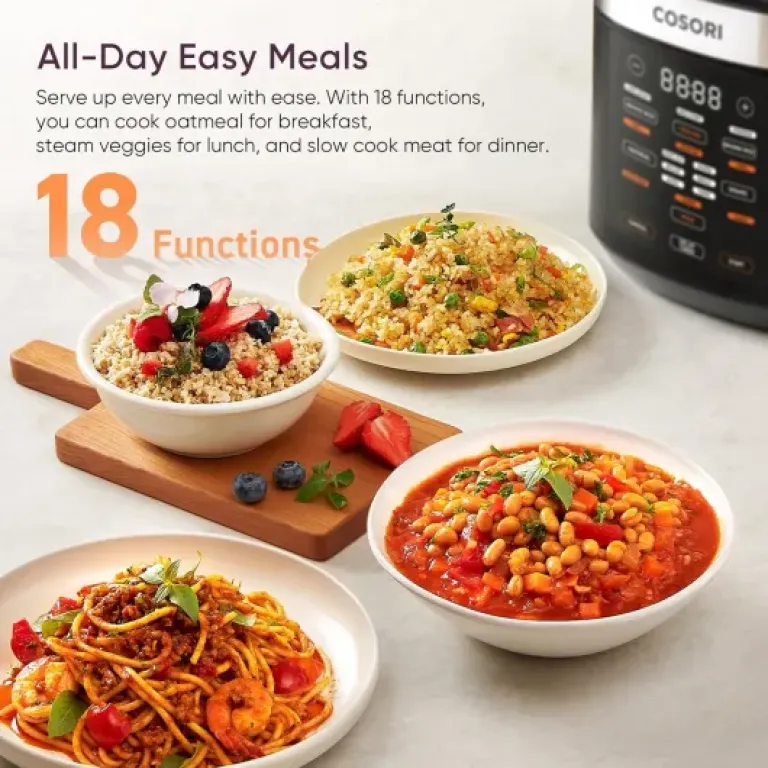
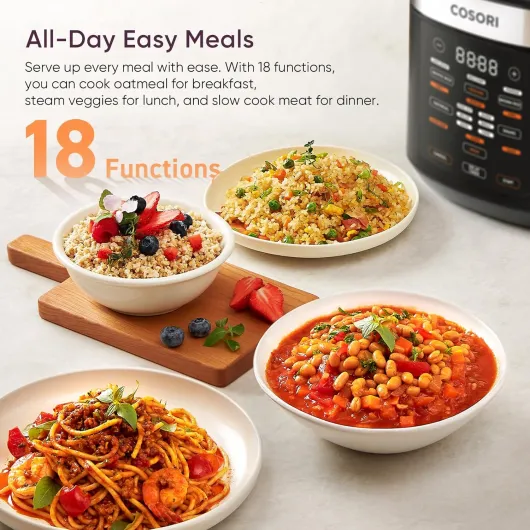
What surprised me is how much I ended up using the other functions. I thought the 18 programs were just marketing noise, but in practice I used white rice, brown rice, quinoa, oatmeal, sauté, and slow cook. So it’s not just a one-trick pony taking up counter space. It’s closer to a mini multi-cooker that happens to be pretty good at rice. The keep-warm and delay timer are also the kind of boring features you only appreciate after a long workday when dinner is just…ready.
It’s not perfect though. It’s bulkier than it looks in the pictures, and the interface, while clear, still has a bit of a learning curve the first few days. Also, if you’re short on space, a 10-cup cooker is overkill unless you batch cook or have a family. And the whole communication around the inner pot coating (ceramic vs Teflon on older batches) is a bit confusing and something you need to double-check if you care about that.
Overall, it’s a pretty solid machine that gets the basics right and adds a bunch of side features that are actually useful. But you need to be okay with giving it some counter or cupboard space, and you should know you’re paying a bit more than for a basic no-frills rice cooker. If you just want something tiny to make one cup of rice now and then, this is too much. If you cook rice or grains several times a week and like the idea of one appliance doing rice, oats, steaming, and simple one-pot meals, then it starts to make sense.
Value for money: worth it if you actually use the features
In terms of value, this COSORI sits in the middle: it’s not the cheapest rice cooker out there, but it’s also not in the high-end Japanese Zojirushi price bracket. For the money, you’re getting solid performance on rice and grains, a decent slow cook and sauté function, a ceramic-coated pot (on newer units), and a stainless steel steamer basket. Plus, the Amazon rating is sitting around 4.8/5 with thousands of reviews, which lines up with my experience: it’s a pretty solid buy for most households that cook rice regularly.
If you only cook rice occasionally and don’t care about oats, quinoa, steaming, or slow cooking, then honestly, a cheaper basic cooker might be enough. You’d save money and counter space. Where this COSORI starts to make sense is if you’re using it several times a week, doing things like: rice for dinners, oatmeal in the morning, steaming veggies, and the odd one-pot stew. In that case, you’re basically replacing a separate rice cooker, a small slow cooker, and maybe an extra pot on the stove, which makes the price easier to swallow.
Compared to more expensive fuzzy-logic brands, this one hits a nice middle ground. You don’t get super advanced settings or fancy Japanese branding, but you also aren’t paying a premium. The ceramic pot and detachable lid are nice bonuses that some competitors skip. On the downside, the confusing communication about the coating type in older batches is a bit of a red flag from a transparency point of view. It’s sorted now (new units = ceramic), but it’s something to be aware of.
Overall, I’d call the value good but not mind-blowing. You’re paying a fair price for a reliable multi-function cooker that does its job well and makes everyday cooking easier. If you actually use the different modes, it’s worth it. If you just want occasional rice as a side dish, you’re overbuying, and a simpler cooker will do the job for less.
Design: compact-looking, but actually a chunky little box
From the outside, the COSORI looks like a modern black box with a top lid and a front control panel. It’s not ugly or flashy; it just looks like a typical countertop appliance. The footprint is about 12.3" deep x 10.6" wide x 9.2" high, and the weight is around 9 pounds (4.2 kg). On a small kitchen counter, you definitely feel it. It’s not the kind of thing you casually move in and out of a cabinet every day unless you’re okay with a bit of lifting. If you’ve got a small apartment kitchen, you’ll want to think where this will live permanently.
The control panel is actually one of the better parts of the design. The display is bright, and the touch buttons are clear and labeled with actual words, not weird icons. Switching between modes, setting the timer, and adjusting texture is straightforward after you’ve used it once or twice. There is a tiny learning curve if you’re used to just one on/off switch, but nothing crazy. Even people in the Amazon reviews mention their kids can use it, and I believe that. You won’t be digging through a manual every time.
One design choice I appreciate a lot is the detachable inner lid and steam cap. They pop off so you can clean them properly, which really matters over time. My older rice cooker had a fixed lid and steam vent that were a nightmare to clean, and it always smelled vaguely like old rice. Here, you can actually scrub those parts or throw them in the dishwasher. It keeps smells under control and avoids crusty buildup.
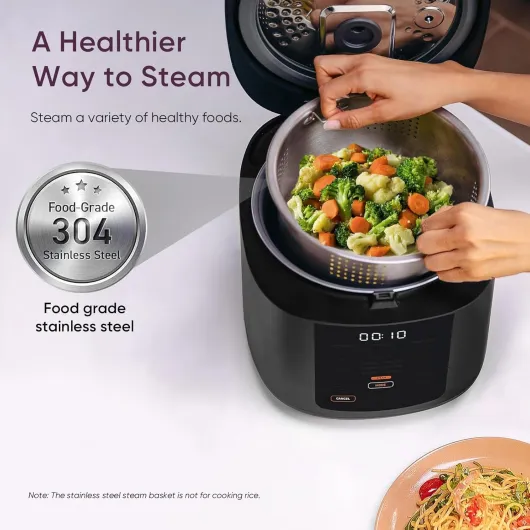
On the downside, a few small annoyances: the water level marks inside the pot are hard to see unless the light hits just right. They’re not filled in with a contrasting color, so you kind of have to squint. Also, the included steamer basket is deep; you can steam veggies, but you can’t easily do the classic “rice in the bottom, veggies on top” combo the way you can with some shallower baskets. A user mentioned this, and I ran into the same thing. Finally, there’s no dedicated storage lid for the inner pot, so if you want to stick the whole pot with leftovers in the fridge, you have to cover it with a plate or plastic wrap. None of these are deal-breakers, but they’re the kind of small design misses you notice once you use it daily.
Ease of use, cleaning, and everyday comfort
In terms of daily comfort, this cooker is easy to live with. The interface is straightforward: you’ve got clearly labeled buttons for rice types, grains, oats, steam, sauté, slow cook, and so on. The display is bright and easy to read from across the kitchen. I never had to fight the controls or dig through menus. After one or two uses, I knew exactly where everything was. Setting a delay timer for morning oats or evening rice is as simple as tapping a few buttons.
The best part for comfort is how easy it is to clean. The ceramic inner pot is genuinely low-effort. Most of the time, a quick rinse and a soft sponge is enough, even after sticky rice or oatmeal. The detachable inner lid and steam cap pop off and can go in the dishwasher, which is a big plus if you hate scrubbing nooks and crannies. I don’t have a dishwasher, and even handwashing these pieces was quick. Compared to my old rice cooker with a fixed lid that always felt a bit gross, this is a lot more hygienic.
The downside for comfort is mainly the size and storage. At around 9 pounds, it’s not crazy heavy, but it’s bulky enough that you probably won’t be moving it in and out of cabinets every single day. If you’ve got a small kitchen, it’s one more big box on the counter. Also, the power cord is fixed (not retractable), so you end up with a loose cord nearby unless you manage it yourself with a clip or tie.
Noise and heat are fine. It’s quiet while cooking, just some light humming and occasional clicks. The exterior stays cool enough that you won’t burn yourself brushing against it. There’s a beep when it finishes, but it’s not ear-splitting. Overall, from an everyday comfort point of view, it’s pretty user-friendly. You dump in ingredients, press a button, and it doesn’t ask for much attention, which is exactly what I want on busy evenings.
Materials and coating: ceramic now, but check which batch you get
The materials are decent for the price range. The body is mostly plastic with some stainless steel on the lid area, which keeps the outside cool enough to touch during cooking. The inner pot is aluminum alloy with a non-stick ceramic coating (for newer units), and you get a stainless steel steamer basket, which I like a lot more than the flimsy plastic baskets that come with cheaper cookers. The removable lid insert and steam cap are also easy to wash and feel solid enough, not paper-thin.
The big topic here is the inner pot coating. The Amazon listing says ceramic, but some of the official COSORI documentation for this model used to mention PTFE (Teflon) in older versions. One user even contacted COSORI and got the answer that starting October 2024 they switched to ceramic coating, and before that it was Teflon. So depending on when your unit was manufactured, you might have one or the other. If you’re buying now and the listing clearly says ceramic, it should be the newer batch, but if you’re picky about coatings, it’s worth checking the label, manual, or even writing to COSORI with your serial number.
In day-to-day use, the ceramic pot has been genuinely non-stick for me. Rice, scrambled eggs, and oatmeal slid out without scraping, and cleaning was basically a quick rinse and a wipe. I cooked a tomato-based sauce on sauté and then slow cooked it, and even that didn’t leave cooked-on residue that needed soaking. That’s a big step up from my old Teflon-coated pot, which scratched easily and eventually started sticking. So from a usability point of view, the ceramic works well so far.
The trade-off is durability over the long term, which I obviously can’t fully judge after only a few weeks. Ceramic coatings can chip if you abuse them or use metal utensils. COSORI includes a plastic paddle, and I’d stick to silicone or wood to keep the coating intact. If you’re careful, it should last, but if you’re the type who scrapes aggressively with a fork, you’ll damage any coating, ceramic or Teflon. Overall, the material choices feel practical: stainless for the basket, ceramic-coated aluminum for even heating, and removable parts that you can actually clean without babying them too much.
Durability and long-term concerns (based on early use and build)
I haven’t had this cooker for years, so I can’t pretend I know exactly how it will age, but there are a few signs that give a rough idea. The build feels solid enough: the lid hinge doesn’t wobble, the handle on the pot is sturdy, and the buttons don’t feel flimsy. The stainless steel steamer basket also feels like it will outlast the machine itself. Nothing rattles or creaks when you open and close the lid, which is usually a good sign in this price range.
The main durability question is the ceramic coating. So far, after multiple uses for rice, sauté, oats, and sauces, I don’t see any scratches or discoloration. But ceramic coatings in general don’t like metal utensils or rough scrubbing. If you follow the basic rules — no metal spoons, no abrasive pads — it should hold up well. People who used the older Teflon-coated version say the pot lasted as long as they didn’t scratch it, which is basically the same story. In short: treat it decently, and it should last; abuse it, and you’ll damage it.
The detachable lid and steam cap help with long-term cleanliness, which is part of durability. Rice cookers that trap moisture and starch inside the lid tend to get gross and smelly, and that can affect performance over time. Here, because you can actually remove and wash those parts, you’re less likely to end up with mold or gunk hiding in there. That’s a practical detail that matters if you plan on keeping it for several years.
If I compare it to cheaper rice cookers I’ve had, this feels more solid and thought-through. It’s not built like a tank, but it doesn’t feel cheap either. My only long-term worry would be finding a replacement inner pot if the coating ever gets damaged, and whether COSORI keeps stocking those for this exact model. If you’re the type who keeps appliances 8–10 years, that’s worth checking. For normal use over several years, with basic care, I’d expect it to hold up fine.
Performance: rice, grains, sauté, and slow cook in real use
Performance-wise, this is where the COSORI earns its spot on the counter. For plain white rice (I mostly used jasmine), the results have been very consistent: fluffy, no burnt layer, and no wet mush at the bottom. I usually do the standard 1:1 water-to-rice ratio by volume and just hit the white rice button. Cooking time is not instant, but it’s reasonable, and there’s also a Quick Rice mode if you’re in a rush. Quick Rice shaves some time off without wrecking the texture, which is handy when you forget to start the cooker until you’re already halfway through making the rest of dinner.
Brown rice, which is where cheap cookers usually fail, came out well cooked with no hard centers. It does take longer (as expected), but you don’t have to guess the time; you just let the program run. I also tried quinoa using the grains setting, and it was on point: not soggy, not burnt, and no need to stand there and stir. Same for steel-cut oats in the morning — I used the oats preset and had a pot of breakfast ready while I got ready for work, with the keep-warm function holding it at a comfortable temperature.
The sauté and slow cook functions make this thing more than a one-trick rice machine. I browned onions, mushrooms, and chicken pieces on sauté directly in the pot, then switched over to slow cook to finish a stew. It doesn’t replace a high-end slow cooker or a pressure cooker, but for simple soups, stews, and sauces, it works fine. Sauté mode gets hot enough to properly brown meat and veg, not just gently warm them. That’s important, because some multi-cookers have a weak sauté that just steams everything.
One performance detail I noticed: the dual heating (top and bottom) does help with condensation. I didn’t get that annoying drip of water onto the rice that some lid-heated cookers have. And the 24-hour keep-warm actually keeps rice moist without turning it into hard pellets or dried-out crust, even after several hours. I personally wouldn’t leave rice on warm for a full 24 hours for food safety reasons, but for 2–6 hours around mealtimes, it’s been fine. Overall, it’s not mind-blowing tech, it just quietly does what it’s supposed to do, which is what I want from a rice cooker.
What this COSORI cooker actually offers in real life
On paper, this thing has a long feature list: 10-cup capacity, 18 functions, fuzzy logic, 24h keep warm, delay timer, sauté, slow cook, stainless steel steamer basket, non-stick ceramic pot, detachable inner lid, dishwasher-safe parts, 1000W power. In practice, the headline for me is simple: it cooks a lot of different grains reliably and doesn’t make a mess. I’ve done white jasmine rice, brown rice, quinoa, steel-cut oats, and some basic soups and stews. The presets handle most of it without me tweaking much.
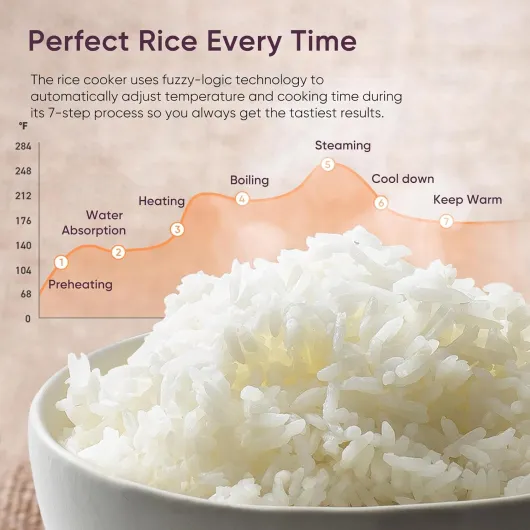
The fuzzy logic bit basically means it adjusts cooking time and temperature based on what’s going on inside, so your rice doesn’t end up crunchy or mushy if you’re slightly off with water or if the room temp is different. I won’t pretend I can see the seven-step cooking curve, but I can say the rice has been consistently fluffy, no burnt layer at the bottom, and no weird wet patches. Compared to a cheap $30 on/off rice cooker I used before, this is a clear step up in consistency and texture, especially for brown rice and quinoa.
The 10-cup capacity (uncooked) is nice if you batch cook. For reference, I cooked 3 cups (uncooked) of jasmine rice and that easily fed four adults with leftovers. If you mostly cook for 1–2 people, you can still use it, but it will feel big. On the plus side, you can cook small quantities like 1 cup without it drying out or burning, which isn’t always the case with larger cookers.
Function-wise, the ones that actually matter and that I used are: white rice with texture options, brown rice, grains (quinoa), oats, steam, slow cook, and sauté. The rest are mostly variations or presets I haven’t needed. The 50 recipes in the booklet are decent for getting started, but you’ll probably end up using your own recipes once you understand the timings. Overall, the feature set is broad, but the core of it is simple: it’s a reliable rice and grain cooker that doubles as a basic slow cooker and steamer.
Pros
- Consistently good rice and grains with minimal effort, thanks to fuzzy logic and clear presets
- Non-stick ceramic inner pot (newer units) and detachable lid/steam cap make cleaning very easy
- Versatile: handles rice, oats, quinoa, steaming, sauté, and simple slow-cooked meals in one appliance
Cons
- Bulky 10-cup size takes up a lot of counter or cabinet space
- Water level markings are hard to see and steamer basket is too deep for cooking rice and steaming veggies together
- Past confusion about inner pot coating (Teflon vs ceramic) and need to confirm you have the newer ceramic batch
Conclusion
Editor's rating
The COSORI 10-cup rice cooker is a solid choice if you cook rice and grains regularly and like the idea of one appliance handling rice, oats, steaming, sauté, and basic slow cooking. It’s not flashy, but it’s reliable: white and brown rice come out consistent, quinoa and oats are easy, and the 24h keep warm and delay timer make weekday meals less of a hassle. The ceramic-coated inner pot on newer units is genuinely easy to clean, and the detachable lid and steam cap help keep everything hygienic. The interface is clear enough that even non-techy family members can use it without drama.
It’s not perfect. It’s bulky, the water level markings are hard to see, the steamer basket could be shallower, and the whole coating-history story (Teflon before, ceramic now) is a bit annoying if you’re picky about materials. Also, if you only cook rice once in a while for one or two people, this is probably overkill and takes up more space than it’s worth. But for families, meal-preppers, or anyone who wants a dependable rice and grain cooker that also doubles as a basic multi-cooker, it’s a pretty good deal. You get strong everyday performance, easy cleaning, and enough flexibility to justify the price — as long as you actually use the extra functions.